





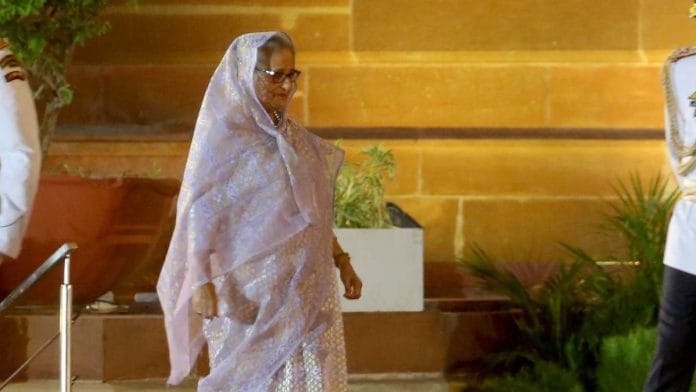



New Delhi: Sheikh Hasina, Bangladesh’s former Prime Minister called for the cancellation of the elections held Thursday, labelling the whole exercise as a “farce” and an “unconstitutional” sham staged by Chief Adviser Muhammad Yunus.
“Today’s so-called election organized by Yunus, who took power through illegal and unconstitutional means, was essentially a carefully planned farce. Disregarding the people’s voting rights, democratic values, and the spirit of the constitution, a deceptive election was arranged without the Awami League and without voters,” Hasina said in a statement issued late Thursday evening.
She added: “In this situation, we demand the cancellation of this voterless, illegal, and unconstitutional election; the resignation of Yunus; the withdrawal of false cases and the release of all political prisoners as well as teachers, journalists, intellectuals, and professionals; the removal of the suspension imposed on the activities of the Awami League; and the restoration of the people’s voting rights through the arrangement of a free, fair, and inclusive election under a neutral caretaker government.”
The Awami League, the party led by Hasina, has not been allowed to take part in the elections. Hasina was ousted from power in August 2024, following a student-led demonstration that originally began as an anti-quota stir that evolved into removing the Awami League-led administration. Hasina was in power for 15 consecutive years between 2009 and 2024.
Hasina fled Dhaka for India on 5 August 2024 and has remained in the country, which remains an irritation in ties. The former Prime Minister of Bangladesh was sentenced to death for allegedly committing crimes against humanity by the International Crimes Tribunal – Bangladesh (ICT-B) in 2025.
“From the evening of 11 February, this farce began through the capture of polling centres, gunfire, the widespread use of money to buy votes, stamping ballot papers, and taking agents’ signatures on result sheets. From the morning of 12 February, voter turnout in most polling centers across the country was extremely low. Many polling stations in the capital and other parts of the country were completely empty of voters,” said Hasina.
The latest update from the Election Commission of Bangladesh indicates that the voter turnout between 7:30 AM and 2:00 PM stood at 47.91 per cent, as per reports from around 36,000 voting centres out of over 42,000 booths.
“According to the Election Commission’s briefing, voter turnout until 11 a.m. (within three and a half hours) was only 14.96%. This low participation at the peak voting period proves that the public boycotted and rejected this election without the Awami League,” said Hasina, calling the low early turnout as a rejection of the legitimacy of the elections. The voting day went through mostly peacefully, with some incidents reported by various parties.
Hasina alleged that in the last few days there were “continuous attacks, arrests, intimidation, and an atmosphere of fear targeting Awami League voters, supporters, well-wishers, and minority communities, in an attempt to forcibly take them to polling stations.”
The former Prime Minister further alleged that “there have been observations that the number of voters on the voter list—especially in Dhaka—has increased abnormally, which is highly questionable and unbelievable.”
The elections for the 350-seat Jatiya Sangsad or Parliament of Bangladesh started at around 7:30 AM and polls closed at 4:30 PM local time. As per Bangladeshi law, 300 seats are directly elected by the voters, while 50 seats are reserved for women.
This is the first major election this century that does not feature the Awami League, in a major shift in the South Asian nation’s polity. The Awami League led the country to independence during the 1971 Liberation War, and has been a strong pillar of Bangladeshi politics for over five decades.
A total of 127 million people out of a population of around 175 million are eligible to vote. The two parties in the running are the Bangladesh Nationalist Party (BNP) led by Tarique Rahman and the 11 party-coalition led by Jamaat-e-Islami and the National Citizens Party (NCP), which was formed by some of the student demonstration leaders.
Shafiqur Rahman, a leader within the Jamaat-e-Islami has alleged that a number of fake ballots have been cast, while attempts were being made to capture polling booths. Yunus hailed the conduct of the elections, labelling it as a “new Bangladesh.”
(Edited by Shashank Kishan)
Also Read: I fought alongside Bangladeshi Hindus in 1971 War. Their suffering is a national emergency