


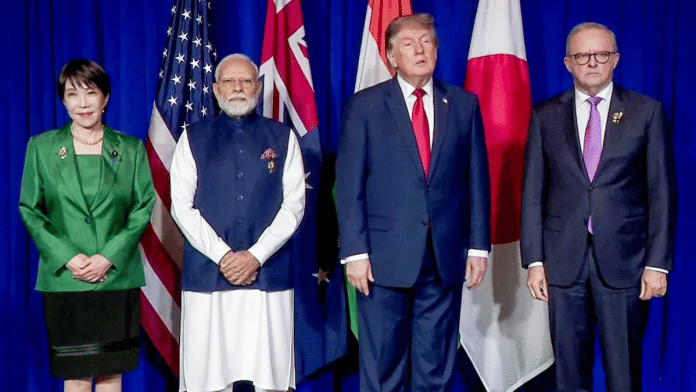
New Delhi: The Quad leaders Tuesday condemned cross-border terrorism in the first summit at this level since the 2025 Pahalgam terror attack which left 26 people dead.
“We unequivocally condemn terrorism and violent extremism in all its forms and manifestations, including cross-border terrorism, and commit to strengthening the Quad’s ongoing cooperation on counterterrorism,” the joint press release published by the Ministry of External Affairs said.
The leaders did not issue a joint statement, issuing only a press release announcing five new initiatives, including a business leaders forum for next year, a new artificial intelligence accelerator, the Indo-Pacific Maritime Surveillance Collaboration, the partnership for cable connectivity and resilience and cybersecurity cooperation.
“We are proud to welcome the Indo-Pacific Maritime Surveillance Collaboration, a new initiative to enhance information sharing and maritime domain awareness. In 2027, our respective P-8 and P-3C patrol aircraft are scheduled to fly in a maritime exercise for the first time in a Quad context, making our seas safer,” said the joint press release.
For India, the paragraph condemning cross-border terrorism is significant following the Pahalgam terror attack and Operation Sindoor. Ties between India and the US deteriorated last year largely due to differences on trade, while US President Donald Trump embraced the Pakistani establishment through a number of deals in the latter half of 2025.
The new initiatives point to the direction of the grouping that has been perceived to have been placed in the back seat since Trump returned to the White House last year, and sought a new diplomatic paradigm with China. The Quad consists of India, the US, Japan and Australia.
Unlike earlier leaders’ summits that had joint statements outlining the vision for the grouping going forward, the summit in Manila focused solely on the new announcements of new initiatives and the condemnation of cross-border terrorism.
Trump in his remarks during the summit pushed for closer military cooperation, pointing to the maritime surveillance collaboration and use of maritime patrol aircraft in joint Quad exercises.
The press release made no mention of the situation in West Asia or the Russia-Ukraine war, which were seen in earlier editions. The larger vision in the press release was outlined in the first paragraph.
“We strongly oppose any destabilising or unilateral actions that seek to change the status quo, including by force or coercion, which escalate tensions and undermine regional peace and stability. We express grave concerns about economic coercion, including through arbitrary export restrictions,” said the press release.
It added: “We are securing critical supply chains, protecting freedom of navigation and overflight, driving growth through technologies of the future including investments and deployment of trusted Artificial Intelligence (AI), and responding to disasters with life-saving assistance.”
The Quad leaders’ summit held in Manila, is the first time a meeting at this level has been held in a non-member country. The summit comes ahead of Trump’s travel to China for the Asia-Pacific Economic Forum to be held on 18 November. On 19 November, Trump is set to attend a trilateral meeting along with Chinese President Xi Jinping and Russian President Vladimir Putin.
(Edited by Gitanjali Das)
Also Read: Trump pushes AI, military cooperation at Quad summit; India pushes safety of seafarers