





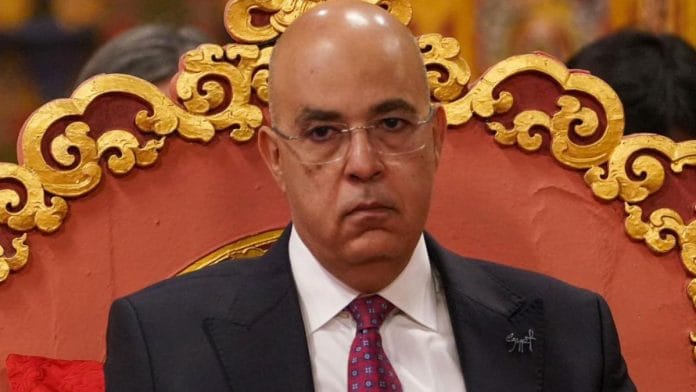



New Delhi: “If Egypt joins IMEC today, it will be functional by tomorrow morning”, but the country refuses to merely be a bypass for international trade that excludes the Suez Canal, Egypt’s Ambassador to India, Kamel Zayed Galal, said in New Delhi Thursday.
Galal was responding to a question by ThePrint on the India-Middle East-Europe Economic Corridor (IMEC) at the Foreign Correspondents’ Club in New Delhi Thursday.
At the club, the Egyptian ambassador also shared his views on President Trump’s proposed “Board of Peace” for Gaza amid an uneasy ceasefire, following Israel’s heavy bombardment in the region, which has left much of the area in ruins.
“Let’s keep our eyes on the objective…The objective is to stop the killing,” Galal said, refusing to speculate about motives or imperial designs behind the US President’s Gaza plan. He emphasised that Trump’s role had been “instrumental” in de-escalation efforts in West Asia.
IMEC vs network
Egypt, Galal said, has been deliberating about IMEC, which has India, the US, the EU, Saudi Arabia, and the UAE as its signatories. But instead of a single, fixed trade corridor that bypasses Egypt, the ambassador proposed a broader, more flexible trade “network”, integrating Egypt’s ports, the Suez Canal, and its wider transport and energy infrastructure into regional and global supply chains.
“We have expressed our willingness to be incorporated based on the parameters of the Egyptian foreign policy, but the Suez Canal cannot be excluded. The idea that we have come up with is that instead of looking into a trade corridor, let’s look into a trade network,” he said.
Further, Galal called suggestions that Egypt was uneasy about IMEC because it’s an alternative route designed to bypass the Suez Canal “flawed”. The Suez Canal, he emphasised, could not be excluded from global trade, and no viable international trade route could replace it.
Expounding on his proposal of “a network”, he argued it would draw on Egyptian ports on both the Mediterranean and the Red Sea, as well as the country’s railways, highways, and electricity grids, and the free-trade agreements it has with Africa, Europe, and the Arab world.
“Through Egypt, India would gain access not just to a market of 100 million Egyptians, but to nearly two billion consumers across Africa, Europe, the UK, Mercosur, and the Greater Arab Free Trade Area,” he added.
According to Galal, Egypt’s top-tier ports on both the Red Sea and the Mediterranean, a green railway linking the two seas, over 7,000 kilometres of new highways, and growing capabilities in green hydrogen and electricity grids, have reinforced its logistical and multimodal trade infrastructure.
Egypt has also operationalised power connectivity with Saudi Arabia and is engaged in trilateral electricity cooperation with Jordan and Iraq.
A major source of revenue for Egypt, the 193-km-long Suez Canal is a strategically vital waterway connecting the Mediterranean with the Red Sea and, until recently, facilitated 10–12 percent of total global trade. As the shortest maritime route between Europe and Asia, the Suez Canal has been crucial for transporting oil, consumer goods, and raw materials worldwide.
But the route is facing a crisis. Since late 2023, Houthi rebels in Yemen started attacking commercial ships in the Red Sea in response to Israel’s war in Gaza. The Houthi threat has forced shipping companies to reroute their vessels around southern Africa, thereby increasing both travel time and costs. The most severe impact has been on Egypt, with officials estimating that it lost nearly $13 billion in canal revenue in roughly one year.
The disruption exposed the vulnerability of Egypt’s economy, the largest in the Arab world, to external shocks, pushing Cairo to intensify its diplomatic efforts to help end the war in Gaza. It mediated limited humanitarian pauses and hostage-prisoner exchanges before starting to lure shipping companies back to the Suez Canal with financial incentives and new services, and highlighting the relative calm in parts of the Red Sea.
These efforts have had some success. Since the partial end of the war in Gaza, 45 ships have been transiting the canal daily, up from only 35 earlier. Still, traffic remains well below pre-war levels of at least 70 ships a day, according to reports.
However, the ambassador is hopeful. “Egypt is in the middle of each and every kind of connectivity in the Middle East and Africa, so we can add value. If Egypt is a member of IMEC today, tomorrow, at 10 in the morning, we will have it functional,” he repeated.
Also Read: FTA, defence agreement, intel sharing: How EU-India summit is set to shape up
Trump, Gaza & the UN
On the issue of Palestine, Galal said that he appreciated Trump’s efforts in stopping Israel’s war.
“Ever since he came, Trump has put his leverage behind stopping the war, and this was very important, including through diplomatic pressure on regional actors. It’s important, now, to move on to Stage 2 of the UN Security Council Resolution 2735. We have been pushing for it. Recently, Egypt announced its acceptance in order to bring genuine peace, not only to Gaza, the Palestinians, and to the Palestinian cause,” he said
But Egypt’s commitment to multilateralism remain unchanged. “The heart of multilateralism is the United Nations,” Galal said, though he added it must be reformed.
Towards the end, the conversation turned to water and Egypt’s deepest strategic anxiety.
“According to World Bank benchmarks, Egypt is at extreme water poverty,” he said, citing per-capita availability, which is far below global thresholds.
Ethiopia’s Grand Renaissance Dam, he argued, is not about development but leverage. “They are weaponising water,” he said, noting that Ethiopia already receives heavy rainfall.
Egypt, he said, had negotiated for 15 years. “We are very patient,” he said. “But Egyptian national security will not be tampered with.”
(Edited by Madhurita Goswami)
Also Read: In stunning U-turn, Trump slams UK for Chagos handover, calls it an ‘act of great stupidity’