





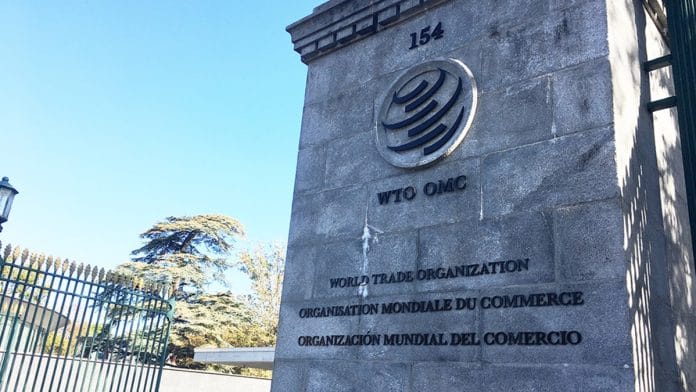



New Delhi: China filed a complaint against Indian photovoltaic and information and communication technology subsidies as well as its production linked incentive (PLI) schemes with the World Trade Organisation (WTO), labelling them as “unfair.”
“On December 19, China submitted a request to India for consultation on tariff measures and photovoltaic subsidy measures for India’s information and communication products at the WTO,” the Chinese Ministry of Commerce said in a statement Friday.
“India’s relevant measures are suspected of violating many obligations such as WTO binding tax rates and national treatment, and constitute import substitute subsidies by the WTO. These measures give India an unfair competitive advantage to its own industry and harm China’s interests…We once again urge India to abide by its relevant commitments in the WTO and immediately correct its wrong practices,” the statement added.
The latest allegations from Beijing comes as the two countries continue to work towards stabilising economic ties, following the political thaw in ties over the last year. India, in recent weeks, has reformed its business visa rules to allow Chinese nationals easier access to travel—one of the measures that Beijing has been urging New Delhi to implement to continue building confidence between the two sides.
In October, China took India to the WTO for subsidies connected with the Production-Linked Incentive (PLI) scheme for the development of advanced chemistry cell (ACC) batteries that are used in the automotive industry and also for facilitating production of electric vehicles.
The consultative process is the first stage of the dispute resolution mechanism within the WTO, which allows the two sides to come to an amicable agreement within 60 days. According to the WTO, a majority of disputes have been resolved at this stage, without requiring further adjudication by a panel formed by the organisation.
While subsidies are allowed under the WTO, they must not unfairly impact international trade of other countries by distorting competition in the markets. China’s latest allegations accuse India’s imposition of tariffs and subsidies on the production of photovoltaic cells and ICT products constitute “import substitute subsidies” that are prohibited under the WTO rules.
Also Read: India’s merchandise exports to US rising month-on-month despite Trump tariffs, govt data shows
Subsidies prohibited by WTO
According to the WTO, a subsidy is a financial contribution by the government or the arm of a government that confers a “benefit” to specific enterprises that could potentially distort trade. Under the WTO, there are two types of subsidies—those that are prohibited and those that are actionable. Two kinds of subsidies are prohibited Subsidies and Countervailing Measures (SCM) agreement and are defined in Article 3 of the same.
The two prohibited subsidies are: export promotion subsidies and import substitution subsidies. Export subsidies are those financial contributions that are granted linked to the export performance of specific sectors of the economy, while import substitution subsidies are those that require for example a specific use of domestically produced goods over imported goods.
In that sense, if countries promote the use of domestically produced goods over imported goods and subsidise the same, it could be considered as one that is prohibited under the WTO agreement.
Actionable subsidies such as production subsidies are most commonly used. However, while they are not prohibited, they are subject to challenge through the dispute resolution mechanisms under the WTO.
In this instance, China has specifically labelled India’s tariffs and subsidies in the aforementioned sectors as those that are “import substitution subsidies”.
What are the next steps?
The first stage of the dispute resolution process within the WTO is the consultative stage. Article 4 of the Dispute Settlement Understanding (DSU) of the WTO highlights that bilateral consultations are the first formal stage in the process.
Only if these mandatory consultations have failed to lead to an amicable settlement within 60 days of the complaint can an adjudication panel be requested by the complainant, according to the DSU. Consultations are an important non-judicial measure to resolve disputes between two countries.
However, once an ad-hoc panel of three members is constituted after the second meeting of the Dispute Settlement Body (DSB) has agreed to under Article 6 of the DSU. At this stage, there are 20 days given for the panel to come to an agreement to the terms of reference (ToR). The panel has roughly six months to submit its report to the parties of the dispute from the moment of composition.
The panel has nine months to submit the report to the DSB which then adopts the report, within 60 days unless the report is appealed by either of the parties. In this instance, the appellate review is allowed for roughly 90 days, according to the rules of the WTO.
However, the appellate body has been frozen since 2019 over the appointments to the body being blocked by member-countries, effectively paralysing the final stage of the WTO dispute resolution process. Till the appellate body is regularised and resurrected, it implies that the disputed subsidies continue under status quo despite the WTO’s panel report, until the appeals process is completed.
(Edited by Tony Rai)