





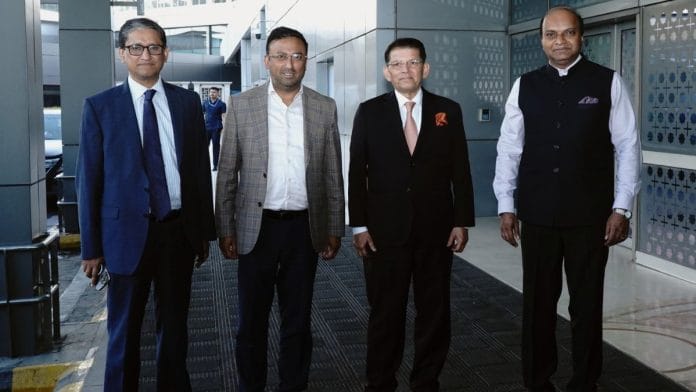



New Delhi: Bangladesh Foreign Minister Khalilur Rahman has arrived in New Delhi for what Dhaka has labelled as a “stopover”—a part of a “goodwill visit” ahead of his participation at the Indian Ocean Conference in Mauritius. India, however, has termed it an official visit, underscoring a subtle difference in how the two countries are framing Rahman’s visit domestically.
“Hon’ble Foreign Minister, Dr Khalilur Rahman, leaves Dhaka on a goodwill visit to India. He departed Dhaka for Delhi on 7 April afternoon, en route to Mauritius to participate in the Indian Ocean Conference scheduled to be held from 10 to 12 April 2026. On the way, he will make a stopover in New Delhi, and is scheduled to hold courtesy meetings with the external affairs minister, the national security adviser, and the minister of petroleum and natural gas of India,” the Bangladesh foreign affairs ministry said Tuesday in a statement.
Normally, India issues no official press release but a media advisory, ahead of a visit by a foreign minister. In the advisory published Tuesday, Bangladesh Foreign Minister Khalilur Rahman’s visit has been labelled as “official”. The advisory also provides details of the meetings he is expected to attend.
Labellings usually indicate the level of discussions to be held. In this case, it appears to also be a signal to the respective domestic audiences. For Bangladesh, India remains a challenging topic, especially for the new government led by Prime Minister Tarique Rahman of the Bangladesh Nationalist Party (BNP).
Diplomatic sources have informed ThePrint that Khalilur Rahman’s visit to India will be open-ended, with no specific agenda, apart from a focus on building a rapport between the respective sides and setting the stage for future ties. Another source indicated that India understands the challenge Dhaka faces domestically, and the visit will be the first between Rahman and External Affairs Minister S. Jaishankar to reopen communication channels between the two countries.
Ties between New Delhi and Dhaka cratered following the ouster of former Prime Minister Sheikh Hasina in August 2024. The interim government led by Nobel laureate Muhammad Yunus rarely met with India at the political level. The then-foreign adviser Touhid Hossain met Jaishankar only on the margins of multilateral meetings. New Delhi’s past, especially its close ties with Hasina, has impacted its reputation within the Bangladeshi polity.
Dhaka, in its statement, pointed out that the minister’s visit will “lay emphasis on stability and continuous development of bilateral relations based on dignity, mutual trust and respect, and shared interests.” “It is hoped that this visit will lay an important foundation for elevating the areas of cooperation between Bangladesh and India to a more fruitful and sustainable level in the future,” its statement added.
The diplomatic source told ThePrint that it was too early for the two sides to negotiate any agreement, but an open agenda would help engender trust and allow all issues to be discussed, setting the stage for deeper engagement, without tying down India-Bangladesh ties to “specific” regimes.
Also Read: Dhaka is resetting ties with New Delhi. Modi govt must open up
Dhaka’s priorities
Further, for Dhaka, the choice of meetings with National Security Adviser Ajit Doval, Jaishankar, Minister of Commerce and Industry Piyush Goyal, and Minister of Petroleum and Natural Gas Hardeep Singh Puri indicates its early priorities at this moment.
The security situation, opening communication channels, visa issues, economic restrictions imposed from both sides, and a courtesy visit to negotiate potential further energy supplies amid the ongoing war in West Asia are all priority areas.
Last month, India sent nearly 5,000 tonnes of diesel to Dhaka as emergency supplies and has offered another 40,000 tonnes by the end of April. The supplies were through the existing friendship pipeline between the countries.
Another area where challenges remain is trade. Last year, Bangladesh took several steps to restrict imports from India, including increased import checks at land boundaries and restrictions on goods imports, such as cotton yarn.
In response, India moved to cancel transhipment rights and allowed Dhaka to export goods solely via the Jawaharlal Nehru Port in Navi Mumbai on its Western coast. Water issues are likely to be raised, especially as the Ganges Water Treaty is set to expire in December.
However, the diplomatic source was clear that, being the first meeting at such a level, major outcomes remain to be seen. For 18 months, channels of political communication, which were common under the Hasina administration, have been closed. Rahman, in his previous role as NSA for the interim government, maintained open communication channels with Doval—the main remaining link between the two countries.
The interaction between Rahman and Jaishankar will not be solely in New Delhi. The two will be present in Mauritius for the Indian Ocean Conference, allowing interactions at different levels.
Rahman is being accompanied by Humayun Kabir, the prime minister’s foreign affairs adviser. Prime Minister Tarique Rahman has been cautious in opening relations with India.
Prime Minister Narendra Modi had sent a letter along with Jaishankar at the end of last year, condoling the death of Prime Minister Rahman’s mother and former Bangladeshi Prime Minister Khaleda Zia.
Jaishankar’s visit to Dhaka for Zia’s funeral also saw the Indian minister hold a roughly 20-minute meeting with Rahman. In February, India’s Parliamentary Speaker Om Birla and Foreign Secretary Vikram Misri attended Rahman’s swearing-in ceremony after the elections.
The signal to Bangladesh that Birla’s representation of India sent is one of respecting the results of the parliamentary elections, a diplomatic source at the time had said.
Bangladesh’s Foreign Minister’s visit to New Delhi, even as a “stopover”, should formalise this bilateral reset, leading to future engagement at different levels, according to these sources.
(Edited by Madhurita Goswami)
Also Read: Awami League leader who was Bangladesh’s 1st female speaker arrested over 2024 uprising