








New Delhi: China again staked its claim on the Shaksgam Valley amid India’s assertion that the region falls under its territory, in the backdrop of the announcement of the second phase of the China-Pakistan Economic Corridor (CPEC).
Reiterating the validity of what India terms as the “illegal and invalid” land transfer, Beijing regurgitated its usual narrative. “China and Pakistan in the 1960s signed a boundary agreement and delimited the boundary between the two countries, which is the right of China and Pakistan as sovereign countries,” it said Monday.
New Delhi has never recognised the so-called China-Pakistan ‘Boundary Agreement’ signed in 1963, through which Islamabad ceded the territorial control of the strategically located valley to Beijing.
India also registered its protest against infrastructural construction in the Shaksgam Valley, as it stands as a violation of its territorial sovereignty, the reason that New Delhi never recognised the Belt and Road Initiative (BRI) or one of its flagship projects, the CPEC, passing through Pakistan-occupied Kashmir.
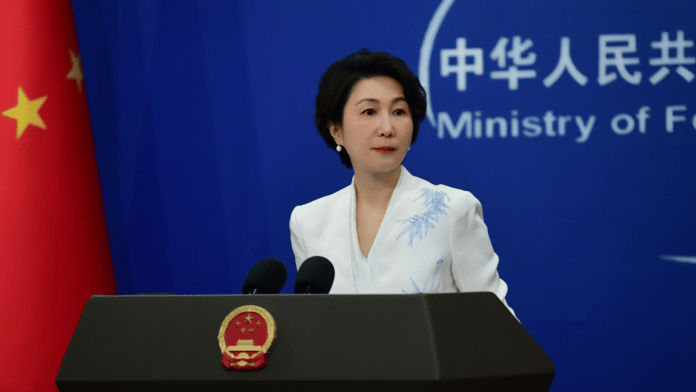
“It’s fully justified for China to conduct infrastructure construction on its own territory,” Chinese Foreign Ministry spokesperson Mao Ning said, reacting to comments from New Delhi.
The pace of infrastructure development has accelerated since the 2017 Doklam standoff. It includes a recent all-weather road through the Shaksgam Valley that runs close to the Siachen glacier, challenging India’s hold over the region.
Satellite imagery shows that the road branches out from an extension of Highway G219 in China’s Xinjiang and ends around 50 km from Indira point, the northernmost point of the Siachen glacier, touted as the world’s highest battlefield. Military experts point to the immense security implications it entails for India, given the cooperation between Pakistan and China.
“The CPEC, as an economic cooperation initiative, aims at promoting local socioeconomic development and improving people’s livelihood,” Mao said, downplaying the security angle and the politically contentious nature of the project, as repeatedly conveyed by New Delhi over the years.
In diplomatic double-speak, the Chinese spokesperson mentioned that: “The China-Pakistan boundary agreement and CPEC do not affect China’s position on the Kashmir issue and the position remains unchanged.”
This comes after Ministry of External Affairs (MEA) spokesperson Randhir Jaiswal reaffirmed that the Union Territories of Jammu and Kashmir and Ladakh constitute an integral and inalienable part of India.
India’s diplomatic protest and China’s response follow a period of resumed ties between the two neighbours, which have been on the path to normalcy with several confidence-building measures after a tense few years.
Since 2015, China has invested immense economic, political, and diplomatic capital in the CPEC, which connects China’s restive western region of Xinjiang to Pakistan’s Gwadar port.
Pakistan, too, considers the CPEC as its “economic lifeline”. It has, however, encountered serious domestic opposition and violent resistance in Balochistan, where the port city of Gwadar is located. The project, passing through Pakistan-occupied Kashmir, has been consistently protested by New Delhi as it infringes on India’s territorial sovereignty.
Sushovan Chakraborty is an intern with ThePrint
(Edited by Tony Rai)