







New Delhi: India-Bangladesh ties mending at a steady pace since the new government was sworn in, seem to have faltered last week. The bone of contention? Tangail sarees and the question of ‘a shared heritage’.
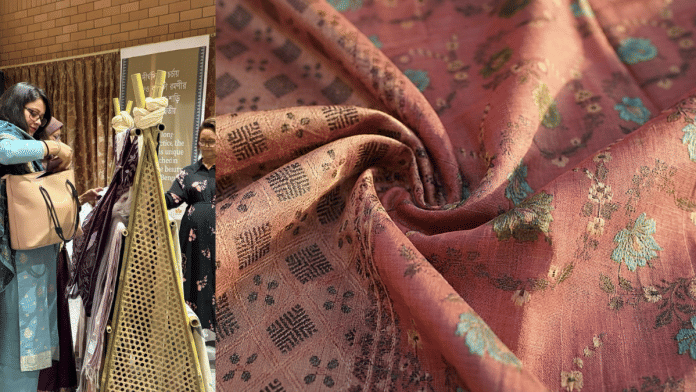
On 17 April, the Bangladesh High Commission held a saree exhibition at its premises in New Delhi.
The original plan was to hold the exhibition at Travancore House and was meant to be a Tangail saree exhibition just like the Jamdani saree exposition in September 2025 at the National Crafts Museum, in Delhi.
Sources said that the Bangladesh High Commission contacted the Indian government over permission to use Travancore House, but when they did not come, the sarees were exhibited at the high commission.
Indian government sources told ThePrint that the two governments disagreed over the origin of certain weaving styles that were part of the exhibit. But even as the debate continued, the Bangladesh High Commission decided to host the exhibition at its premises.
On the other hand, Bangladesh officials say they were refused permission. “We were not given an official explanation,” said a person familiar with the matter at the high commission, requesting anonymity. “We were simply told it could not proceed there.”
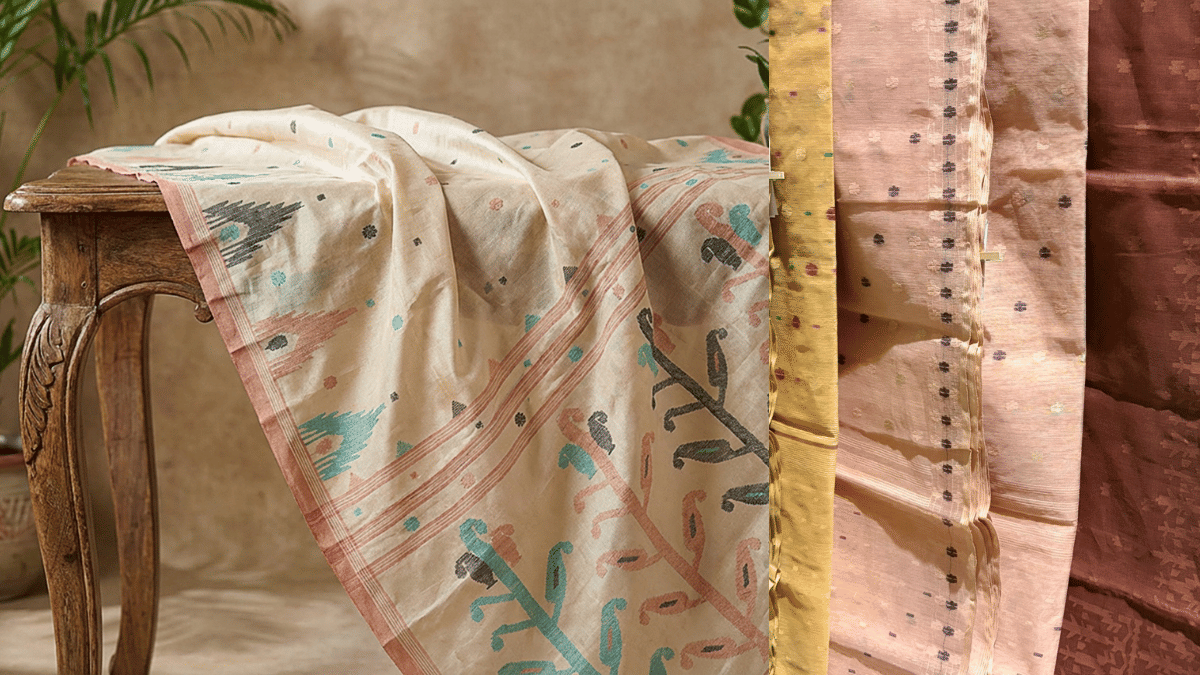
Here’s the problem: For both India and Bangladesh, the Tangail saree and its origin is not just a shared legacy, its also a contested one. Weaving styles of Tangail—those made in India and those made in Bangladesh—differ. Bangladesh does not use religious motifs on the sarees, whereas Indian weavers do.
At the heart of the disagreement lies a Geographical Indication (GI) tag, a form of intellectual property that links a product to a specific place of origin. In 2024, there was a massive uproar in Bangladesh after India claimed the Tangail saree GI tag, saying it originated from West Bengal’s Nadia district.
The registration process for a GI for the Tangail Saree began on 8 September 2020, when the Government of West Bengal submitted an application under the name ‘Tangail Saree of West Bengal’. The application acknowledged the saree’s historical roots in East Bengal (present-day Bangladesh) and stated that it was brought to West Bengal by migrating traders.
However, on 11 September 2020, the application failed the initial formal check due to issues related to compliance with India’s GI Act of 1999, inconsistencies in naming, and insufficient historical evidence.
A response addressing these issues was filed on 21 January 2021, but the supporting documents continued to identify Tangail in Bangladesh as the place of origin.
The process moved forward with a consultative group meeting on 10 November 2022, followed by an examination report on 26 December 2022, which suggested revising the GI name.
Consequently, on 30 March 2023, the name was changed to ‘Tangail Saree of Bengal’, a move that drew criticism for potentially creating ambiguity about its geographical identity.
The application was published in the GI Journal on 31 August 2023, initiating a three-month period for opposition. As no objections were filed—either by Bangladesh or any related parties—the GI ‘Tangail Saree of Bengal’ was officially registered on 2 January 2024.
A Facebook post by the Indian Ministry of Culture in 2024 said: “The Tangail saree, originating from West Bengal, is a traditional handwoven masterpiece. Renowned for its fine texture, vibrant colours, and intricate Jamdani motifs, it epitomises the region’s rich cultural heritage.”
The post, which was deleted later, caused a public outcry in Bangladesh, where social media users took offence at the use of the phrase “originating from West Bengal”.
Amid the furore, the Bangladesh government in a counter move officially labelled the Tangail saree as its own Geographical Indication (GI) product a month later.
The saree and its tradition have long crossed borders but the debates continue, with both countries laying claim to the GI tag.
Despite the complications, the exhibition opened on 17 April and featured more than 300 curated sarees, blending traditional designs with contemporary interpretations. It, however, went ahead with a generic name ‘the art of saree weaving’ and did not mention ‘Tangail’ in its title.
Bangladesh also brought a 9th generation weaver from the Basak community to highlight the heritage and its lineage. The exhibition was inaugurated by Bangladesh High Commissioner M. Hamidullah Riaz and crafts activists and Padma Shri awardees Laila Tyabji and Sunita Kohli.
At the event, Hamidullah described it as an act of “shared heritage.”
“This is not an act of diplomacy… This is purely to celebrate craftsmanship. Each saree carries a unique emotional expression and a story of ‘obstinacy’, the stubborn refusal of these artists to let a beautiful tradition die,” he said.
The display included heritage pieces as well as contemporary interpretations. Curated by Chandra Shekhar Shaha, the president of the Bangladesh Crafts Council in Bangladesh and textile artisan Chandra Shekhar Veda from India, the exhibition reflected a shared cross-border effort to preserve and celebrate South Asia’s textile traditions.
Such was the craze for the handmade curated sarees, that the exhibition had to end prematurely before its scheduled 3 days because the sarees were sold out within 48 hours.
Tangail and its history
Tangail sarees have a complex history, rife with the impact of colonialism, Partition and displacement.
It originated in the Tangail region (now in Bengladesh) in the late 18th and 19th centuries, when zamindars (landowners) invited skilled muslin weavers, mainly from the Hindu Basak community near Dhaka to settle there and develop a new style of fine, smooth-textured sarees.
After the 1947 Partition, a large number of weavers migrated to India, particularly to Phulia in West Bengal, where they continued their craft. While this led to the growth of Tangail-style sarees in India, their original roots remain in Bangladesh.
In West Bengal, especially from the 1950s onward, weavers began modifying traditional Tangail designs. Pioneers like Biren Basak and Suren Basak introduced new patterns, including curvier motifs and even human figures, known as ‘figure jamdani’, which differ from the more traditional Bangladeshi designs influenced by Islamic artistic norms.
Inputs by Keshav Padmanabhan
(Edited by Viny Mishra)
Also read: Dhaka’s top diplomat in Delhi, India-Bangladesh look to further meets while keeping irritants aside