





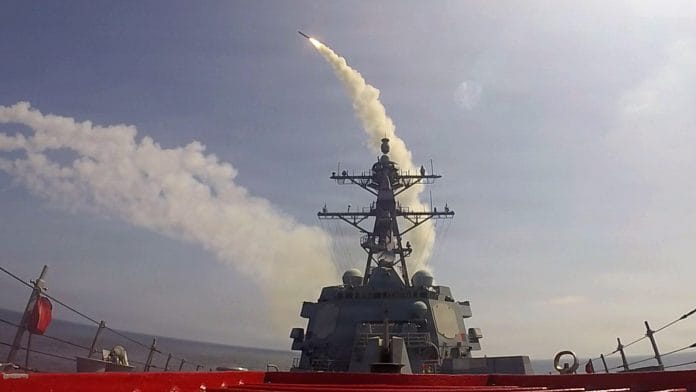



For the first time since 1945, a US submarine has sunk an enemy warship. When the Iranian navy ship IRIS Dena went down, it was 2,000 miles from home and seven nautical miles from Sri Lankan waters. Both those figures are of importance, for different reasons.
Put together, they will suggest to countries across Asia that the US is no longer a responsible and reliable presence in our waters — and America will be considerably weaker as a consequence.
The Dena was only in Sri Lanka’s exclusive economic zone, not within its territorial waters; and Washington has said it had the right to hit a possible threat to shipping in the Strait of Hormuz, thousands of miles to the north.
That’s answering the wrong question. What disturbs Asians is how and when the US chose to attack. The Dena was returning from a largely ceremonial naval exercise, where 73 other nations were represented — including the US Navy, which ironically “conducted anti-submarine warfare drills with other participating naval forces.”
The Iranian ship’s hosts in the Indian Navy had posted photos of them welcoming the Iranian crew; images of its sailors parading in front of the Indian president and visiting local tourist hot spots were widely shared.
For political and military leaders in New Delhi, the US decision to hit the ship as it was leaving an Indian-organized exercise is a direct insult. New Delhi has been forced to make the case that the hosts had no responsibility to defend or avenge their guests. They’re making such an effort to put that line out that the only possible conclusion is that it’s true technically and legally, but not morally and politically.
This is an embarrassment Prime Minister Narendra Modi didn’t need. The one thing his voters expect from him is that India will be treated with respect, and that he personally won’t allow himself to be bullied or fooled by anyone. The last few weeks have tested their faith.
First, Modi gave in to President Donald Trump on trade, agreeing to a deal that seems to have opened up some previously closed sectors of Indian agriculture. Then he was seemingly blindsided by attacks on Iran, a long-time partner of New Delhi’s, launched barely days after he completed a visit to Israel.
A war that threatens India’s vast diaspora in the region will hardly be popular. It sharply raises costs in a country dependent on fossil-fuel imports, and has stranded travelers for whom Gulf airports are a lifeline to the world. And in many parts of India — for example in troubled Kashmir — Shiite Muslims are vital bulwarks of state power. The targeted killing of Ayatollah Khamenei has therefore complicated the nation’s internal security considerably.
Now Modi has been put in the position of explaining why the US chose to attack a ship “on our watch, in our oceanic backyard,” as one commentator put it. Especially given the widespread belief in India that the Dena carried “little or no munitions,” as was the custom at the naval exercise it was attending.
Sri Lanka’s government is being similarly tried. The Dena was a short distance out of territorial waters, but it had sought permission to dock that had not yet been granted. Not the behavior, some might think, of a warship racing to attack shipping in the distant Gulf.
Since then, President Anura Dissanayake has had to make a nationally televised address to say he had swiftly granted refuge to the crew of another Iranian ship, the unarmed naval auxiliary IRIS Bushehr. He added that it could not be anchored near Colombo because it would drive up maritime insurance, and so would be taken to a smaller port on the eastern coast of the island.
Think about that for a moment. The US is now trusted so little in Asia that the president of a sovereign nation believes his capital city’s harbor will be seen as too risky a location for an unarmed support ship.
Everything about this decision is inexplicable. Iran has already angered neutrals — there’s no reason for the US to as well. The Dena had thousands of miles to go before it became a threat; if it had to be attacked, why choose a time and location that would cause maximum embarrassment to your friends? This expands the theatre of war dangerously, and puts pressure on Modi — who, so far, has been careful not to say anything in support of Iran, although the bilateral relationship is and always has been strong.
Navies are capable of making mistakes that diplomacy can address. But there’s been no effort to do that, either. Instead, Washington seems bent on making things worse. The Secretary of War’s bellicose rhetoric has received a great deal of attention; but more troubling is that to Asian ears it all sounds theatrical and amateurish. Less Churchill, more Chemical Ali.
Why should the US care? Because in the end — as its wrangle with Britain this week should have reminded them — America still needs bases,friendly ports, and overfly rights. You can spend 10 times what everyone else does, but you can’t conjure up airfields and harbors out of thin air.
Even those in India and elsewhere who have long argued for logistical agreements with the US military are rethinking their positions. All such deals are concluded on the unstated assumption that America is a responsible, mature nation that will not misuse the privileges it is granted. That belief sank alongside the Dena.
This column reflects the personal views of the author and does not necessarily reflect the opinion of the editorial board or Bloomberg LP and its owners.
Mihir Sharma is a Bloomberg Opinion columnist. A senior fellow at the Observer Research Foundation in New Delhi, he is author of “Restart: The Last Chance for the Indian Economy.”
Disclaimer: This report is auto generated from the Bloomberg news service. ThePrint holds no responsibility for its content.
Also read: US will try to derail India’s rise. New Delhi must put behind innocence in ties
One does not recall extensive debates when four foundational agreements ( LEMOA, etc ) were signed with USA. Whether all contingencies were carefully thought through. What happens if USA and China fight a war over Taiwan. Would India, at least indirectly, be dragged into the conflict.