



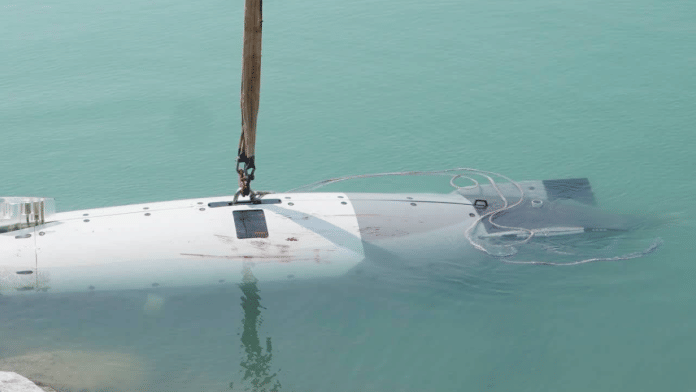
New Delhi: The Iranian Revolutionary Guards (IRGC) said on Tuesday that it captured one of the US’ “most modern” underwater drones near the Strait of Hormuz. Iranian state media identified the vessel as a Dive-LD, a large autonomous underwater vehicle manufactured by Anduril, a California-based defence technology company.
The roughly 19-foot (5.8 meters) unmanned submersible is designed for missions including mine countermeasures, seabed mapping, intelligence gathering and the inspection of underwater infrastructure such as cables and pipelines.
“One of the US military’s most advanced unmanned underwater vehicles was seized by Iranian forces near the entrance to the Strait of Hormuz,” the IRGC Navy said.
Purported images of the submersible released later showed a partially submerged, cylindrical gray-and-white vessel bearing Anduril markings and US Navy serial identifiers consistent with the platform’s known design.
The Pentagon, however, disputed the characterisation of the incident as a military capture. A spokesman for the US Central Command said the underwater drone had malfunctioned over a day before the Iranian announcement and had effectively been disabled in the water.
“The drone was essentially dead in the water for more than a day. It was surveying regional waters in support of ongoing operations,” US Navy Captain Tim Hawkins told Defensescoop, a Washington-based news outlet covering US military acquisitions. He also said the vehicle was an older model that “neither collected sensitive data nor carried any classified sonar or radar equipment.”
Anduril confirmed that one of its Dive-LD vehicles had been lost but downplayed the incident. The company described the Dive-LD as an “attritable autonomous system,” meaning that it is designed to operate in hazardous environments where the loss of a vehicle is considered an acceptable possibility.
“Its purpose is to keep warfighters out of the most dangerous parts of the undersea mission,” an Anduril spokesman said, adding that the vehicle had accumulated thousands of hours of operations in the US Central Command area. Unlike conventional submarines, these systems can conduct extended missions without putting crews at risk.
Enhanced capabilities
According to Anduril’s website, the Dive-LD is 1.2 meters in diameter and weighs roughly three tons. It can remain at sea for extended periods and is designed to operate at depths of up to 6,000 meters. The company has also said that the vehicle’s open mechanical, electrical and software interfaces, allow different sensors and payloads to be integrated for specific missions.
The vehicle can be configured for intelligence, surveillance and reconnaissance, mine warfare and what Anduril describes as “precision placement.” Its modular design has also raised the possibility of variants eventually carrying a broader range of military payloads, although there is no public evidence that the particular vehicle Iran displayed was armed.
Dive-LD vehicles are known to have entered US Navy service in April 2025, including with units responsible for unmanned undersea operations. The US Navy is also pursuing larger autonomous underwater systems, including Anduril’s Dive-XL, as part of a broader effort to expand its undersea capabilities.
Can Iran obtain data from the vessel?
According to Iranian media, an intact underwater vehicle could provide far more intelligence than a damaged or destroyed wreck and Iranian engineers could potentially examine the pressure hull’s materials and manufacturing tolerances, disassemble the battery system to study its cell chemistry, packaging and energy density, and inspect the propulsion system and control-surface actuators for engineering techniques aimed at reducing noise.
The most valuable information, however, could lie inside the vehicle’s electronics. If its data storage and onboard computing systems were not remotely erased, physically damaged or protected by anti-tamper mechanisms before the capture, they could potentially offer insights into the autonomy software, navigation algorithms and mission-planning systems that allow the vehicle to operate with limited or no human intervention.
The vehicle’s onboard memory could also contain detailed underwater data gathered during its mission, including high-resolution maps of the seabed.
Iran already maintains extensive charts of the waters on its side of the Strait of Hormuz. But data collected by the Dive-LD could potentially include surveys of the Omani side of the strait, as well as deep-water approaches and underwater terrain that Iranian forces have historically had less visibility into, according to reports.
Such information could give Iranian naval planners a more detailed picture of seabed contours, depth profiles and underwater obstacles across a strategically important waterway.
For Iran, which has been developing its own unmanned underwater systems, access to an intact Dive-LD could also offer a shortcut through years of research and development. Reverse engineering would not allow engineers to simply reproduce the vehicle, but studying its components could reveal solutions to some of the hardest problems in autonomous undersea operations, including surviving extreme water pressure, reducing acoustic signatures, managing power over long missions and maintaining accurate navigation without GPS.
(Edited by Chingkheinganbi Mayengbam)