





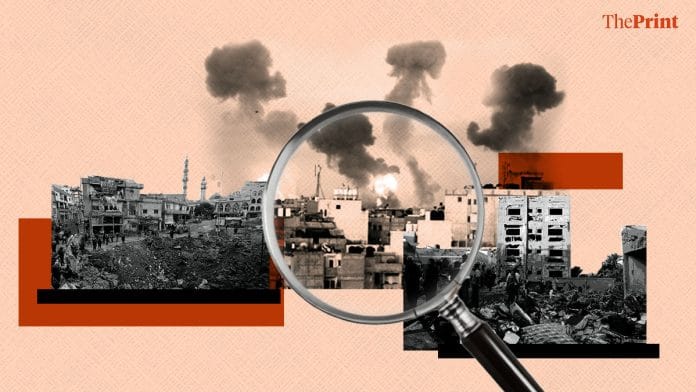


New Delhi: The US-Israel and Iran war is emerging as a watershed in military history: it’s the first conflict in which artificial intelligence (AI) is not merely an enabler but a driver of operations. AI has moved from the sidelines to the centre of combat by shrinking decision-making into seconds and helping carry out precision strikes at a pace never seen before.
Analysts and policymakers increasingly see the war as a transition point into an era of machine-speed warfare, where algorithms compress decisions, reshape command structures, and challenge long-standing norms of human control.
Professor Toby Walsh, an artificial intelligence expert at the University of New South Wales, says the war highlights a dramatic shift in how battles are fought. “What we’re seeing in this current conflict is decisions being handed to machines. We’re going to look back and think, this was the critical turning point,” he told The Daily News, Australia.
Also Read: India working on lowering military reaction time to hostilities, boosting use of AI—CDS Gen Chauhan
AI for targeting & ‘kill chain’ acceleration
AI has transformed the traditional “kill chain”, a structured, step-by-step process used to identify, engage, and destroy an enemy target, by drastically reducing the time between detection and strike. AI systems process satellite imagery, drone feeds and signals intelligence in real time, enabling what analysts call a compressed “sensor-to-shooter loop”.
In this conflict, AI tools have helped cut the time it takes to identify and strike targets from hours or days to seconds. The result is a shift towards machine-speed warfare, often described as operating “quicker than the speed of thought”.
The core of the US military’s AI deployment in Iran is a system called the Maven Smart System, built by software company Palantir Technologies, incorporating the large language model (LLM) Claude, developed by Anthropic.
Maven consolidates what were previously eight or nine separate intelligence and targeting systems, like satellite imagery, drone video feeds, signals intelligence, intercepted phone calls, text messages, internet surveillance radar, and human intelligence reports, into a single digital platform.
Machine learning algorithms then process this vast ocean of data to identify and prioritise potential targets, recommend appropriate weaponry, and even evaluate the legal grounds for a strike. On the first day of the war, more than 1,000 Iranian targets were struck by the US airstrikes, almost double the strikes carried out on the first day of the Iraq War in 2003.
These strikes were linked to the massive use of AI by the American and Israeli militaries, said strategic studies and defence sociology specialist Dr Jean-Michel Valantin in the Small War Journal.
Also Read: The end of the internship? AI threatens entry-level roles in the UK
Decision support systems
AI systems in the war function primarily as decision-support tools rather than autonomous weapons. They aggregate data, identify patterns and recommend actions, while human commanders retain final authority. The US military has confirmed the use of advanced AI tools to help personnel process troves of data and improve situational awareness.
Brad Cooper, head of the US Central Command (CENTCOM), said that AI is helping US soldiers process vast volumes of data.
“Our war fighters are leveraging a variety of advanced AI tools. These systems help us sift through vast amounts of data in seconds so our leaders can cut through the noise and make smarter decisions faster than the enemy can react,” Cooper said in a video message.
However, as AI accelerates decision cycles, the balance between human judgment and machine recommendation is shifting.
Experts caution that while humans remain “in the loop”, the speed of AI may limit meaningful oversight, raising concerns about accountability and escalation risks.
AI-enabled drone warfare
AI is playing a central role in enabling modern drone warfare, particularly through autonomous navigation, target recognition, and swarm coordination.
Both high-end systems and low-cost loitering munitions have been deployed at scale, reflecting a shift toward “affordable mass warfare”.
AI has allowed drones to operate with greater independence and precision, reducing reliance on constant human control. Swarm tactics, where multiple drones attack simultaneously, require AI-driven coordination to overwhelm defences.
This development highlights how relatively inexpensive AI-enabled systems can challenge traditional military advantages, reshaping the cost dynamics of warfare.
The ongoing war between Russia and Ukraine has been a testing ground for AI in war. They are using it for finding targets, gathering intelligence and de-mining. For the Ukrainian army, AI has become indispensable.
“Our military gets more than 50,000 video streams [from the front line] every month which are analysed by artificial intelligence,” said Ukraine’s deputy defence minister, Yuriy Myronenko. “This helps us quickly process this massive data, identify targets and place them on a map.”
AI in cyber and electronic warfare
The Iran war has underscored the growing role of AI in cyber and electronic warfare.
AI systems are being used to detect vulnerabilities, automate cyber operations, and enhance electronic attacks such as radar jamming and communications disruption.
These capabilities have targeted the digital backbone of military systems, aiming to degrade situational awareness and command effectiveness.
As modern warfare becomes increasingly network-centric, AI-driven cyber tools act as force multipliers, enabling faster and more adaptive responses.
Analysts note that breaking an adversary’s data and communication networks can be as decisive as physical destruction on the battlefield.
The US-Israel vs Iran conflict highlights a clear shift. Iranian missile and drone strikes across the Middle East have deliberately targeted radar, early-warning systems, and communication networks that support air defence.
Several key radar assets were reportedly damaged. By combining drone swarms with missile attacks, Iran sought to overwhelm interception systems. These strikes were just not random; they were focused on disabling the digital backbone of missile defence.
Information warfare and AI-generated propaganda
AI-generated misinformation during the US, Israel and Iran conflict was spread at an unprecedented scale, with online creators monetising fake videos and fabricated satellite imagery that have collectively drawn hundreds of millions of views, according to BBC Verify.
Experts warn that advances in generative AI have dramatically lowered the barrier to producing convincing war footage.
“The scale is truly alarming, what once required professional production can now be done in minutes,” said Timothy Graham of Queensland University of Technology.
This dimension of the war highlights how AI is not only a tool for physical combat but also a powerful instrument of psychological and information warfare, capable of shaping narratives and undermining trust.
Vinay Singh is an alum of ThePrint School of Journalism, currently interning with ThePrint.
(Edited by Sugita Katyal)
Also Read: Deluge of AI-generated Iran war videos from Pakistan prompts X to change its rules & warn creators