





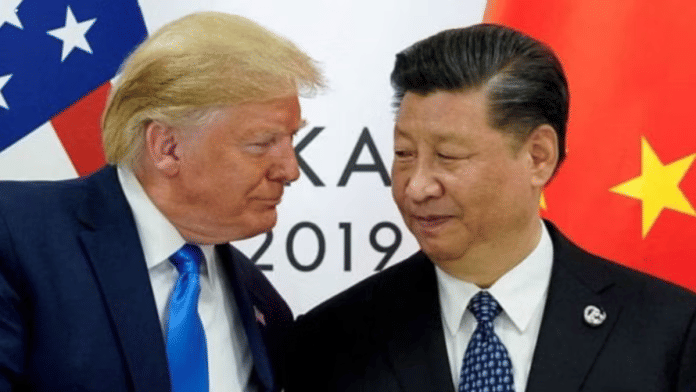



New Delhi: The Trump Administration has officially designated China as the “second most powerful country” in the world behind only the United States, as the Pentagon unveiled its National Defence Strategy 2026.
In line with the US President Donald Trump’s focus on Homeland and protecting American interests in the Western Hemisphere, the new defence strategy is a significant departure from the Biden-era 2022 Pentagon policy, both in terms of a softer tone towards traditional rivals, China and Russia, and emphasis on allies shouldering increased burdens with less backing from Washington.
The new strategy document does not mention American ally Taiwan, which China claims as its territory. There is also no mention of India in the defence strategy.
“As US forces focus on homeland defense and the Indo-Pacific, our allies and partners elsewhere will take primary responsibility for their own defense with critical but more limited support from American forces,” the document said.
It urges “respectful relations” with Beijing and describes the threat from Russia as a “persistent but manageable” one affecting NATO’s eastern members.
“We will defend the Homeland and ensure that our interests in the Western Hemisphere are protected. We will deter China in the Indo-Pacific through strength, not confrontation. We will increase burden-sharing with allies and partners around the world. And we will rebuild the U.S. defense industrial base as part of the President’s once-in-a-century revival of American industry,’ the strategy document said.
The previous NDS, released in 2022, had described China as Washington’s most consequential challenge and said Russia posed an “acute threat”.
Speaking on China specifically in its security outlook, the new Defence strategy said, “By any measure, China is already the second most powerful country in the world—behind only the United States—and the most powerful state relative to us since the 19th century. And, while China faces very significant internal economic, demographic, and societal challenges, the fact is that its power is growing. Beijing has already spent vast amounts on the PLA in recent years, often at the expense of domestic priorities.”
It added that China can still afford to spend even more on its military, should it choose to do so—and it has shown that it is able to do so effectively.
“Indeed, the speed, scale, and quality of China’s historic military buildup speak for themselves, including forces designed for operations in the Western Pacific as well as those capable of reaching targets much farther away,” it said.
Talking about the US strategy on China, the document said President Trump seeks a stable peace, fair trade, and respectful relations with China, and he has shown that he is willing to engage President Xi Jinping directly to achieve those goals.
But President Trump has also shown how important it is to negotiate from a position of strength—and he has tasked DoW accordingly. Consistent with the President’s approach, DoW will therefore seek and open a wider range of military-to-military communications with the People’s Liberation Army (PLA) with a focus on supporting strategic stability with Beijing as well as deconfliction and de-escalation, more generally, it said.
“But we will also be clear-eyed and realistic about the speed, scale, and quality of China’s historic military buildup. Our goal in doing so is not to dominate China; nor is it to strangle or humiliate them. Rather, our goal is simple: To prevent anyone, including China, from being able to dominate us or our allies—in essence, to set the military conditions required to achieve the NSS goal of a balance of power in the Indo-Pacific that allows all of us to enjoy a decent peace,” it said.
To that end, the NSS directs that the US will erect a strong denial defense along the First Island Chain (FIC). “We will also urge and enable key regional allies and partners to do more for our collective defense.”
“In doing so, we will reinforce deterrence by denial so that all nations recognize that their interests are best served through peace and restraint. This is how we will establish a position of military strength from which President Trump can negotiate favorable terms for our nation.”
“We will be strong but not unnecessarily confrontational. This is how we will help to turn President Trump’s vision for peace through strength into reality in the vital Indo-Pacific,” the new defence strategy said.
Also Read: Trump trains guns on US defence giants, singles out Raytheon & what it means for India
The Russia ‘threat’
On Russia, the document said Moscow will “remain a persistent but manageable threat to NATO’s eastern members for the foreseeable future”.
It said that although Russia suffers from a variety of demographic and economic difficulties, its ongoing war in Ukraine shows that it still retains deep reservoirs of military and industrial power.
“Russia has also shown that it has the national resolve required to sustain a protracted war in its near abroad. In addition, although the Russian military threat is primarily focused on Eastern Europe, Russia also possesses the world’s largest nuclear arsenal, which it continues to modernize and diversify, as well as undersea, space, and cyber capabilities that it could employ against the U.S. Homeland,” it said.
It added that the Department of War will also continue to play a vital role in NATO itself, even as it calibrates U.S. force posture and activities in the European theater to better account for the Russian threat to American interests as well as US allies’ own capabilities.
“Moscow is in no position to make a bid for European hegemony. European NATO dwarfs Russia in economic scale, population, and, thus, latent military power. At the same time, although Europe remains important, it has a smaller and decreasing share of global economic power.
“It follows that, although we are and will remain engaged in Europe, we must—and will—prioritize defending the U.S. Homeland and deterring China,” the document said.
It noted that NATO allies are substantially more powerful than Russia—it is not even close.
Germany’s economy alone dwarfs that of Russia. At the same time, under President Trump, NATO allies have committed to raise defense spending to the new global standard of five percent of the GDP in total, with 3.5 percent of GDP invested in hard military capabilities.
“Our NATO allies are therefore strongly positioned to take primary responsibility for Europe’s conventional defense, with critical but more limited U.S. support.
“This includes taking the lead in supporting Ukraine’s defense. As President Trump has said, the war in Ukraine must end. As he has also emphasized, however, this is Europe’s responsibility first and foremost. Securing and sustaining peace will therefore require leadership and commitment from our NATO allies,” the new defence strategy said.
(Edited by Ajeet Tiwari)
Also Read: Trump says ‘deal is done’, China to remove curbs on exports of critical minerals to US