





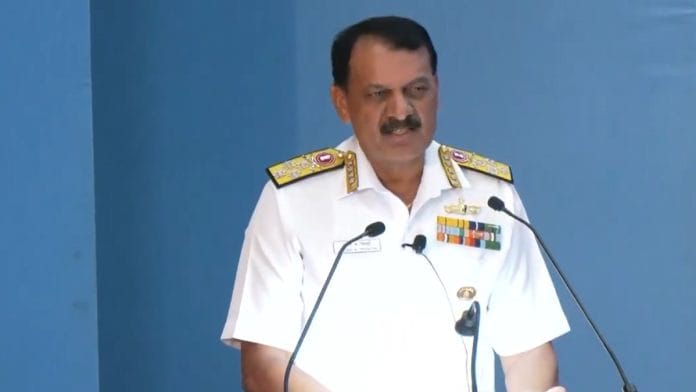



Bengaluru: The Indian military is closely monitoring developments in the ongoing US-Israel and Iran conflict, especially what has or hasn’t worked for the warring parties, Navy chief Admiral Dinesh Tripathi said Thursday.
Speaking at the Ran Samvad here, Admiral Tripathi said that it is too early to take lessons from the conflict because it is still ongoing. “It’s too early right now. We’re monitoring like a hawk, what’s working, what’s not working, what we can imbibe from that, what’s to be done, and more importantly, what’s not to be done. That part is being collated,” he said.
Kinetic actions, he said, haven’t stopped, “notwithstanding whatever tweets have gone out”.
Admiral Tripathi also said, “The services are looking at this in all seriousness on a regular basis, 24×7 if I may say so.”
Talking about multi domain operations (MDO), the theme for this year’s Ran Samvad, he said the Navy has always operated across multiple domains.
This, he said, extends from subsea and surface to air and space, adding that the Navy is also increasingly leveraging the electromagnetic, cyber and cognitive domains in achieving outcomes. “What has changed, however, is the character of this maritime battlespace, which today can be visualised as a dense yet more transparent, layered yet deeply interconnected grid extending from the seabed to space domain,” he said.
The Navy chief pointed out that the ongoing conflict in West Asia illustrates that speed is no longer merely an enabler of warfare but a distinct capability.
“AI-driven battlefield decision systems such as Lavender, Gospel and Palantir’s Gotham link satellite feeds, surveillance inputs and phone records to process thousands of targets in compressed cycles and conduct precision strikes,” he said.
Explaining other changes, he said that growing modularity of warships, as also uncrewed systems, with strap-on payloads, allows rapid role adaptation for surveillance, air defence, and strike roles.
Whether it is MAGURA—the unmanned surface vehicles (USV) developed by Ukraine—launching surface-to-air missiles, or Ursula USVs deploying FPV (first person view) drones, lethality from micro platforms is scaling macro-effects at sea, he said.
(Edited by Amrtansh Arora)