





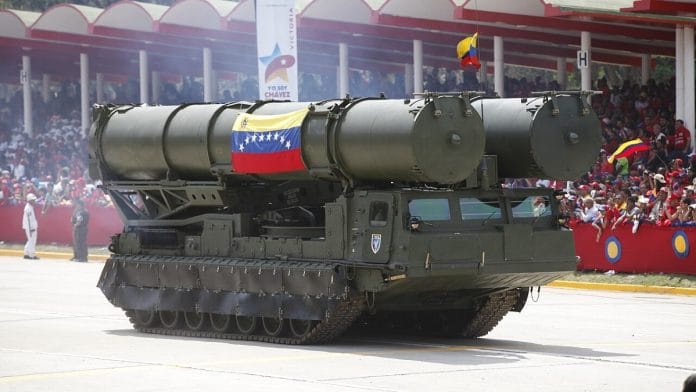



New Delhi: On paper, the Venezuelan forces appear to be a formidable fighting force. But all of that military might proved futile when US forces swooped in Saturday and captured President Nicolas Maduro along with his wife. Both were flown to New York where they face charges of involvement in a conspiracy to import tonnes of cocaine into the US.
While there is speculation on why Venezuelan armed forces never challenged the American troops since they operate the Russian S-300 air defence system, ThePrint takes a look at Venezuela’s armed forces in general and its air defence in particular.
The mix of legacy Soviet weapons and advanced weapons systems that Caracas primarily procured over the years from Washington’s strategic rivals, including China, bolstered the image of Venezuela having one of the well-equipped forces in South America; but questions linger over the maintenance of equipment and training of personnel.
Years of economic hardship, rocketing inflation, international sanctions have had an effect on the level of operational capability and asset availability of the Venezuelan armed forces.
Also Read: US military intervention in Venezuela — the 3 lessons to remember
Soviet weaponry
The bulk of defence equipment in service in Venezuela is either Russian or Soviet Union-origin. Major weapons systems include Su-30 fighter jets, T-72 battle tanks, S-300 air defence system, Pechora and Buk anti-aircraft missiles, as well as portable Igla-S systems and Kalashnikov rifles, all of which were designed in Soviet times.
The sturdiness of Venezuela’s air defence over the years has been majorly built on Russian weaponry. Long-range S-300 missiles; medium-range Buk systems and Pechora units, both in operation with its army, and numerous portable Igla-S launchers showcase the multi-layered Russian presence.
The S-300s were bolstered with the acquisition of Chinese JY-27 long-range early-warning radars, which it is claimed are capable of detecting F-22 and F-35 stealth fighters.
In the midst of US-Venezuela tensions last month, several Venezuelan S-125 “Pechora-2M” surface-to-air missile units were spotted near Maracay in northern Venezuela, after it alleged that US fighter jets had started flying near its borders.
Russia has supplied Venezuela with 92 T-72B1 tanks under a 2009 deal, similar to those being used in Ukraine, and 123 BMP-3 infantry fighting vehicles, which provide a fillip to its armoured brigades. Artillery systems sold by Moscow include the Russian Msta-S self-propelled howitzers and Smerch rocket launchers.
Air defence systems available with the Venezuelan armed forces include its ground-based systems, operated by the Venezuelan Army, as well as fighter jets flown by the Venezuelan Air Force.
The mainstay of the Latin American country’s fighter force is the 21 Su-30MK2V flanker fighters. Once the pride of the air force, a few of the old US F-16A/B exist alongside the Su-30s.
The Latin American country also operates man-portable air defense systems (MANPADS), including the Russian-made Igla-S (SA-24 Grinch) and the Swedish RBS 70, adding another formidable layer to its air defence.
According to a 2017 report in Reuters, the Venezuelan military had a total inventory of approximately 5,000 Igla-S missiles at that point. The military also has a smaller number of RBS 70s in its arsenal.
Moscow reportedly sold Pantsir-S1 short-range and Buk-M2E medium-range systems to Venezuela late last year in the midst of Washington’s saber-rattling in the Caribbean to bolster the air defence of the Latin American country.
A radar array, comprising the JYL-1 three-coordinate long-range surveillance radar and the JY-27 meter-wave radar, both of Chinese origin, served as a crucial component of the nation’s air defence network.
Drone arsenal
In the age of modern warfare, drones play a pivotal role as a low-cost asymmetrical warfare strategy against a heavily endowed adversary.
Venezuela boasts of a diverse portfolio of unmanned aerial vehicles capable of carrying out surveillance, reconnaissance and being employed for kinetic purposes as well. This follows over two decades of close collaboration with Iran, which has one of the most advanced drone fleets globally.
The Arpía/ANSU series, imported Mohajer-6s, and Shahed-inspired Zamora V-1 (a kamikaze drone whose design is based on the Iranian Shahed-136) give Venezuela a layered UAV portfolio from tactical ISR (intelligence, surveillance and reconnaissance) to armed UCAVs and loitering munitions.
Mohajer-6, the combat-tested and battle-hardened Iranian long-range strike drone, was deployed by Venezuela just last month. The Mohajer-6 can perform surveillance and reconnaissance missions and be armed with small guided munitions as well.
Sanctioning the Venezuela-based Empresa Aeronautica Nacional (EANSA), the US Department of Treasury stated on 30 December that it contributed to Iran’s UAV trade with Venezuela. It noted that “EANSA maintains UAVs operated by the Venezuelan armed forces, including the Iranian Mohajer-2, known locally as Arpia or ANSU-100”.
Sushovan Chakraborty is an intern with ThePrint
(Edited by Nida Fatima Siddiqui)
Also Read: US intervention in Venezuela mirrors Panama 1989, raising legal and moral concerns