



New Delhi: The Centre for Digital Economy Policy Research (C-DEP) released a report Tuesday proposing a new framework—Bharat Sovereign Cloud Assurance Levels Evaluation (B-SCALE)—to reduce dependence on foreign technology for data storage, communications and critical infrastructure.
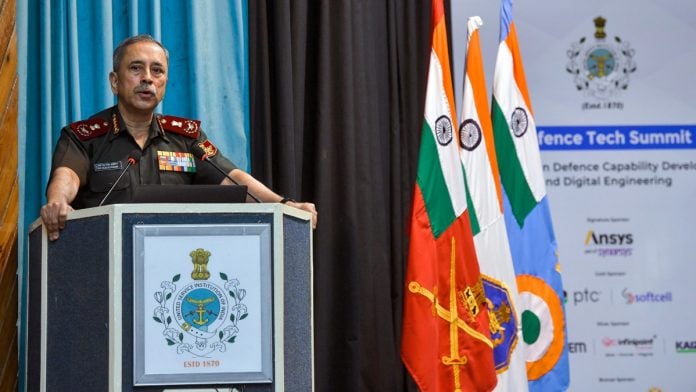
Titled ‘Pathways for Sovereign Cloud Adoption in India’, the report was released at the United Service Institution of India’s (USI’s) Defence Tech Day event. It proposes a phased approach to increasing Indian control over cloud systems underpinning critical digital services.
The report was released by Major General Pawan Anand, a former Indian Army officer, in the presence of Chief of Defence Staff General N.S. Raja Subramani and senior officials from the Department of Telecommunications.
“As public services, regulated sector platforms and AI-enabled applications move to cloud infrastructure, India must adopt Sovereign Cloud where the government can enforce control over data, operations, legal rights and the technology stack. Sovereignty cannot be assessed only by the location of a data centre,” the report says.
“Data may remain in India while an external provider retains control over administrator access, encryption keys, networks, cloud platforms, software updates, intellectual property and service continuity. A Sovereign Cloud must therefore be assessed by the degree of Indian control over the complete service,” it adds.
Also Read: India’s Essar group to build largest steel plant in America, Trump says his tariffs made it possible
What is B-SCALE?
Recognising that India may not currently possess the domestic capability required to place cloud workload under full-stack control, the report proposed B-SCALE for a staged pathway from external dependence to full sovereignty.
Under the framework, B-SCALE 0 represents a cloud environment without an India-specific sovereign-control boundary. B-SCALE 1 establishes Indian control over data, operating personnel, administrative access, monitoring, incident response, disaster recovery and server execution.
B-SCALE 2 extends this control to encryption keys, networks, infrastructure and platform operations, source repositories, updates, supplier approvals and interoperability. B-SCALE 3 places the entire cloud stack, including Software as a Service, source code, licensing, release processes, workload portability and continuity rights, under Indian jurisdiction and control.
“India could therefore adopt B-SCALE as a dynamic, workload-based assurance framework and implement it through sector-specific Sovereign Clouds. This approach recognises present domestic capabilities while creating a measurable pathway towards full Indian control over critical cloud infrastructure and long-term strategic self-sufficiency,” the report says.
Note: An earlier version of this report mistakenly stated that it was the USI that released the report, when it is a C-DEP report released at a USI event.
(Edited by Chingkheinganbi Mayengbam)
Also Read: Trump offered US-made weapons, discussed Taiwan arms sales with Xi, admits US envoy to Beijing