





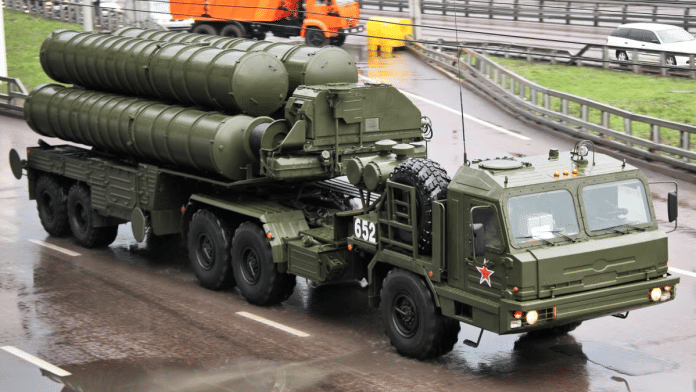



New Delhi: India’s fourth S 400 Triumf air defence system, which has been delayed by nearly three years, is finally ready and undergoing final tests before delivery in the second quarter of this year, ThePrint has learnt.
Sources in the defence and security establishment told ThePrint that the system was to be delivered in March but will now reach the Indian shores by May, or June.The sources said that the fifth S-400 system will be delivered in the last quarter of this year, giving a flip to India’s planned air defence network.
It is learnt that out of the total five systems, three would be deployed along the western border with Pakistan. The sources said that with the three systems deployed, the air defence against threats emanating from Pakistan will be complete.
The third system, of the five ordered in 2018 under a $5 billion deal, was delivered in early 2023. Subsequent deliveries got delayed due to the ongoing Russia-Ukraine war.
The pending deliveries was an issue that was raised during the meeting between Prime Minister Narendra Modi and Russian President Vladimir Putin during his visit to Delhi last December.
The deliveries will take place at a time when India is already working on placing an additional order for five new S-400 air defence systems, which will become integral to the Project Sudarshan Chakra, announced by Modi on Independence Day.
In November, ThePrint reported that India was looking at placing an order for five more S-400 air defence systems.
The sources said that once all the 10 air defence systems are in place along with India’s own planned Project Khusha, the airspace around the country will almost become impregnable when it comes to drones, 4.5 Gen plus fighters, and missiles.
They explained that the S-400s had performed exceptionally well during Operation Sindoor and was able to keep Pakistani aircraft at bay, including the J-10s.
Not only did the S-400 record its longest hit ever during the 88-hour conflict between India and Pakistan, the sources said the ability of the system to shoot and scoot in a short span of time, which allows it to evade enemy fire, was also proved.
On 7 May, the IAF took down a JF-17 aircraft of the Pakistan Air Force well within the Pakistani airspace and forced their fighters to draw back.
However, the fighters did manage to enter into a missing coverage area for a limited period to launch their munitions.
The sources explained that during Operation Sindoor, two S-400 systems were deployed along the western theatre and there was a small gap.
“Once the third system is deployed, the entire western border becomes a fully secure arc and every single fighter, even deep inside Pakistani airspace, can be targeted,” a source explained.
The S-400 is capable of destroying incoming hostile aircraft, missiles and even drones within a range of up to 400 km. It has a tracking capability of nearly 600 km.
The system has been designed to knock down flying targets, including those equipped with stealth technologies, at a distance of about 400 km. It is also capable of taking out ballistic missiles and hypersonic targets.
Compared to its predecessor the S-300, the S-400 has a firing rate that is 2.5 times faster. The S-400 can be armed with four different types of missiles with ranges of 400 km, 250 km, 120 km and 40 km. The system’s Long Range radar can track more than 100 flying objects simultaneously while being able to engage a dozen targets.
(Edited by Tony Rai)