





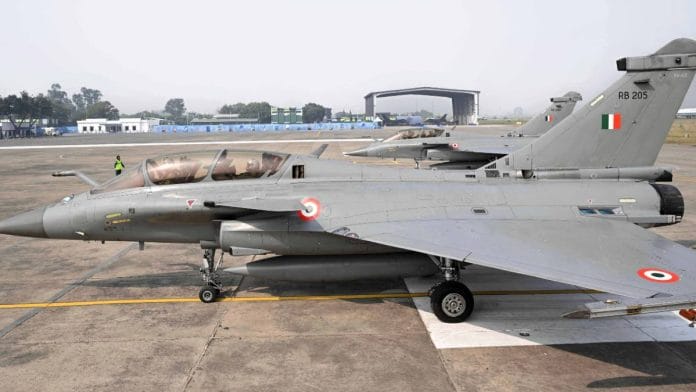



New Delhi: Despite a slight dip in imports, India remains the world’s second-largest importer of major arms, accounting for 8.2 percent of the global share between 2021 and 2025, according to a new report by the Stockholm International Peace Research Institute (SIPRI).
The report, which attributes the dip partly to India’s indigenous defence production, documents a sharp decline in New Delhi’s decades-long dependence on Russia for arms supply.
Moscow’s share, it noted, has fallen from 70 percent in 2011-15 to 40 percent in 2021-25, with Western companies emerging as the key beneficiaries. France and Israel have been the biggest gainers, with their respective shares rising to 29 percent and 15 percent.
On consistent reduction in Russia’s share in India’s defence imports, Profesorr Manish Dabhade, founder of The Indian Futures & Associate Professor, School of International Studies, JNU, said, “This shows a deliberate, phased migration from Soviet-era dependency toward a diversified supplier base anchored in France, Israel, and the United States and taking cognisance of the deepening strategic partnership between Russia and China.”
“This is not reactive hedging; it is strategic foresight. New Delhi has also internalised that supply-chain sovereignty in defence is as vital as the weapons themselves. Moscow’s industrial constraints have merely accelerated a correction long overdue,” added Dabhade
The trend is set to deepen. India has a pending order for 114 Rafale fighter jets from France and six air-independent propulsion (AIP)-equipped conventional submarines from Germany. New Delhi is also set to procure six additional P-8I Poseidon maritime patrol aircraft from the US, and several deals with Israel are in the pipeline.
Globally, the SIPRI report said, there was a rise of 9.2 percent in arms trade between 2021 and 2025 compared to the 2016-2020 period.
India managed to buck this trend with a 4 percent fall in arms imports compared to the 2016-2020 cycle.
“The decrease can be partly attributed to India’s growing ability to design and produce its own weapons—although there are often substantial delays in domestic production,” the report released Monday said.
It also referred to the brief armed conflict between India and Pakistan in May 2025—Operation Sindoor—noting that India’s arsenal is principally driven by the dual threat from China and Pakistan.
“These tensions have regularly led to armed conflict, as they did briefly between India and Pakistan in May 2025, with both sides using imported major arms,” it said.
Also Read: Decoding India’s defence budget & how various govts struggled to spend it—from UPA to NDA
In the neighbourhood & beyond
SIPRI noted that Pakistan’s reliance on Chinese arms has surged from 73 percent in 2016-20 to 80 percent in 2021-25.
Pakistan has simultaneously climbed from tenth to the fifth position among the world’s largest arms recipients—a rise SIPRI directly links to Islamabad’s efforts to counter India’s military capabilities.
China, meanwhile, has dropped out of the top 10 arms-importing nations for the first time since the early 1990s, now ranking 21st globally. Beijing has successfully substituted foreign systems with domestically produced alternatives, cutting imports by 72 percent in 2021-2025 compared to the previous cycle.
On the export side, China has consolidated its position as a major global supplier, with a strategy heavily tilted towards South Asia—61 percent of all Chinese arms exports are directed to Pakistan. SIPRI identified this “all-weather” military partnership between Beijing and Islamabad as a primary driver of India’s defence expenditure.
The report said that the US has solidified its position as the world’s pre-eminent arms supplier, with its share of exports rising to 42 percent following a 27 percent increase in volume between 2016–20 and 2021–25.
For the first time in two decades, Europe became the primary destination for American weapons, receiving 38 percent of total US exports as shipments to the region more than trebled over the two cycles. Prior to this, West Asia was the primary destination for American weapons.
On Europe’s increasing focus on developing its own military capabilities to reduce reliance on Washington, Dabhade said, “We are witnessing the structural militarisation of statecraft. Europe, rattled by American ambivalence, is rearming at a pace unseen in decades.”
While highlighting the impending conflict in West Asia, Dabade added that, “Gulf monarchies, encircled by escalation from Gaza to the Strait of Hormuz, are stockpiling Western platforms at a breathtaking scale.”
“The global order is fragmenting, and now nations are drawing the only rational conclusion: when alliance credibility collapses, self-armed deterrence becomes the last sovereign guarantee,” he said.
SIPRI derives the figures based on data collated from countries that supply and import weapons, besides four non-state armed groups.
This is an updated version of the report
(Edited by Prerna Madan)
Also Read: France expands nuclear arsenal after decades, to extend umbrella across Europe. Here’s what it means