





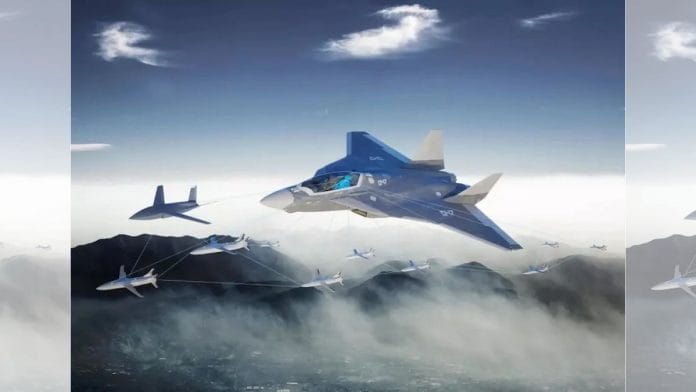



New Delhi: In what could be a major collaboration in the aviation sector, India is exploring the possibility of teaming up with France for co-development and co-manufacture of a futuristic sixth-generation fighter under the Future Combat Air System (FCAS) programme, ThePrint has learnt.
Initial talks have already been held on the possibility of India entering the programme that was started in 2017 between France, Germany and Spain to ensure European sovereignty in defence and security.
However, nearly nine years later, the ambitious project is going through turbulence, with sharp differences over leadership and workshare threatening its future.
German Chancellor Friedrich Merz said last week that the Euro 100 billion programme no longer worked for him. However, he underlined that this was “not a political dispute” but a technical one.
France needs a jet that can carry nuclear weapons and launch from aircraft carriers, while Germany does not since it is against nuclear weapons and has even shut down its nuclear power plants.
The companies involved in the project are Dassault Aviation (France), Airbus (Germany/Spain) and Indra Sistemas (Spain).
Such has been the bickering between Airbus and Dassault, that the European aviation major has publicly suggested a “two-fighter solution” where France and Germany/Spain could pursue separate fighter designs under a shared FCAS architecture to avoid the entire programme collapsing.
The Guardian quoted Airbus’ chief executive Guillaume Faury signalling a potential route forward Thursday by suggesting France and Germany each develop separate jets, but link them through the shared combat cloud and drone systems.
Speaking at the company’s annual results announcement, he said the deadlock “should not jeopardise the entire future of this high-tech European capability, which will bolster our collective defence”.
“If mandated by our customers, we would support a two-fighter solution and are committed to playing a leading role in such a reorganised FCAS delivered through European cooperation,” Faury said.
While FCAS was at a “difficult juncture”, he added, “we continue to believe that the programme as a whole makes sense”, The Guardian reported.
The Indian interest
Sources in the defence and security establishment said that India has informed the French “loud and clear” that it is willing to look at joining the FCAS project in case it does not work out with Germany.
India is already developing its own fifth-generation Advanced Medium Combat Aircraft (AMCA) and collaboration on FCAS could potentially accelerate India’s exposure to sixth-generation technologies such as manned-unmanned teaming, combat cloud networking and advanced propulsion and stealth.
Whether FCAS evolves into a unified European programme, splits into parallel efforts, or morphs into a broader India-France partnership remains to be seen, but early conversations suggest New Delhi is closely watching the turbulence in Europe’s most ambitious air combat project.
This is the second time India would be teaming up with a foreign country for the development of future technology in the aviation sector.
India had tied up with Russia earlier for the Fifth Generation Fighter Aircraft (FGFA) but left it in 2018 due to work share issues and the inability of the aircraft to meet 5th generation standards.
Indian authorities have put their trust behind France and this dates back to the 1950s. Since then there has never been a period when the Indian Air Force (IAF) has not flown a fighter built by Dassault Aviation or with a French connection.
(Edited by Viny Mishra)
Also read: Suspected brake failure leads to Tejas accident after landing, airframe likely to be written off