





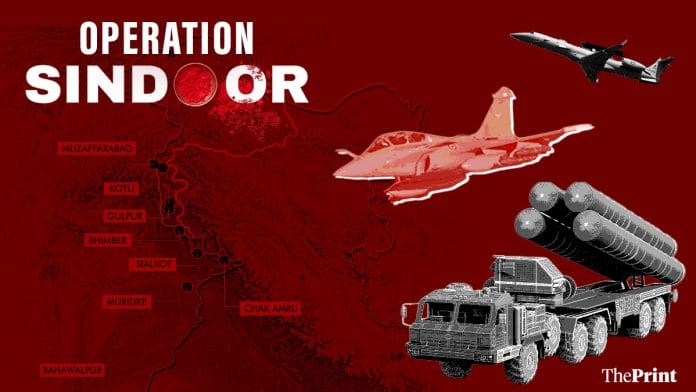



New Delhi: The Indian Air Force (IAF) established clear air superiority over large parts of Pakistan during Operation Sindoor, coercing Islamabad into requesting a ceasefire by 10 May 2025, according to a detailed study by a Swiss military think tank.
The report by the Switzerland-based Centre for Military History and Perspective Studies (CHPM) concludes that by the final phase of the 88-hour conflict, the IAF had the freedom to conduct long-range strikes at will, while the Pakistan Air Force (PAF) had lost its ability to mount effective counter-operations.
Authored by military historian Adrien Fontanellaz and translated by former French defence attache to India Benedict Smith, the study provides one of the most comprehensive foreign analyses of the India–Pakistan air conflict during Operation Sindoor.
The review committee for the research paper had Claude Meier, who is the chairman of the Centre d’Histoire et de Prospective Militaires (CHPM) in Pully, Switzerland. He is a retired Swiss Air Force Major General and was the Chief of Staff of the Swiss Armed forces from 2016 to 2020. Also part of the committee were Joseph Henrotin, a political scientist and strategist who specialises in defence; and Arthur Lusenti, a specialist in international affairs with a focus on security, defence and armament policy issues.
“Sufficient elements appear to indicate that, by the morning of 10 May 2025, the Indian Air Force had succeeded in achieving air superiority over a significant portion of Pakistan’s airspace. This in turn enabled it to continue long-range strikes against enemy infrastructure at will, at least for as long as it retained sufficient stocks of munitions such as BrahMos or SCALP-EG,” the report said.
The PAF, it added, “had lost the ability to repeat the operations it had conducted so successfully on 7 May 2025, owing to the loss of its forward air-surveillance radars and the threat posed by S-400 systems to its AWACS standoff weapons delivery platforms, while its own strikes conducted between 7 and 10 May 2025 had been largely thwarted by Indian defences”.
Initial clash & losses
The report confirms the IAF launched two strike packages on the night of 7 May, involving Rafale and Mirage 2000 aircraft, targeting the Jaish-e-Mohammed (JeM) headquarters complex in Bahawalpur and the Lashkar-e-Taiba (LeT) headquarters in Muridke
One formation reportedly penetrated Pakistani airspace at low altitude before executing a pop-up attack—deliberately exposing itself to interception. Pakistan responded by scrambling over 30 fighters and firing PL-15 long-range air-to-air missiles, prioritising Rafales.
While Islamabad claimed the destruction of six Indian aircraft, the Swiss study puts visible losses of at least one Rafale (serial number BS001), one Mirage 2000, and one additional fighter which could either be a MiG 29 or a Su-30 MKI while noting that several IAF pilots successfully evaded incoming missiles.
Chief of Defence Staff General Anil Chauhan had in an interview with Bloomberg in Singapore last year termed “absolutely incorrect” Pakistan’s claims that six Indian aircraft were downed during Operation Sindoor. “What is important is that, not the jet being down, but why they were being down,” he had said, adding, “Numbers are not important.”
Pakistani response
The report said that Pakistani ground-based radar and electronic listening stations, supported by an Erieye airborne early warning and control (AEW&C) system, detected the approach of the IAF strike and diversion formations shortly after midnight.
Repeating what the PAF has said, the report said that over the following 20 minutes, Pakistan identified eight distinct groups of six to eight aircraft each, concentrated along four main axes, totalling 60 aircraft, including 14 Rafales, soon reinforced by a further dozen combat aircraft.
The PAF, which initially ran three combat air patrols (two of four and one of two aircraft), scrambled 32 additional fighters (F-16s, JF-17s, and J-10Cs) on quick reaction alert, most of which concentrated in the east of Pakistan’s airspace, from Lahore to east of Islamabad.
Once the Indian formations released its air-to-ground ordnance, the PAF chief immediately instructed pilots operating over the eastern sector to engage the Indian aircraft, aiming to shoot down as many as possible while minimising their own exposure to return fire, the report said.
Several J-10C and JF-17 fighters fired at least one salvo of PL-15 long-range air-to-air missiles, while an HQ-9 or HQ-16 surface-to-air missile (SAM) battery also engaged Indian fighters, it said adding that the Pakistani forces concentrated their fire on the Rafale, designated as a priority target due to their symbolic value.
Subsequently, Islamabad claimed the destruction of six Indian aircraft over a one-hour long sequence, including three Rafale, one Su-30MKI, one MiG-29UPG and a large drone, all shot down inside Indian airspace at ranges reported between 13 and 98 km from the border, or the Line of Control (LoC).
“The subsequent circulation of images of wreckage fragments on social media and in Indian and Pakistani media, however, confirmed the loss of at least one Rafale, one Mirage 2000 and either one MiG-29UPG or one Su-30MKI.
“The discovery of multiple PL-15 missile casings on Indian territory indicates that other IAF pilots successfully decoyed or evaded some of the missiles fired against them,” the report said.
Also Read: Op Sindoor is India’s first AI-enabled operation. How ‘heavy use’ of modern tech by Army played out
Pakistan’s operation that failed
The report said that as early as the morning of 7 May, Pakistani artillery targeted Indian Army positions along the LoC, to which their Indian counterparts immediately responded.
Later on at night, the PAF launched a massive attack involving over 300 drones and JF-17s firing multiple CM-400AKG missiles. The Chinese anti-ship missile homes in on radiation and was meant to take out Indian air defences, a task that Pakistan failed.
The drones targeted Indian Army forward posts, brigade, division, and corps headquarters, logistics centres and air stations, but they were also intended to prompt Indian air-defence systems to activate, thereby making them detectable to Pakistani electronic intelligence (ELINT) assets.
“Songar drones, capable of delivering small offensive payloads, and much more sophisticated, Turkish-designed Yihaa-III suicide drones, operated within or behind decoy drone formations to allow rapid engagement of any targets unveiled as they engaged the decoys.
“In parallel with these kinetic actions, the PAF also conducted a series of cyberattacks against both military and civilian targets,” the think tank report said detailing the how and why the Pakistanis were operating the drones.
It noted that the manoeuvre did not catch the Indians off guard and over the four days of the conflict, anti-aircraft guns destroyed more than half the Pakistani drones, with jamming and spoofing systems playing a major role.
“Crucially, the integration of the Air Force’s IACCCS and the Army’s Akashteer network allowed the Indians forces to fuse data collected by optical and electromagnetic sensors operated by both services, by the few radars kept active, and by numerous reports from civilians.
“The resulting air picture proved sufficient to coordinate the engagement of air-defence systems, and, importantly, to trigger them only when targets were well within their firing envelope. This approach allowed the radars controlling missile batteries to be activated only for very short periods, making it extremely difficult for enemy operators to triangulate their positions.
“As a result, the Pakistanis failed to accurately map the Indian electronic order of battle following this initial strike,” the report said.
During the night of 8-9 May, Pakistani forces repeated the manoeuvre, targeting key Indian positions located 100 to 150 km from the border and the LoC, including air stations such as Adampur and Srinagar.
The S-400 batteries, deployed close to the air stations, were considered particularly high-priority targets. Indian Army positions were also engaged.
This second wave involved the launch of approximately 600 drones, once again combining low-cost devices intended to draw enemy fire with more sophisticated attack models, aiming to saturate Indian defences.
In addition to Yihaa III drones, the PAF deployed Bayraktar TB2s and Akinci drones operating at higher altitude to engage targets with guided munitions, while the Pakistan Army fired several salvos of long-range Fatah I and II artillery rockets, as well as short-range Hatf II ballistic missiles.
PAF combat aircraft also operated on the periphery of the Indian air-defence bubble, waiting for opportunities to fire air-to-ground ordnance at enemy targets.
However, the Pakistani effort again failed to saturate Indian defences or reach critical enemy centres. Most incoming munitions were intercepted, while Indian SAM battery positions couldn’t be triangulated. Those were relocated whenever they risked detection, the report said.
Then, on 9 May at 20:00, the Pakistanis launched a third wave of attacks, which continued until 01:30 a.m. on 10 May.
This wave was even larger than the previous ones and focused exclusively on air stations and nearby S-400 batteries, with Adampur, Srinagar, and Kutch being particularly targeted.
In addition to drones and artillery rockets, air power was used much more intensively, including F-16s and JF-17s, tasked with delivering medium- and long-range air-to-ground munitions.
The PAF claimed to have achieved a major success that night by neutralising Indian air-defence systems through cyberattacks and electronic jamming.
In particular, a JF-17, protected by intensive electronic jamming and extensive use of decoys, is said to have penetrated the firing envelope of the S-400 battery at Adampur before launching two CM-400AKG missiles at it, as claimed by PAF. But there was no damage to the S-400 battery. The report, which goes by its method of verification of losses, does not take into account Pakistan’s claims of damage to the S-400 battery.
The Indian retaliation
The report said that the first wave of Pakistani attacks on the night of 7–8 May 2025 resulted in a second stage of Indian escalation, planned during the preparatory phase of Operation Sindoor.
On 8 May, the IAF launched its own campaign of air interdiction and air strikes against Pakistan air-defences. This operation, focused on border surveillance radars and long-range SAM batteries, carried on until the evening of 9 May.
It was relatively discreet, with the Indians employing Israeli-origin Harop and Harpy loitering munitions. Eight air-defence sites were struck on 8 May, and a further four the following day, resulting in the visually documented neutralisation of at least two early-warning radars at Chunian and Pasrur.
The IAF claimed to have struck at least one HQ-9 battery, although the Pakistani side stated that their air-defence systems had shot down 25 drones on the morning of 9 May.
Notably, one of the IAF’s S-400 batteries reportedly surprised the PAF, likely by lying in ambush near the border, and engaged an Erieye or electronic warfare aircraft orbiting well beyond. The IAF claimed to have destroyed the enemy aircraft at a range close to 300 km.
The cumulative effect of these operations was a drastic reduction in both the extent and quality of Pakistani airspace coverage, as several radars that remained intact ceased emissions to avoid attracting enemy strikes, thereby facilitating the potential penetration of a further escalation stage by India.
The Indians detected preparations for the Pakistani attack scheduled on the evening of 9 May and opted for a quasi-immediate counterstrike, the report said.
As soon as the Pakistani action concluded, between 02:00 and 05:00 on 10 May, the IAF conducted a series of strikes using BrahMos, SCALP-EG and Rampage missiles launched from within Indian airspace by Su-30MKIs, Jaguars and Rafales.
The missiles struck seven sites up to 200 km inside Pakistani territory, including one SAM battery and five air bases.
After having detected preparations for a PAF counterstrike, the IAF launched a second wave of attacks at 10:00 on 10 May, which employed the same munitions and the same tactics, but this time extending their targeting to manned aircraft, whereas the previous night’s strikes mostly been restricted to drones and their support infrastructure.
In central Pakistan, Sargodha Air Base, home to multiple combat squadrons, was rendered inoperative by several missile impacts at the intersection of its runways. Indian strikes were even more destructive in the south. At Jacobabad Air Base, an F-16 maintenance hangar suffered a direct hit, while a radar was damaged or destroyed, along with electrical and cooling facilities.
At Bholari Air Base, another hangar housing one or more Erieye aircraft was severely damaged.
In total, the IAF assessed that at least four or five F-16s, one Erieye, one C-130 transport aircraft, several MALE (Medium Altitude Long Endurance) drones, two radars, two command-and-control centres and one SAM battery were destroyed on the ground, at the cost of roughly 50 long-range munitions.
The PAF, however, reported that the Erieye hit at Bholari was only lightly damaged and was quickly repaired though five personnel were killed in the strike, the report said.
Nevertheless, by noon on 10 May, Pakistani military authorities requested a ceasefire from their Indian counterparts, it said.
This was quickly accepted, as the political objectives assigned to the military, namely to conduct spectacular retaliatory strikes to deter JeM and Lashkar-e-Taiba (LeT) while countering the Pakistan military’s response, had been achieved.
New Delhi thus claimed to have brought the conflict to a close, whereas other powers repeatedly got bogged down in the conflicts they initiated, it said.
Also Read: Op Sindoor: Inside story of what led Pakistan DGMO to make frantic calls for ‘ceasefire’
Claims & counter-claims
Nevertheless, and for both sides, claims resulting from the long-range engagement of their SAM batteries or fighter aircraft appear primarily to stem from information collected during the encounters by their radars and electronic warfare and electronic intelligence assets, the report said.
It added that while this method may at first sight seem entirely reliable, as it is based on technical and objective data, the reality is more complex.
The sudden disappearance of a targeted aircraft from radar screens may have causes other than its destruction, such as abrupt evasive manoeuvres, particularly in mountainous terrain, or the effective employment of electronic countermeasures, it added.
The initial setback
The think tank said that although obtaining even a rough picture of the 7 May 2025 air engagement will remain impossible until the IAF provides its own account of the encounter, it seems clear that this has been one of the largest confrontations in decades, and that the “IAF suffered a serious setback on that night”.
“The loss of at least one Rafale provided the adversary with a key element to support its public relations line of operation, while the Indian narrative, which highlighted the success of the air strikes against JeM and LeT camps, which was the core objective of Operation Sindoor, remained comparatively inaudible to international media,” it said.
The root cause of the Indian setback appears to be multifactorial, the Swiss think tank said, adding that the first reason according to it was that the Pakistanis were likely not surprised by the Indian operation, which was very similar in design, albeit more ambitious to Operation Bandar in 2019.
Second, the Indians appear to have assumed that the Pakistanis would continue adhering to their established practice of refraining from firing at aircraft outside Pakistani airspace. Indian pilots were therefore likely taken by surprise by long-range Pakistani fire while some were operating tens of kilometres from the border or the LoC, it said.
“Third, on a more tactical level, some Pakistani fighters may have succeeded in remaining covert by switching off their electromagnetic emissions and by flying at low altitude in order to conceal behind the mountainous terrain, despite at least one IAF AEW&C platform supporting the attack.
“Furthermore, as in 2019, the Pakistanis did their best to disrupt adversary communications,” it added.
Fourth, Indian intelligence reportedly underestimated the threat posed by the PL-15 missile, assuming that the PAF possessed an export variant with a maximum range of 150 km, well short of the 200 km at which some missiles were actually fired, surprising Indian pilots, the report said.
Finally, the PAF is believed to have used its Link 17 data link, capable of integrating Western and Chinese technologies, to conduct cooperative engagements.
“If this was the case, JF-17 and J-10C fighters may have had the option to keep their radars off and to fire PL-15 missiles with active radar guidance using targeting data transmitted by the Erieye, which was orbiting well to the rear of the formation.
“The Erieye would then have relayed the mid-course targeting data updates to the missiles either through the fighter fire control system or directly to the missiles, enabling them to perform the necessary trajectory corrections towards their targets several tens of kilometres away.
“Only in the final phase of flight would the missiles’ own radar seekers activate to guide them onto their assigned targets, thus leaving the pilots only a few seconds to react, as their onboard threat detection systems would not have considered the distant emissions from the Erieye as an imminent threat,” the report said.
ThePrint had reported about this tactic used by Pakistan on 24 July last year.
(Edited by Tony Rai)