





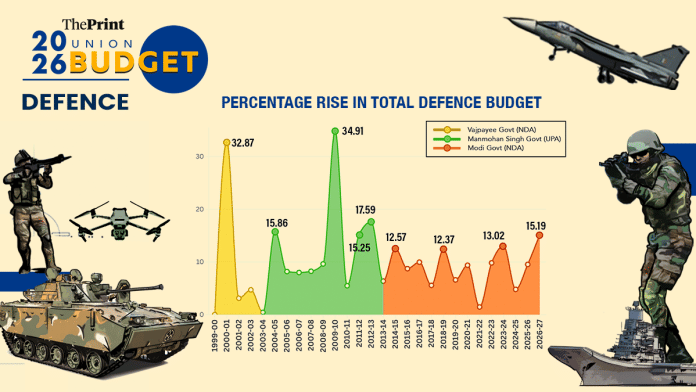



New Delhi: The Union Budget 2026-27 announced Sunday has seen a significant increase of 21.8 percent in the capital outlay for the armed forces, and a 15 percent hike in the overall defence budget.
Capital outlay is the amount that the services have to undertake the modernisation process, and procure the required equipment, like new fighter aircraft, ships, submarines, and armoured vehicles, among others.
Capital expenditure this time accounts for 27.95 percent of the entire budget, which under Narendra Modi’s tenure as Prime Minister is the third largest budget for procurement as a share of the defence budget.
A glance at every budget between 1999 and 2026 shows, however, that the capex as a total share of the defence budget was consistently the highest under the two United Progressive Alliance (UPA) governments led by former prime minister Manmohan Singh between 2004 and 2014.
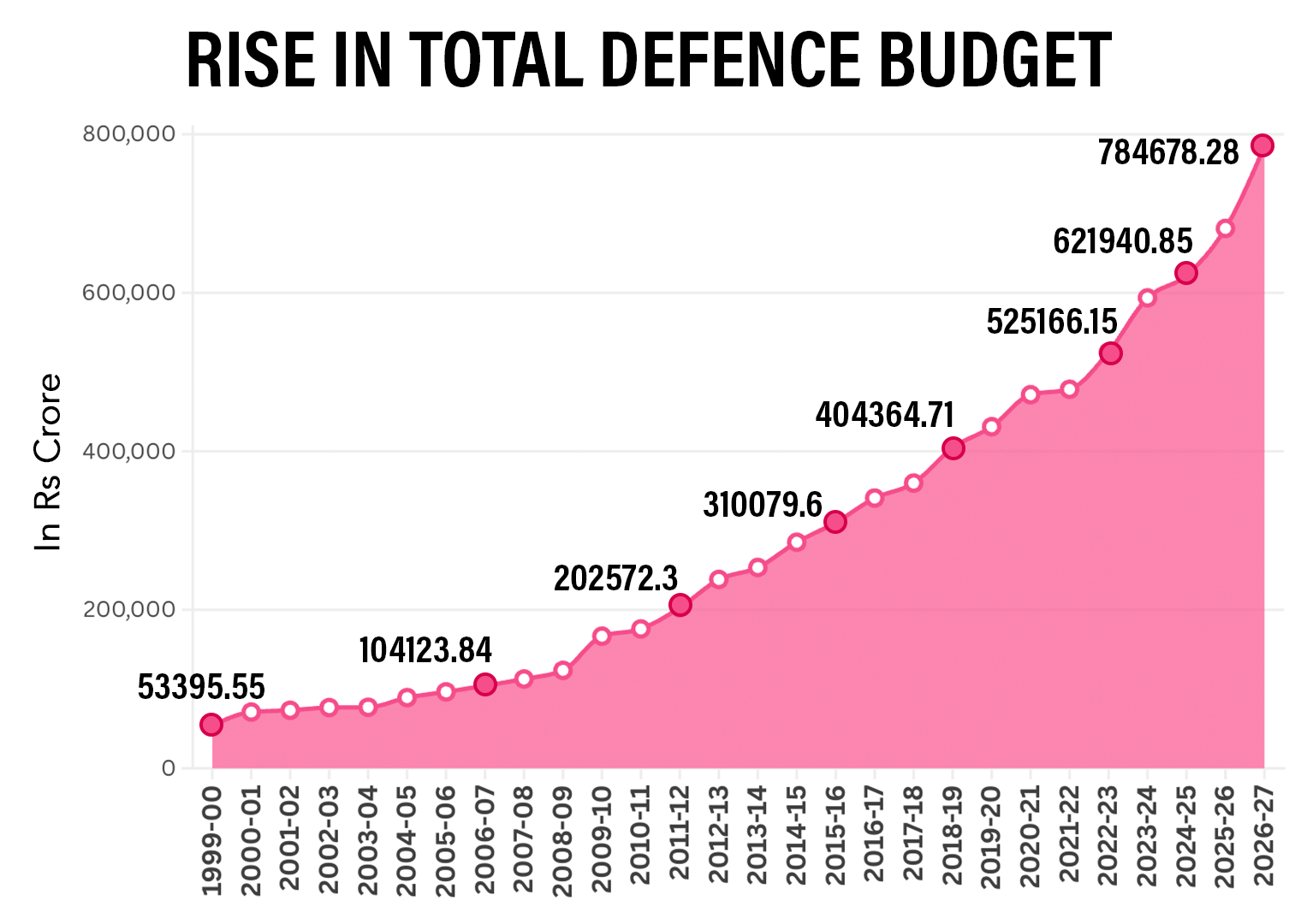
In the last 28 budgets analysed by ThePrint, the UPA governments consistently estimated around 35 percent of its defence budget for capital expenditure. In absolute terms, the 10 years of UPA rule saw a 213 percent surge in defence spending from Rs 89,136 crore allocated in its first budget in 2004-05 to Rs 2,79,202.87 crore in the last budget presented in 2014-15, which was an interim budget on the account of elections held later that year.
Considering the various budgets announced by the Modi government, starting 2014-15 to the latest one, the percentage change in absolute value is around 175 percent—from Rs 2,85,202.87 crore to Rs 7,84,678.28 crore in 2026-27 Union Budget.
The defence budget over the years has seen the capital outlay ebb and flow according to the needs of the Indian military at the time, with larger jumps in outlays in the years after conflicts, or changes in the security scenario.
The 2000-01 defence budget was 32.87 percent higher than the previous year, following the Kargil war. Similarly, the 2009-10 defence budget saw a 34.91 percent increase from previous year, after the 26/11 Mumbai terror attacks that had left 166 people dead, including nine terrorists.
The current budget, similarly, sees a 15.19 percent increase from last year, in the wake of the Pahalgam terror attack and the subsequent Operation Sindoor, conducted in May 2025 against terror complexes across Pakistan.
The 2026-27 Union Budget also arrests the decline of defence expenditure as a portion of the overall gross domestic product of India. The budget estimate for the year is roughly 1.99 percent of total GDP, close to the 2 percent threshold—a known global standard, especially since the North Atlantic Treaty Organisation (NATO) set this marker for its member-states almost a decade ago.
The 2025-26 budget estimate of Rs 6.81 lakh crore was roughly 1.9 percent of India’s total GDP. For 2023-24, defence expenditure as a percentage of GDP fell marginally below the 2 percent threshold, according to an analysis published by PRS Legislative Research.
Defence expenditure as a percentage of GDP in the 2022-2023 budget stood at roughly 2 percent. In the 2012-2013 budget, it accounted for roughly 2.3 percent of GDP, according to PRS Legislative Research, which further indicates the decline of defence expenditure over the years.
Capital outlays since Vajpayee govt
Yashwant Sinha’s second budget as Union Minister of Finance in February 1999 had seen a budget estimate of Rs 53,395.55 crore. The capital outlay was estimated at Rs 12,229.68 crore, or roughly 22.9 percent of the total defence budget.
Later that summer, India and Pakistan fought the Kargil War between May and June. The then prime minister, Atal Bihari Vajpayee, called for elections later that year, post the fall of the National Democratic Alliance (NDA) coalition in Lok Sabha, and returned as PM for a third term.
Sinha’s third budget and the first in the new Vajpayee ministry in 2000-01 saw a 32.87 percent spike in the defence budget to Rs 70,947.79 crore. The budget was the first after the Kargil War, and the capital outlay grew to Rs 17,926.4 crore from Rs 12,229.68 crore in the budget before—a 46.58 percent increase.
The 2000-01 defence budget saw the biggest increase during Vajpayee’s third term. For the rest of his tenure, there were minimal increases—3.1 percent, 4.7 percent and 0.42 percent. Capex for these years stood at roughly 27 percent consistently.
Manmohan Singh government’s first budget for 2004-05 announced in July 2004 saw a 15.86 percent leap in total defence outlay. The budget for that year stood at Rs 89,136 crore, with capital outlay at Rs 33,482.85 crore, or 37.56 percent of the defence budget.
Under Singh, the defence capex stayed above 30 percent during his 10 years at the helm. The lowest figure was in the 2009-10 budget, with capital expenditure accounting for 32.9 percent of overall defence budget of Rs 1,66,663 crore.
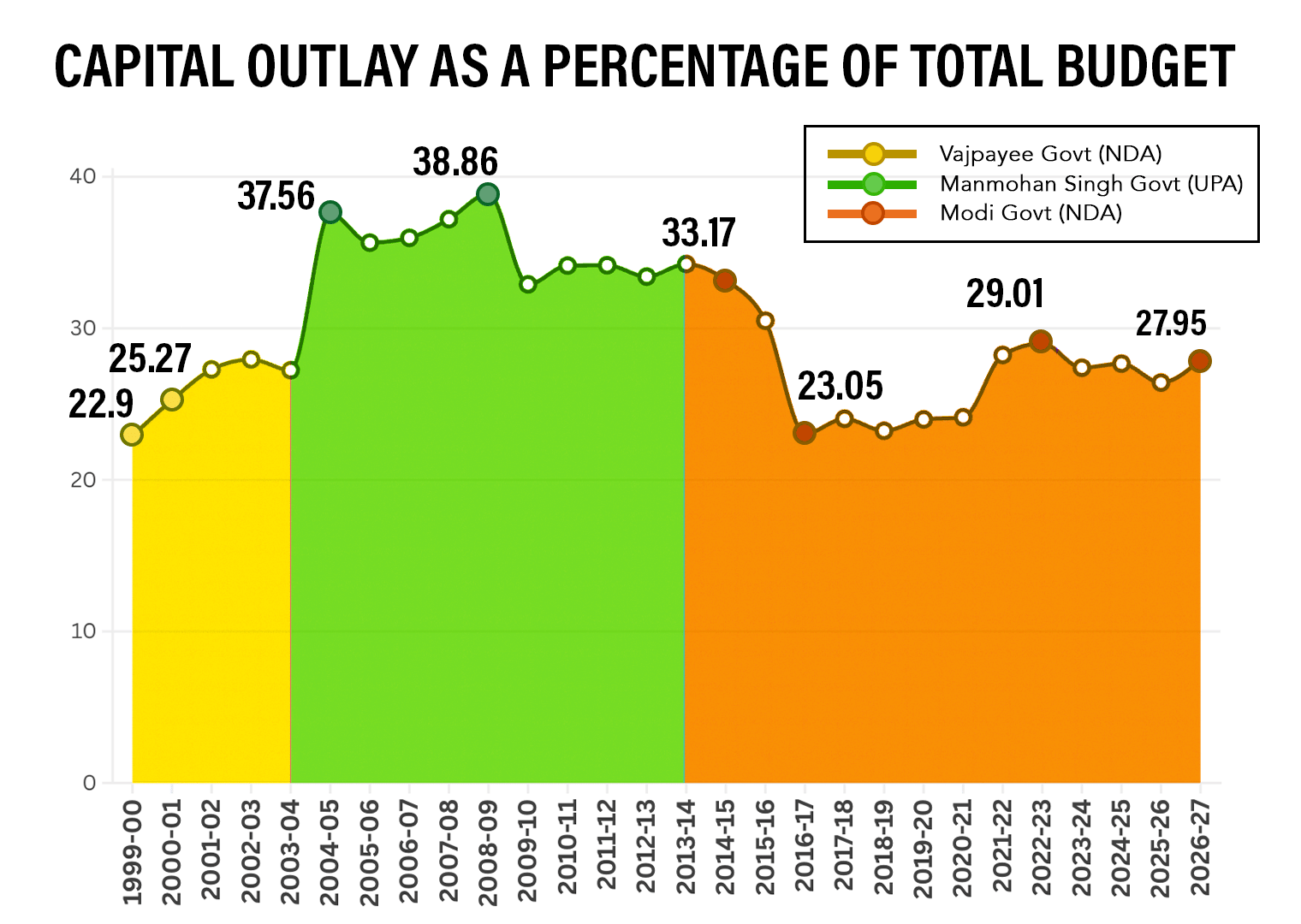
PM Modi stormed to power in 2014-2015, and his first budget closely mirrored the interim budget passed by UPA II earlier in the year, with defence expenditure estimated at Rs 2,85,202.87. Capital expenditure in Modi’s first budget stood at Rs 94,587.95 crore, about 33.17 percent of overall estimated defence expenditure.
The next year, capital expenditure fell to roughly 30 percent of total defence budget, and has since remained below this mark.
Growth in pensions outlay
At the end of 2015, the Modi government notified the One Rank, One Pension (OROP) scheme for ex-servicemen, which accounted for growth in pension expenditure in the budget year of 2016-17.
The 2015-16 Union Budget estimated Rs 54,500 crore for pensions, which grew to Rs 82,332.66 crore in 2016-17. In the 2016-2017 expenditure profile showing ministry-wise spending, pensions along with civil expenses accounted for an outlay of 1,18,465.84 crore.
The overall expenditure estimated for defence stood at Rs 3,40,921.98 crore in the 2016-17 Union Budget, with capital expenditure falling to a low of 23.05 percent of the total budget. Rs 78,586.68 crore was set aside for procurement of new defence equipment that year.
The next year saw the pension bill grow to Rs 85,740 crore, before crossing Rs 1 lakh crore in the 2018-19 budget. For 2026-27, the Union government has estimated Rs 1,71,338.22 crore for pensions for ex-servicemen.
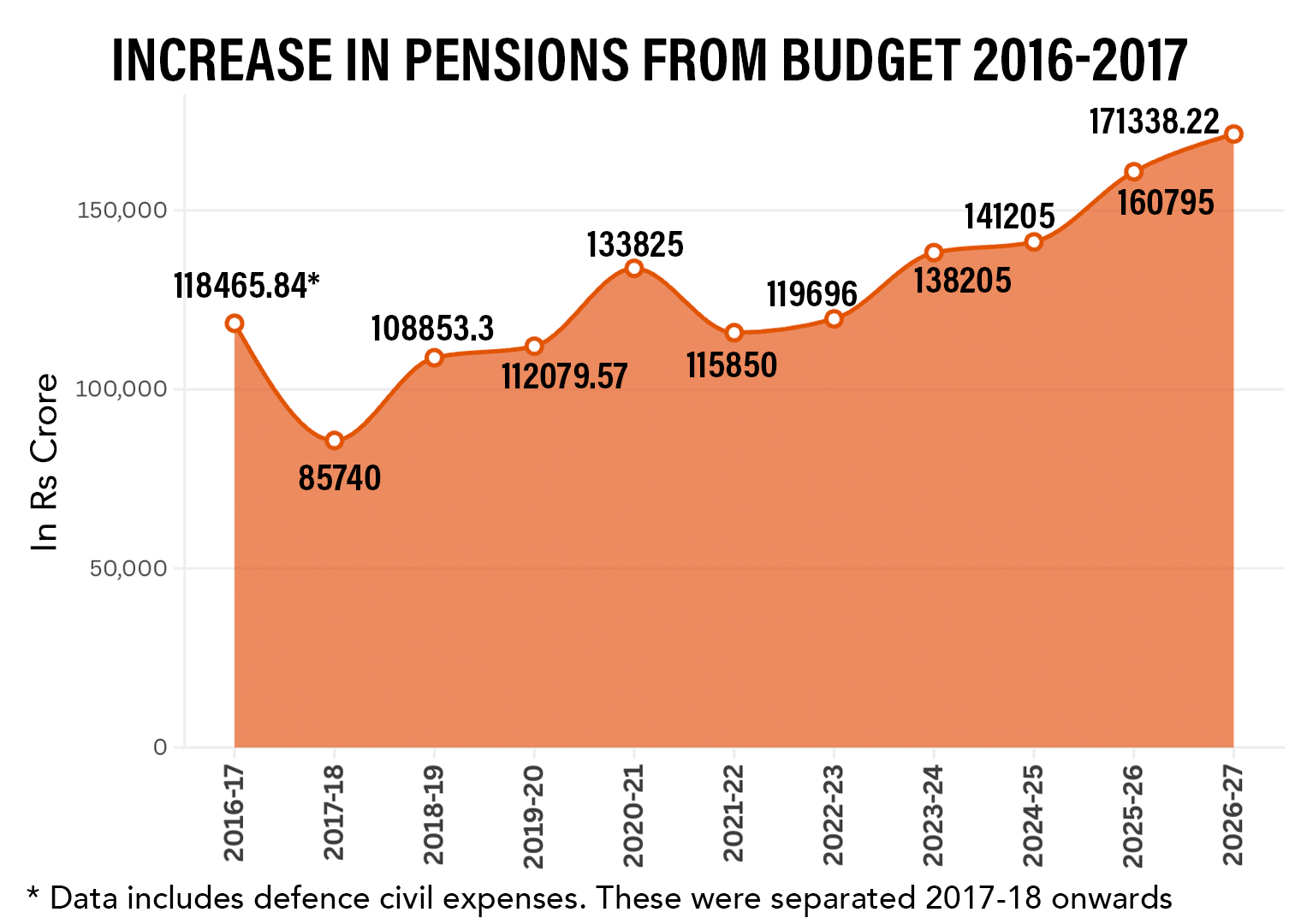
In the 1999-00 Union Budget presented in Vajpayee’s second term, the outlay for pensions was Rs 7,348.65 crore. Manmohan Singh’s first budget in 2004-05 had estimated Rs 11,250 crore as expenditure for this purpose, while the last full budget of UPA II in 2013-14 had set aside an estimated Rs 44,500 crore.
From Rs 7,348.65 crore in the 1999-00 budget, the outlay for pensions has grown to Rs 1,71,338.22 crore for the 2026-27 financial year, marking a significant jump in outlay, without taking into account the relative values of the Indian rupee between the years.
(Edited by Mannat Chugh)
Also Read: More boots, bigger budget: Agnipath outlay jumps 58%, Army’s share the largest