








New Delhi: The Central Industrial Security Force (CISF) is all set to take over the security of all sea ports where export and import activities take place in the country, in addition to the dozen major ports already secured by the force, the force’s chief, Praveer Ranjan, said Monday.
Additionally, he said the government has asked CISF to raise a dedicated vertical for port security, for which the force would require an additional 12,000 personnel. “The proposal for recruitment and their training with respect to specific requirements for security of ports has been approved by the government, and we are working on preparing an action plan,” he said.
“The system for port security will be at par with the security arrangements and protocols in place at airports. There will be an increased emphasis on training of personnel before their deployment at ports, for which a dedicated port security vertical is being considered at the maritime institute in Gujarat’s Okha port,” Ranjan said Monday at a press conference.
CISF is currently providing security at 12 major seaports, including those in Mumbai, Chennai, and Visakhapatnam. Officials of the CISF said there are more than 200 non-major ports in the country, of which 78 are currently handling export and import activities. So far the state police was guarding most of these ports.
The development comes in the backdrop of the Union Home Minister Amit Shah chairing a meeting to constitute a dedicated body for the security of vessels and port facilities in the country.
Called the Bureau of Port Security (BoPS), it has been envisaged as a statutory body on the lines of the Bureau of Civil Aviation Security (BCAS) that regulates policies related to the security of airports as well as airlines and passengers, along with training of staff and audits of arrangements to ensure global standards.
The CISF chief was addressing the media at the curtain raiser for the second edition of the Vande Mataram Coastal Cyclothon, the force’s initiative aimed at strengthening coastal security awareness, national unity, and community participation along India’s coastal belt.
The security apparatus at entry points from sea into India has long been flagged as a major security vacuum. The arms and ammunition for the 1993 serial blasts in Mumbai, such as RDX and AK-56 rifles, were smuggled into Maharashtra by the terrorists, such as Dawood Ibrahim, Tiger Memon, and their associates from Pakistan through the coast in Raigad district.
Decades later, 10 terrorists belonging to the Lashkar-e-Taiba (LeT) entered Mumbai through the sea route for the 26/11 Mumbai attacks in 2008, on a hijacked sea boat and killed 166 people.
6-point submission & adoption of hybrid model
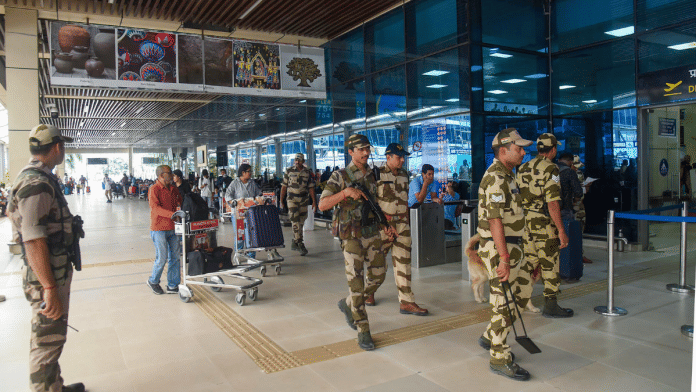
Ranjan further said that the CISF’s security arrangements have evolved into a hybrid model, with the force dividing its airport operations into core and non-core functions.
There are around 15 core functions performed by the force, such as screening, access control, perimeter security, and the Quick Response Team—all of which have wider security implications, CISF officials said. On the other hand, non-core functions such as managing queues and assisting passengers during check-in have been outsourced to private agencies, after their staff were trained, they further said.
“This hybrid model has been adopted after the exercise with the BCAS, and similarly, the government has accepted CISF’s proposal of providing security to ports, in the hybrid model, in which the private agencies or state police will be handed the responsibility of non-core functions,” Ranjan said.
“The Government of India has adopted the hybrid security model as a large number of personnel are required to fulfil security necessities, which can not be fulfilled immediately. Empowering the state agencies or private agencies eases the burden of the force from the requirements of a large number of personnel,” he added.
Further discussing the arrangements for the security of ports and the additional director general rank office, Sudhir Kumar said that a committee he headed submitted a six-point set of findings and recommendations to the government.
“The committee has asked for the CISF to be identified as the Recognised Security Organisation (RSO) which carries out security assessment and security planning of each port. These functions were earlier carried out by private agencies. Now the CISF will carry out these exercises, and the central government has accepted the recommendations for the standard of security protocols across all ports specific to different types of ports, such as major and non-major ones, on the lines of airports, which were found lacking during inspection by the committee,” ADG Kumar said at the press conference.
Kumar further said that the committee headed by him also recommended the implementation of a drive-through container scanning system across all 78 exim ports to ensure a seamless movement of goods. The entire movement of containers at these ports should be monitored through an Integrated Command and Control Centre (ICCC), as is the case across airports, he added.
Among other recommendations and findings of the committee, Kumar said that inadequate training of personnel deployed by private security agencies was also identified, and that the CISF has accepted recommendations on the mode and methods of their training.
(Edited by Viny Mishra)
Also read: Finding jobs for Agniveers: CISF forms committee to assess ways to induct them into force