





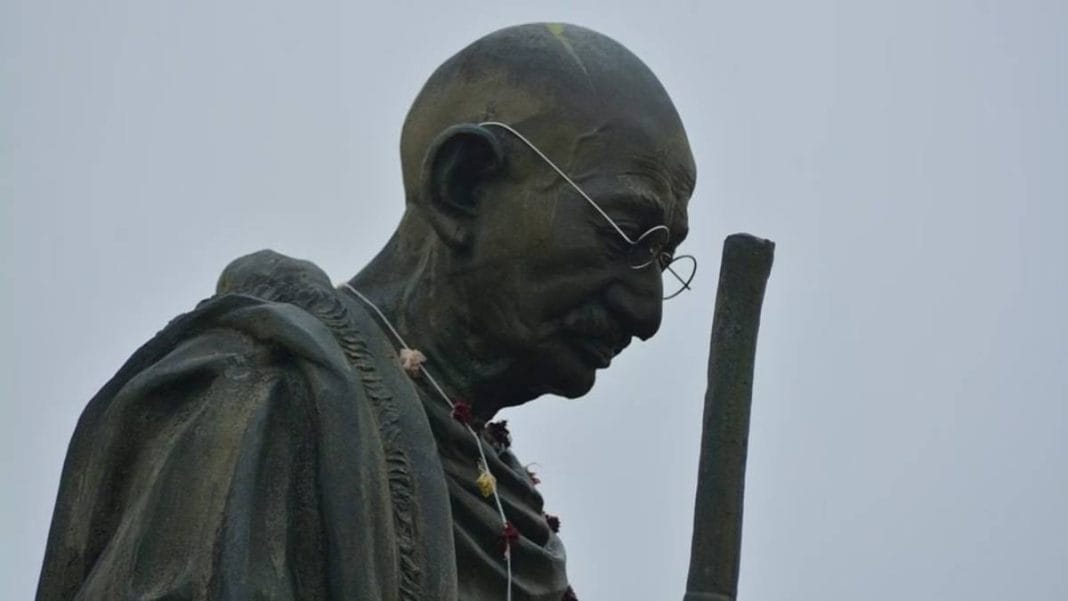



It was March 1930, when Mohandas Karamchand Gandhi decided to launch his famous Salt March to Dandi. The criminalisation of the independent collection, manufacture and sale of salt by Indians under 1882 British Salt Act had prompted Gandhi to pick up the issue. He was largely successful in rallying people behind him for the common cause.
Today, 96 years later, there still exists a common issue that demands similar kind of unity from millions of Indians. It’s the issue of ‘dignity’ that has become a rare commodity for the majority of the inhabitants of this country. But surprisingly, there is no Gandhi today to mobilise people around the issue.
M.K. Gandhi is one figure in India’s history who can be appropriated by followers across the political spectrum. In contemporary India, we are witnessing a similar appropriation of Gandhi’s ideas by the Hindu Right. The Hindu Right is typically associated with conservatism, the maintenance of hierarchy, and strict codes of conduct for women, which some scholars describe as Brahminical patriarchy.
On deeper analysis of Gandhi’s life, one can find many incidents and instances that may interest right-wing politics in India. For a long period after Independence, the right wing was hesitant to accept Gandhi, but the tide has turned since the summer of 2014.
Let us analyse the latest debate around UGC (University Grants Commission) equity guidelines. It has been argued by certain sections of societies that these guidelines will result in the fragmentation of Hindu society. It has also been argued that consensus should be given priority instead of rigid rules, and that change should come from within for societal transformation.
Now compare this with what Gandhi thought when separate electorates were awarded to the Scheduled Castes through the MacDonald Award of 1932. He had opposed the award, arguing that it would permanently break Hindu society.
For the emancipation of the depressed castes, he believed in the idea of Hriday Parivartan—the belief that an opponent can be transformed through love, patience and self-suffering, rather than being defeated or coerced. Gandhi believed that through these methods the hearts of members of dominant castes would change, and they would begin to provide equal treatment to the oppressed. This emphasis on moral transformation, along with a strong concern for Hindu unity, can also be found in the thought of the Hindu Right.
On the contrary, B.R. Ambedkar believed that the depressed castes could not wait for the hearts of the dominant sections to melt and that equality could only be instituted through laws. He was also an ardent critic of the Varna system. Gandhi, meanwhile, believed in Varnashram Dharma, which according to him had degenerated into the present caste system over the years. All these are common arguments that can also be found in the discourse of the right wing in India.
The politics of the Hindu Right revolves heavily around Muslims in India. For a considerable period, they portrayed Gandhi as “pro-Muslim” in their discourse and narratives. However, on a closer reading, they can also find elements in Gandhi’s thought that come to their rescue on this front.
“There is no doubt in my mind that in the majority of quarrels the Hindus come out second best. My own experience but confirms the opinion that the Musalman as a rule is a bully, and the Hindu as rule is a coward. I have noticed this in railways trains, on public roads, and in the quarrels which I have had the privilege of setting. Need the Hindu blame the Musalman for his cowardice? Quarrels must break out so long as the Hindus continue to be seized with fear. Bullies are always to be found where there are cowards. The Hindus must understand no one can afford them protection if they go on hugging fear.”
This statement by Gandhi bears significant similarity to the language often used by the right wing to incite passion among fellow Hindus. Kutumb Prabodhan (family awakening) and Nagrik Kartavya (duties of citizens) find an important place in the Panch Parivartan programme of the Rashtriya Swayamsevak Sangh (RSS).
The Hindu Right can find consonance with Gandhi even in this regard. “So long as the parents of the middle-class Hindus, themselves timid, continue to transmit their timidity by keeping their grown-up children in cotton wool, so long will there be the desire to shun danger and run no risks. They will have to dare to leave their children alone. Let them run risks and even at times get killed in so doing.”
Apart from this, the Hindu symbolism that Gandhi carried through his bhajans and his engagement with the Bhagavad Gita also appears to have a certain closeness with the Hindu Right.
Perry Anderson, in his book The Indian Ideology (2012), described Mahatma Gandhi as a conservative and criticised him for infusing religion into politics. Gandhi’s insistence on Hindi (or Hindustani) as the national language also appears to align with the agenda of the Sangh Parivar.
Therefore, at a time when the older Gandhi has already been appropriated by the current political dispensation, the question arises: How will a new Gandhi emerge with a new vocabulary to address the question of “dignity”?
Prathmesh Mani Tiwari is a Doctoral Candidate, Centre for Political Studies, Jawaharlal Nehru University. Views are personal.
Also Read: One state’s freebie can be another state’s welfare
Nicely articulated and thought provoking.
Behuda article .has no sense at all