




Pune: Stressing that research and innovation are the driving forces behind India’s industrial and economic progress, Harshwardhan Patil, Chancellor of Pimpri Chinchwad University (PCU), announced that the university is being developed as a startup-focused institution, creating an ecosystem that transforms research into impactful entrepreneurial ventures.
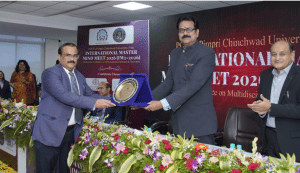
Patil was addressing the inaugural session of the International Mastermind Meet (IM3) 2026, held at PCU, Sathe, Vadgaon Maval, under the aegis of Pimpri Chinchwad Education Trust (PCET). The conference aims to accelerate the vision of Viksit Bharat 2047 through research, innovation, and global collaboration.
Outlining PCU’s roadmap, Patil said the university will intensify research in green energy, climate change, sustainable agriculture, artificial intelligence, and global partnerships, converting emerging challenges into opportunities while strengthening the startup ecosystem. He also emphasized the importance of India–Japan collaboration in advancing innovation and supporting the vision of a developed India by 2047.
The inaugural ceremony was attended by Vice Chancellor Dr. Santosh Sonawane, Director of Research & Development Dr. Bharat Kale, Director General of Science & Technology Park Dr. Rajendra Jagdale, Dr. Ashok Joshi, Founder of Microlin (USA), Prof. Ajayan Vinu of the University of Newcastle, Australia, Dr. Kaustubh Dalal of Mid Sweden University, Prof. Vijay Mohanan Pillai, Director of CECRI, Prof. P. S. Anil Kumar and Dr. Sachin Rondiya from the Indian Institute of Science, Bengaluru, Dr. Richard Lobo, Global Head – Innovation, Tata Chemicals, Dr. Krishnanjan Bhattacharya of C-DAC, Dr. Vilas Kharche of Mahatma Phule Krishi Vidyapeeth, Dr. Phulufhelo Nemangwe of the University of Venda, South Africa, along with leading scientists, researchers, academicians, industry leaders, and policymakers from India and abroad. An Abstract Souvenir was also released.
Welcoming the delegates, Dr. Santosh Sonawane highlighted PCU’s robust research, innovation, and entrepreneurship ecosystem and encouraged students and researchers to pursue socially relevant, impact-driven research.
In his keynote address, Prof. Ajayan Vinu spoke on carbon emissions, green energy, hydrogen fuel, clean energy technologies, and advanced nanomaterials. During the technical sessions, Dr. Ashok Joshi emphasized that innovation transforms knowledge into economic value, while Prof. Vijay Mohanan Pillai discussed advances in energy storage, two-dimensional materials, electrocatalysis, lithium-ion batteries, battery recycling, and clean energy technologies.
The conference also featured expert presentations by internationally acclaimed researchers. Prof. Ajayan Vinu presented research on advanced porous carbon materials, hydrogen production, carbon dioxide capture, and sustainable energy solutions. Prof. P. S. Anil Kumar explained AI-assisted quantum materials engineering and the role of machine learning in developing next-generation electronic materials. Dr. Richard Lobo spoke on Responsible AI, emerging research trends, and technological transformations expected by 2035, while Dr. Kaustubh Dalal discussed the economic impact of AI in healthcare.
Dr. Krishnanjan Bhattacharya addressed data corruption in large language models and strategies for improving AI reliability. Dr. Vilas Kharche highlighted AI-driven precision agriculture, climate-resilient farming, and smart agricultural technologies. Dr. Phulufhelo Nemangwe presented blockchain-enabled green energy systems and AI-based energy forecasting, while Dr. Sachin Rondiya shared insights into advanced semiconductor materials, photovoltaic technologies, and next-generation solar energy research.
The International Mastermind Meet (IM3) 2026 was organized under the guidance of Dnyaneshwar Landge, Chairman of PCET; Padmatai Bhosale, Vice Chairperson; Vitthal Kalbhor, Secretary; Shantaram Garade, Treasurer; industrialists Narendra Landge and Ajinkya Kalbhor; and Dr. Girish Desai, Executive Director of PCET.
ThePrint BrandIt content is a paid-for, sponsored article. Journalists of ThePrint are not involved in reporting or writing it.