




The first few days after a stroke are frightening for everyone involved. One side of the body has stopped listening. Speech may be slurred or gone. And the question that sits over every hospital bed is whether any of it will come back.
For most families, the answer is more hopeful than it feels in that moment. Movement often does return, in pieces, over months. But it rarely returns on its own. It returns through stroke paralysis rehabilitation, which is structured, repetitive, professionally guided work that helps the brain build new routes around the damage.
This article explains what that process involves, when it should start, and what to look for in a rehabilitation Centre.
What Is Stroke Paralysis?
A stroke happens when blood flow to part of the brain is blocked or when a vessel bleeds. Brain cells in that area are starved of oxygen and begin to die within minutes.
Because each side of the brain controls the opposite side of the body, damage usually causes weakness or paralysis on one side. Complete loss of movement on one side is called hemiplegia. Partial weakness is called hemiparesis, and it is more common.
Along with the weakness, people often experience stiffness or spasticity, loss of sensation, poor balance, difficulty swallowing, slurred or absent speech, and problems with memory and attention. Which of these appear depends entirely on where in the brain the stroke occurred and how large it was.
How Rehabilitation Helps Improve Mobility After Stroke
The brain is not fixed hardware. When one pathway is destroyed, healthy areas can gradually take over the job. This is called neuroplasticity, and it is the entire basis of stroke paralysis rehabilitation.
The catch is that neuroplasticity responds to demand. The brain rewires around movements it is asked to perform, repeatedly, with effort, and with correct form. A limb that is left alone does not recover. A limb that is worked daily under supervision often does.
This is why therapy looks the way it does. Hundreds of repetitions of the same reach. Standing up from a chair over and over. Weight shifting from one foot to the other until it stops feeling alien. It looks tedious from the outside, and it is exactly what drives change.
Rehabilitation also protects against the problems that quietly derail stroke recovery: shoulder subluxation on the weak side, contractures from unstretched muscles, pressure sores, chest infections, falls, and clots. Preventing these is half the work.
What Does Stroke Paralysis Rehabilitation Involve?
Proper stroke paralysis rehabilitation is a team effort, not a single therapist. A physiatrist, meaning a doctor specialising in physical medicine and rehabilitation, usually leads the plan and coordinates everyone else.
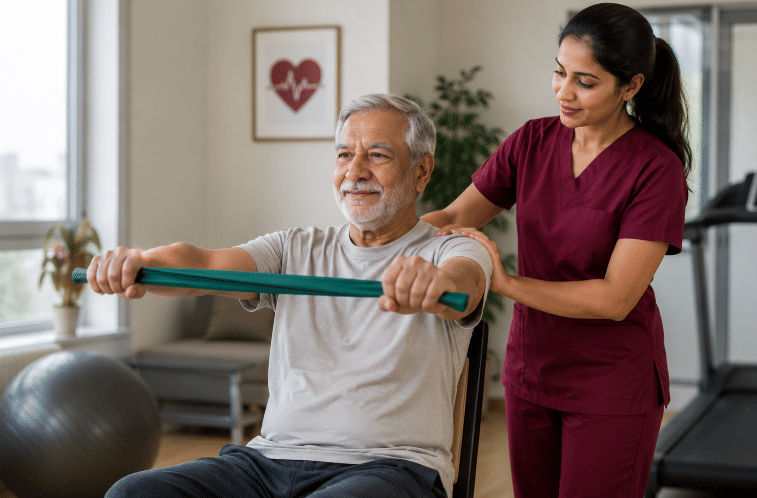
Physiotherapy rebuilds movement from the ground up. Early sessions focus on bed mobility, sitting balance, and preventing stiffness. Later work moves to standing tolerance, transfers, weight bearing through the weak leg, and gait training with parallel bars, walkers, or ankle foot orthoses. Typical stroke recovery exercises include sit to stand repetitions, bridging, step ups, heel raises, and supported side stepping.
Occupational therapy targets the arm and hand, and the practical business of daily life. Therapists work on reaching, grasping, releasing, and fine motor control, then apply it to dressing, eating, bathing, and grooming, often with adapted tools.
Speech and language therapy addresses aphasia, slurred speech, and swallowing difficulty. Swallowing assessment matters more than most families realise, because unsafe swallowing leads directly to pneumonia.
Nutrition therapy supports the whole effort. Rehabilitation is physically demanding, and recovery stalls without adequate protein, hydration, and calories. Diet also has to manage the blood pressure, diabetes, and cholesterol issues that caused the stroke in the first place.
Nursing care runs underneath all of it. Turning schedules, skin checks, catheter and bowel management, medication timing, and vital sign monitoring are what keep a patient well enough to attend therapy.
A landmark review in The Lancet neurology suggests that depression after stroke is extremely common, and approx 30% of stroke survivors face it. It is very important for caregivers to take emotional health in consideration as well.
When Should Stroke Rehabilitation Begin?
Early. Usually within 24 to 48 hours of the stroke, as soon as the person is medically stable.
That does not mean walking on day two. Early rehabilitation means gentle positioning, passive movement of the affected limbs, breathing exercises, and sitting up at the edge of the bed. These small things prevent stiffness, protect the lungs and skin, and start retraining blood pressure control.
The strongest recovery generally happens in the first three to six months, when the brain is most receptive to change. Delays during this window cost function that is difficult to recover later. If a hospital discharges a patient without a clear rehabilitation plan, that is worth questioning.
How Long Does Stroke Paralysis Rehabilitation Take?
There is no single answer, and anyone who gives you a firm number is guessing.
Inpatient rehabilitation after stroke commonly runs from three to six months (as per Cochrane library), depending on stroke severity, age, other health conditions, and how much function was lost. This is usually followed by months of outpatient or home based therapy.
Most measurable neurological recovery happens within the first six months. That is why early neurological rehabilitation is important in cases like stroke, paralysis and TBI. Functional improvement, meaning what a person can actually manage day to day, continues well beyond a year with consistent practice. Progress is not smooth. Plateaus are normal and are not the end of the road.
Why Antara Care Homes’ Model Produces Better Stroke Outcomes
What separates a strong paralysis treatment after a stroke programme from an average one is usually depth of support rather than any single therapy.
Antara Care Homes offers post operative rehab led by a PM&R specialist, with physiotherapy, occupational therapy, speech therapy, and nutrition therapy delivered as one coordinated plan rather than separate appointments. Nursing staff and trained caregivers are available 24 hours a day, seven days a week, which matters most in the early weeks when patients need help with everything from turning to toileting.”
The practical infrastructure is built for this population specifically. Rooms include an in built oxygen pipeline, emergency call buttons within reach, grab bars in bathrooms and corridors, and anti skid flooring throughout, because a fall during recovery can set progress back by months. An in-house pharmacy means medication changes happen the same day rather than after a trip out.
On the administrative side, Antara offers TPA coordination and end to end insurance support, so families are not left navigating claim paperwork while also managing a medical crisis.
Conclusion
Stroke paralysis is not a permanent verdict for most people. It is a starting point, and what happens over the following months depends heavily on how early rehabilitation begins and how consistently it continues.
If someone in your family has had a stroke, act on three things. Begin therapy as early as doctors allow. Choose a centre with a full team and proper safety infrastructure rather than physiotherapy alone. And keep going after discharge, because home practice is where a great deal of long term recovery is actually earned.
Progress will feel slow. Measured over months rather than days, it is usually far greater than anyone expected at the beginning.
Frequently Asked Questions (FAQs)
Can paralysis after a stroke be fully reversed?
Sometimes, particularly after smaller strokes treated quickly. More often, people regain substantial function without returning entirely to their previous state. Independence is a realistic goal even when full recovery is not.
Is home therapy enough?
IIt depends on the condition of the patient. Neurological rehabilitation offers everything under one roof- multiple therapies, pharmacy, doctors,, proper nurtition and recovery environment. In case of severe weakness, swallowing problems, or medical instability generally need inpatient care/ rehabilitation.
Does age affect recovery?
Younger patients often recover faster, but older adults make meaningful gains too. Stroke severity, other health conditions, and therapy intensity matter more than age alone.
What if progress stops?
Plateaus are normal. They usually signal a need to change the programme rather than to stop it. Discuss it with the rehabilitation team.
ThePrint BrandIt content is a paid-for, sponsored article. Journalists of ThePrint are not involved in reporting or writing it.