



Thank you dear subscribers, we are overwhelmed with your response.
Your Turn is a unique section from ThePrint featuring points of view from its subscribers. If you are a subscriber, have a point of view, please send it to us. If not, do subscribe here: https://theprint.in/subscribe/
“Arrest them! They are the illegal immigrants from Bangladesh!” The officer’s voice echoed
through the stillness of the dead night. The jeep carrying armed police personnel came to a
screeching halt in front of the make shift shanty of a migrant labourer from Bangladesh staying with his family in a slum in an Indian state. The police swooped on them, rounded them up and bundled them into the waiting jeep.
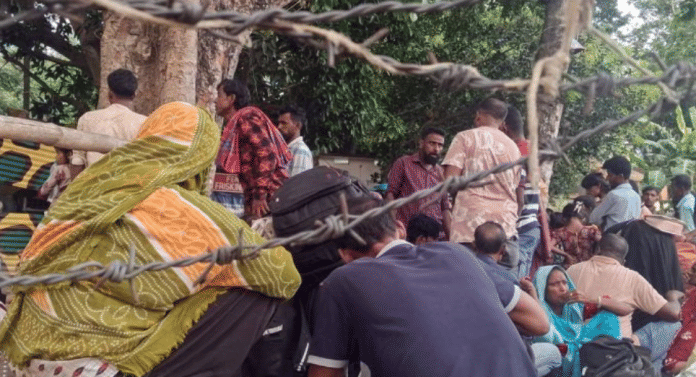
This is the heart-wrenching story of thousands of families in India identified as illegal migrants and deported back to Bangladesh after the Special Intensive Revision (SIR) exercise by the Election Commission of India. The migrants stranded in the no man’s land, caught between the BSF of India and the BGB of Bangladesh each trying to push these hapless people into the other’s territory.
These included abandoned men, women, children, the infirm and the aged treated as personae non gratae by both the governments. While delivering their judgement on the validity of SIR, the Supreme Court of India has unequivocally clarified that it would be invalid to claim that, exclusion from the SIR will automatically decide a person’s citizenship or make someone an illegal migrant. But by side-stepping this clarification, many states had already announced that people whose names were missing in the electoral list after SIR, will be treated as illegal residents, will not be eligible for benefits under Government Welfare Schemes including free ration and will be deported to the native country. It is reported that nearly 6 crore names were deleted so far post SIR exercise.
This is a body blow to all the poorer and marginalized sections of the society who have been sustaining a living in India working as construction workers, delivery boys, security guards, waiters, maids, drivers, cooks etc. The identification of a person’s resident status through a set of unreliable documents is an extremely dangerous exercise and prone to serious shortcomings and misjudgement. The system is fraught with flaws such as inadequate notice time to respond, routine rejection of the documents, poor application of mind, indifferent attitude of the authorities and the onus on individuals to prove citizenship.
This burden of proof often hits the poor, rural, migrant, displaced and marginalised persons
hardest, driven by poverty and illiteracy. Their records are often incomplete. Incorrectly spelt names, addresses, wrong dates of birth etc. Women not having documents linking their natal and marital homes. Documents lost due to floods, earth quake, other natural calamities and repeated displacement in search of livelihood, eviction drives etc.
History remembers with pride that the same Indian Government took a courageous decision in 1971 in the interest of humanity and opened the borders to approximately 10 million Bangladeshi refugees who fled to India during the 1971 Bangladesh Liberation War to escape persecution by the Pakistani military. This humane gesture saved a massive genocide in East Pakistan.
The two super-powers the USA and China who were supporting Pakistan, were very critical of India’s humanitarian intervention. USA even deployed their 7 th fleet into the Bay of Bengal as a show of force against India. China opposed India’s political and military support to the refugees. Several member countries in the UN also opposed the war and rejected the claims of human genocide. However, despite all these threats from various countries, India went ahead with its decision to support the refugees and extended military support for the liberation of East Pakistan from Pakistan.
We should remember that In 1971 India was liberated from the British barely 24 years ago, and had multitudes of problems internally to deal with and also had to face two wars, against China in 1962 and against Pakistan in 1965. It inherited a tottering economy characterized by a predominant agrarian force, near zero per capita income growth and wide spread poverty and illiteracy. The country was taking baby steps to re-building the nation from the scratch. But despite all these internal and external challenges the Indian Government stood by the refugees and offered them shelter showing the world the veritable face of humanity. While the world has turned into a global village for fastest communications and erasing the distances, humanity lost its relevance. With each country re-drawing its boundaries and lop- sided immigration policies in the name of security, sovereignty and national interest, the free movement of people across the borders is severely constricted.
An ordinary individual seeking asylum for a better life or to escape persecution is often viewed with suspicion and denied entry, the influential and powerful traverse with impunity through political convenience and diplomatic considerations. When the principles of justice,
accountability and humanity are being applied selectively, SIR will create more nameless,
homeless and stateless people.
V. Subramanian
These pieces are being published as they have been received – they have not been edited/fact-checked by ThePrint.