





Thank you dear subscribers, we are overwhelmed with your response.
Your Turn is a unique section from ThePrint featuring points of view from its subscribers. If you are a subscriber, have a point of view, please send it to us. If not, do subscribe here: https://theprint.in/subscribe/
Amir Khusrau is usually remembered as a poet of refinement, music, Sufi culture and linguistic synthesis. He is called Tuti-e-Hind, the Parrot of Bharat. His name is linked with Hindavi expression, qawwali, Indo-Persian elegance and the cultural life of Delhi. In popular imagination, he is often presented as a symbol of harmony.
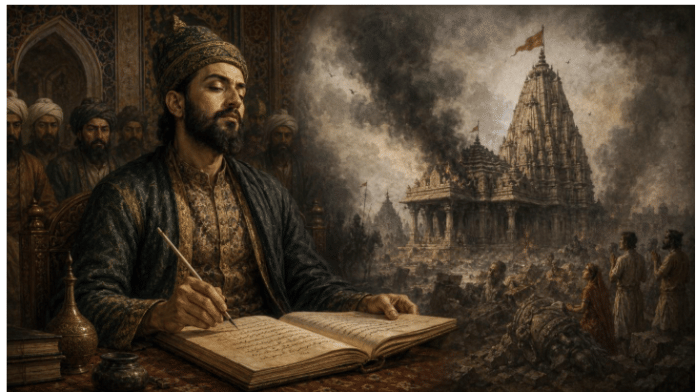
But this polished image cracks when we read his description of Somnath in Khazain-ul-Futuh.
Here Khusrau is not the gentle poet of cultural exchange. He is the court poet of conquest. He writes as a celebrant of Alauddin Khalji’s military power. He does not look at Somnath with reverence, sympathy or neutrality. He looks at it with contempt. For him, Somnath is not one of Hinduism’s holiest shrines. It is a defeated symbol whose humiliation must be recorded and celebrated.
Khazain-ul-Futuh, or Treasures of Victory, was written in praise of Alauddin Khalji’s campaigns. It is not a detached historical account. It is imperial praise. Khusrau writes not as an impartial chronicler, but as a panegyrist of Sultanate power. His prose turns conquest into glory and desecration into achievement.
The Somnath passage is among the most disturbing examples of this attitude.
Somnath was not an ordinary temple. It was a sacred seat of Shiva, a jyotirlinga, a living tirtha, and one of the great centres of Hindu pilgrimage. For centuries, it drew kings, pilgrims, priests, donors, traders and devotees to Prabhas Patan. It carried ritual memory, civilisational pride and sacred continuity.
But Khusrau does not see Somnath in that way.
In Mohammad Habib’s translation of Khazain-ul-Futuh, Khusrau describes Somnath as the “Mecca of the infidels” becoming the “Medina of Islam”. He also imagines the temple being “made to bow towards the Holy Mecca”. These are not innocent metaphors. They are metaphors of humiliation. The shrine is not merely attacked. It is rhetorically forced into submission.
That is the ugliness of the passage.
Khusrau does not mourn the breaking of a sacred place. He does not acknowledge the grief of devotees. He does not pause before the sanctity of the shrine. Instead, he transforms the desecration of Somnath into a theatrical victory. The Hindu temple becomes, in his imagination, a conquered body. Its fall is made to appear like prostration. Its sacred geography is overwritten by the vocabulary of the conqueror.
This cannot be called secular. It cannot be called syncretic. It is imperial theology written in polished Persian.
Modern Bharat must read this Khusrau honestly. It is easy to praise him as a cultural bridge. It is harder to ask what kind of bridge celebrates the breaking of another people’s sacred stones. It is convenient to remember his poetry and music. It is uncomfortable to confront his language toward one of Hinduism’s most sacred temples. But civilisations cannot survive on selective memory.
Some may argue that Khusrau was a man of his age. That is partly true. He wrote in a medieval courtly world. He depended on royal patrons. He used the conventions of Persian panegyric. Court poets often praised power because power rewarded them.
But context is not absolution.
Historical context may explain why Khusrau wrote as he did. It does not make his language noble. It does not turn contempt into harmony. It does not erase the fact that one of Bharat’s most celebrated poets described the humiliation of a Hindu shrine with triumphalist delight.
The Somnath passage matters because it reveals how Sultanate court culture could imagine temple destruction. It was not always treated merely as plunder. It was not always narrated as a side effect of war. In Khusrau’s prose, the attack on Somnath becomes a religious and political performance. The temple is not just robbed. It is made to submit. Its sacredness is mocked. Its defeat is turned into literary ornament.
That is what makes Khusrau’s gaze venomous.
He does not simply report violence. He beautifies it. He does not merely record desecration. He celebrates it. He does not see Somnath as a shrine of living faith. He sees it as an “infidel” centre whose fall proves the superiority of his patron’s power and creed.
This is not to deny his talent. Khusrau was a gifted poet. His literary influence is real. His place in Indo-Persian culture is significant. But talent cannot become immunity. A brilliant pen can still be poisoned. A refined poet can still carry contempt.
Somnath’s own history gives the strongest answer to Khusrau.
He wrote as though the temple had bowed forever. It did not. Somnath was attacked, broken, rebuilt, attacked again and renewed again. The shrine outlived the empire that celebrated its humiliation. Pilgrimage continued. The name of Someshvara survived in memory, ritual, stone and devotion.
The court poet’s metaphor failed. Somnath did not remain bowed. It rose.
Khusrau’s words remain in archives, but Somnath remains in worship. His language tried to make desecration permanent. The temple’s endurance made it temporary.
Bharat must read Amir Khusrau fully. The poet of culture must be read beside the celebrant of desecration. Only then can we understand how medieval power looked at Hindu sacred spaces.
Amir Khusrau looked at Somnath with contempt. Somnath answered with endurance.
These pieces are being published as they have been received – they have not been edited/fact-checked by ThePrint.