




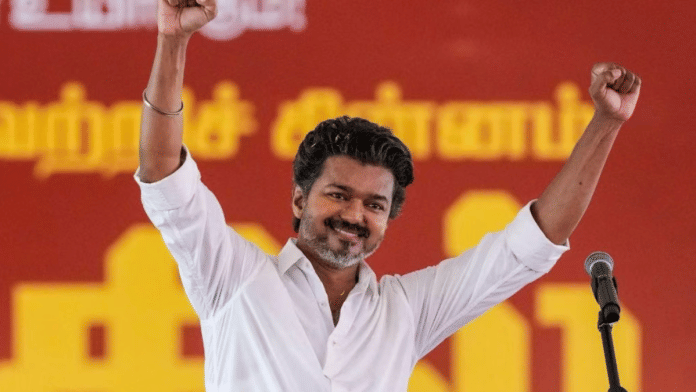

Thank you dear subscribers, we are overwhelmed with your response.Your Turn is a unique section from ThePrint featuring points of view from its subscribers. If you are a subscriber, have a point of view, please send it to us. If not, do subscribe here: https://theprint.in/subscribe/
There have been many political upheavals in Tamil Nadu, but few have evolved with the speed and spectacle of C. Joseph Vijay.
The actor who used to hold audiences spellbound outside theaters is now negotiating a very new stage—as chief minister of one of India’s most politically savvy states.
Not that Tamilaga Vettri Kazhagam (TVK) has upended the decades-long dominance of the DMK and AIADMK, but it is the most interesting development since the ascension of Vijay.
Vijay is attempting to leverage his huge personal popularity into a new style of political activism based on exposure, surprise public appearances, and direct contact with ordinary people. That’s a big change in Vijay’s personality. Before the election, he was often criticized as being somewhat unapproachable.
He had a big fan base, but his political appearances were few relative to traditional politicians. During the campaign, Vijay had promised to personally visit villages and meet people if he was in the government.
Since taking power, his public appearances have become a major part of his political messaging. His work outside the highly controlled environment of political rallies has generated broad interest.
For example, a recent trip on the Chennai Metro became an instant great public encounter as commuters and families swarmed around him. The incidents suggest a peculiarity in Vijay’s political standing: even as Chief Minister, he still gets the same level of spontaneous public response that he did during his film career.
But such trips are more politically significant than celebrity sightings. They give Vijay an opportunity to bridge the gap between the superstar and the voter.
A politician who has spent decades talking to audiences on the movie screen is now trying to portray himself as someone who can be physically present among the people he governs.
This becomes all the more important as Vijay’s personal charisma was a key to TVK’s electoral success.
The challenge is now to translate that emotional attachment into political trust. His visits and public contacts are thus strategic.
They give Vijay a look of accessibility while at the same time keeping him at a distance from the established machinery of the conventional parties of Tamil Nadu.
The message is clear and loud: the Chief Minister should not be restricted to Fort St. George, party headquarters, or carefully staged political platforms.
The politics of Vijay have a visual component. Crowds swarmed around his car, people wanting a glimpse of him, and spontaneous encounters soon began to circulate on television and social media.
These moments can sometimes speak political accessibility better than long speeches in today’s politics.
However, there are obvious disadvantages of this method. Vijay is one of Tamil cinema’s biggest stars, and the line between political activism and celebrity adulation is particularly thin. When people rush to see Vijay, do they expect to see their chief minister or their favorite actor? The answer may be both, for now.
That uncertainty is one of Vijay’s greatest political assets and one of his greatest weaknesses. His popularity gives him access to people that few new politicians have. But good governance demands that this relationship should finally be on the basis of administrative performance and not fame.
His rise has already altered another key feature of Tamil Nadu politics: bipolarity. For decades, the DMK and the AIADMK were the focus of political conflict. Vijay proved that a new political group can disrupt the old order without breaking away from either party.
TVK has also moved in a curious ideological direction. Vijay has cited Periyar, B.R. Ambedkar, and K. Kamaraj to stress social justice, secularism, and state autonomy.
He seems to be trying not to discard Tamil Nadu’s Dravidian political legacy but to rework it for a younger electorate. That constituency will be vital to his political fortunes.
The younger voters in Tamil Nadu have grown up in a state that has been transformed by industrialization, urbanization, education, and internet connectivity.
Their expectations have broadened from traditional welfare politics to jobs, entrepreneurship, infrastructure, cleaner government, and economic mobility. Vijay can listen to their wishes by his public engagement.
It cannot substitute for delivering on them. Tamil Nadu has major structural issues. Chennai continues to face flooding, water management issues, and growing urbanization.
he state needs to continue to build on its manufacturing advantage but also create more high-quality jobs. Regional disparities will need to be managed, and climate resilience and infrastructure investment will challenge administrative competence.
Then there is the question of Centre-State relations (fiscal federalism, language, education, and the Cauvery dispute). How Vijay responds to these will determine whether his promise of a better political culture survives the pressures of government.
That’s why it’s good that he does surprise visits and encounters with ordinary people—but only to a degree.
They argue that Vijay accepts one of the central problems of modern politics: politicians only show up at election time, and citizens are increasingly unhappy about this. Between elections, remaining visible changes the relationship between government and the governed.
But accessibility has to come with responsibility. There’s nothing more powerful than a chief minister walking among the people. A government that solves its problems guarantees political sustainability. Vijay has already done what few expected when he entered politics: he has rewritten the electoral equation of Tamil Nadu and made himself the central character of a new political experiment from an incredibly popular actor.
And now the hardest change is upon us. If his public visits are a means of understanding problems, evaluating administration, and making government more responsive, Vijay may evolve a truly innovative form of political leadership. If they are nothing more than spectacles, the novelty will wear off over time.
Vijay knows how to connect with the audience, and Tamil Nadu knows it. Now it’s a matter of testing if he can connect with citizens and turn that connection into governing.
About the author:
Anusreeta Dutta is a columnist and climate researcher with experience in political research analysis. ESG research and energy policy.
These pieces are being published as they have been received – they have not been edited/fact-checked by ThePrint.