




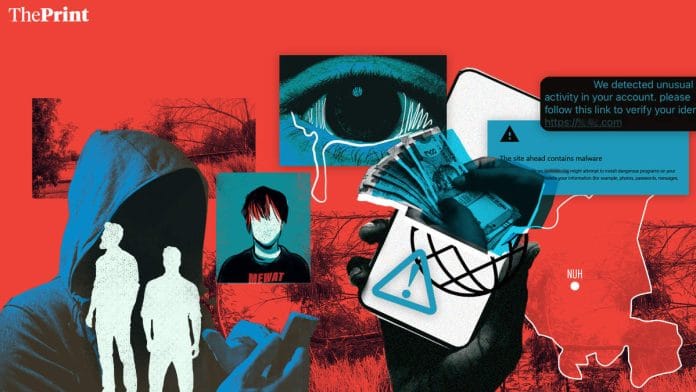

Thank you dear subscribers, we are overwhelmed with your response.Your Turn is a unique section from ThePrint featuring points of view from its subscribers. If you are a subscriber, have a point of view, please send it to us. If not, do subscribe here: https://theprint.in/subscribe/
The arithmetic of scale
Even if only a tiny fraction of the population encounters a fraud attempt in any given year, it still translates into tens or hundreds of thousands of incidents. That means hundreds of cases every day. The sheer scale of our population guarantees a steady stream of such stories, however robust our systems become.
Yet these incidents are rarely seen as statistical inevitabilities. Instead, they become symbols of national decline. A single fraud becomes evidence of widespread deception. A handful of reported crimes becomes proof that society is becoming unsafe. Perception slowly overtakes proportion.
Why perception outruns reality
This gap between reality and perception is rooted in human psychology. Our minds are designed to respond to threat, not assess proportion. That instinct helped our ancestors survive, but in today’s digital world it often misleads us.
Every day, millions of routine interactions occur unnoticed. Salaries are credited, goods are delivered, payments are completed, disputes are resolved and people go about their lives peacefully. Because these events are ordinary, they disappear into silence. Meanwhile, a relatively small number of frauds or crimes dominate headlines and WhatsApp groups. The mind remembers impressions, not proportions. What it sees repeatedly, it begins to accept as reality.
The media magnifying glass
Modern media, particularly social media, magnifies this distortion. Traditional media has long favoured dramatic stories, but digital platforms amplify them through algorithms that reward outrage and emotion.
A newspaper headline may be seen once. A digital headline is encountered repeatedly, shared across platforms, forwarded by friends and endlessly reposted. Repetition gradually acquires the authority of truth.
Social media does not amplify what is common; it amplifies what is exceptional. A violent crime in a distant city can circulate so widely that it feels as though it occurred next door. A fraud affecting a few individuals can be replayed until it appears universal. The exceptional gradually becomes the perceived norm.
Visibility is not prevalence
Consequently, even if crime rates remain stable or decline in several categories, public perception can move in precisely the opposite direction. A society that is objectively becoming safer may still feel increasingly unsafe because fear spreads much faster than facts.
Visibility begins to overpower prevalence. What dominates our screens gradually comes to dominate our minds.
The price of paranoia
This distortion carries significant consequences. A society convinced it is under constant threat becomes more suspicious, more anxious and easier to manipulate. Fear weakens trust, fuels anger and encourages pessimism that bears little relationship to reality. In a democracy, perceptions often shape public discourse more powerfully than facts.
The challenge, therefore, is not merely reducing fraud or crime. Every country faces criminal activity. Even highly digitised societies such as the United States, Singapore, the United Kingdom and Japan report thousands of fraud cases every year. Perfection is unattainable; continuous improvement is the only realistic objective.
The greater challenge is managing perception in an age where information travels faster than reflection. Citizens must distinguish between visibility and prevalence. Governments should communicate data more effectively. Media organisations must recognise the cumulative effects of sensationalism, while social media users should develop the discipline to pause before forwarding panic.
Restoring perspective
A vigilant society is healthy; a paranoid society is not. Vigilance strengthens institutions and sharpens public awareness. Paranoia erodes trust, amplifies misinformation and creates the false impression that the nation is steadily falling apart when the evidence suggests otherwise.
India today is neither uniquely unsafe nor uniquely fraudulent. What is unique is the unprecedented volume of information reaching each of us every day. Every notification, forwarded video and alarming headline adds weight to fears that may be statistically misplaced. The actual risks may be manageable, yet the perceived risks can feel overwhelming.
To restore balance, we must anchor our reactions in context. A nation of 1.4 billion people will inevitably generate a large number of incidents simply because of its scale. Absolute numbers alone tell us little. It is rates, trends and comparisons that reveal whether society is becoming safer or more dangerous.
The more we allow perception to drift away from reality, the more we undermine our own confidence. The more clearly we distinguish between what is genuinely common and what is merely visible, the stronger and more resilient we become as a society.
Because, in the end, what flashes across our screens is not necessarily what defines life on our streets.
Col KL Viswanathan
(The author is an Indian Army veteran and a contemporary affairs commentator. The views are personal. He can be reached at kl.viswanathan@gmail.com )
These pieces are being published as they have been received – they have not been edited/fact-checked by ThePrint.