




Your Turn is a unique section from ThePrint featuring points of view from its subscribers. If you are a subscriber, have a point of view, please send it to us. If not, do subscribe here: https://theprint.in/subscribe/
Reservation in India is one of the most debated public policy instruments since Independence. Conceived as a mechanism for social justice, it aimed to correct centuries of structural inequality rooted in caste-based discrimination. However, over time, the expansion of reservation policies-both at the central and state levels, has raised critical questions about its effectiveness, equity, and long-term impact on meritocracy and governance.
This article examines the evolution of reservation from 1947 to 2026, highlighting its necessity, achievements, and emerging concerns.
The Constitutional Foundation (Post-Independence Vision) At the time of Independence, India inherited a deeply unequal social structure. The framers of the Constitution introduced reservation as a temporary measure to uplift historically disadvantaged communities—primarily Scheduled Castes (SCs) and Scheduled Tribes (STs).
The intention was clear: Ensure representation in education and employment, promote social mobility, Reduce historical discrimination. Initially, reservation was expected to last for only 10 years. However, due to persistent inequality, it has been extended repeatedly.
Expansion of reservation in India has gradually moved from a framework rooted in social justice to one that is also influenced by political considerations. Over the decades, reservation policies have expanded significantly, including the inclusion of Other Backward Classes (OBCs) following the Mandal Commission in the 1990s, the introduction of state-specific quotas, and the addition of a 10% reservation for the Economically Weaker Sections (EWS) in recent years. While these expansions have helped extend benefits to broader sections of society, they have also increasingly been used as instruments of political mobilisation. State governments have often introduced or enhanced quotas to consolidate vote banks, at times without relying on robust socio-economic data.
Current Reservation Landscape (2025–2026)
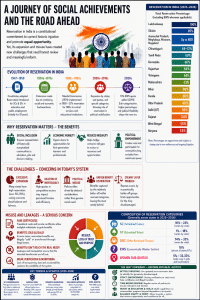
The addition of 10% EWS quota across most states has further expanded the total reservation framework. Recent developments include Sub-categorisation within SC/ST groups Increasing judicial flexibility on the 50% cap Ongoing debates on women’s reservation and sub-quotas
Despite criticism, reservation has delivered significant outcomes across multiple dimensions. It has promoted social inclusion by enabling the representation of historically marginalised communities in government, education, and public institutions. It has also contributed to economic mobility, with many first-generation learners and professionals emerging from disadvantaged backgrounds due to reservation benefits. Additionally, reservation has helped reduce structural inequality by bridging gaps in access to opportunities, although not completely. Furthermore, it has fostered political empowerment by giving a voice and participation to communities that were previously excluded from decision-making processes.
Emerging concerns and demerits, however, highlight several serious challenges within the current system. In several states, reservation has expanded excessively, exceeding 60–70%, which raises concerns about fairness and overall balance. Additionally, high quotas in competitive sectors can affect the perceived fairness and efficiency of merit-based selection. Reservation policies are also at times influenced more by electoral considerations than by genuine socio-economic need, pointing to instances of political misuse. Furthermore, the benefits of reservation do not always reach the most deprived within the reserved categories, resulting in unequal distribution and internal inequality.
Misuse and leakages in the system remain among the most critical issues. Fake certificates and fraudulent claims enable ineligible individuals to access benefits, while in some cases these benefits are informally sold or transferred through illegal means, undermining the policy’s purpose. The creamy layer problem also persists, with relatively well-off individuals within OBC categories repeatedly availing themselves of benefits, leaving the truly needy behind. As a result, the intended beneficiaries are sometimes excluded, weakening the overall credibility of the system.
Judicial and policy developments in recent years indicate a noticeable shift. The Supreme Court has shown greater flexibility regarding the 50% cap, while states are being permitted to create sub-quotas based on empirical data. There is also an increased emphasis on incorporating economic criteria alongside social backwardness. However, a clear national framework that effectively balances equity and efficiency is still in the process of evolving.
The way forward lies in reform, not removal, as the real question is not whether India needs reservation but how it should be implemented going forward. This calls for better targeting through periodic socio-economic data, stricter enforcement to prevent misuse and fraud, and the introduction of time-bound review mechanisms to ensure continued relevance. At the same time, greater focus on education and skill development can help reduce long-term dependence on quotas; while gradually shifting from identity-based to need-based support would make the system more equitable and effective.
There was a clear view advocating the complete removal of reservation, which, in my opinion, contradicts the very premise that it remains necessary for achieving social justice. A stronger and more balanced conclusion would therefore emphasise reform rather than abrupt withdrawal. No doubt, reservation remains a necessary instrument in India’s journey toward social justice; however, the lack of uniformity across states has led to significant distortions, with each state adopting its own approach and several exceeding the notional 50% cap-some even crossing 70%. This unchecked expansion, without periodic review or a coherent national framework, has diluted both the intent and effectiveness of the policy. While the system has delivered meaningful gains over decades, concerns around misuse, unequal distribution of benefits, and political expediency cannot be ignored. The way forward, therefore, is not to abruptly scrap reservations, but to rationalise and recalibrate them through a unified, data-driven approach that ensures benefits reach the truly deserving. At the same time, expanding targeted interventions such as women’s reservation can complement, rather than replace, the existing framework. The objective must be to strengthen equity while restoring credibility, ensuring that reservation remains a tool of empowerment rather than entitlement.
These pieces are being published as they have been received – they have not been edited/fact-checked by ThePrint.