



Thank you dear subscribers, we are overwhelmed with your response.
Your Turn is a unique section from ThePrint featuring points of view from its subscribers. If you are a subscriber, have a point of view, please send it to us. If not, do subscribe here: https://theprint.in/subscribe/
“All empires fall,” historians remind us, not as prophecy but as pattern. From Roman Empire to British Empire, decline has rarely been a dramatic collapse; it is more often a slow erosion—masked by rhetoric, sustained by denial, and accelerated by overreach. In early May 2026, as the United States emerges from its latest military confrontation with Iran, the question is no longer whether American power is being tested, but whether it is entering a phase of irreversible contraction.
The war, launched on February 28, 2026, in coordination with Israel, was meant to be decisive. It was sold as a demonstration of overwhelming force—precision airstrikes, targeted eliminations, and a calculated blow to Iran’s military infrastructure. By May 1, Donald Trump declared the war “terminated.” Yet beneath the declaratory triumph lies a far less stable reality: not peace, but a fragile, uneasy ceasefire that threatens to unravel at any moment.
The Illusion of Victory
The United States has claimed success in degrading Iran’s military capabilities and weakening key leadership structures. But the central political objective—regime collapse or strategic capitulation—remains unmet. Iran has neither surrendered nor fundamentally altered its posture. Instead, it has adapted, recalibrated, and signaled its capacity for asymmetric retaliation.
This is not new. From Vietnam War to Iraq War, the United States has repeatedly demonstrated an ability to win battles but lose the political meaning of war. Military superiority does not easily translate into durable control. In Iran, as elsewhere, power has proven to be far more diffused than American planners anticipated.
The language of “termination” obscures the deeper truth: wars of this nature do not end—they mutate.
Permanent War, Deferred Withdrawal
Even as the Trump administration signals an end to “major hostilities,” it has left the door open to continued military presence. This ambiguity is deliberate. It reflects a broader doctrine of indefinite containment—a strategy that avoids the political costs of full-scale war while maintaining a persistent threat environment.
In practice, this means the United States is unlikely to disengage fully. Instead, it will remain entangled in a low-intensity conflict marked by proxy engagements, targeted strikes, and strategic posturing. The geography of this tension is already visible: attacks on U.S. bases, instability among regional allies, and a widening arc of insecurity stretching across West Asia.
The cost of such a posture is not merely financial. It is existential. Empires do not collapse solely because of external defeat; they erode from the inside when the burden of maintaining dominance exceeds the capacity to sustain it.
The Strait of Hormuz and the Economics of Vulnerability
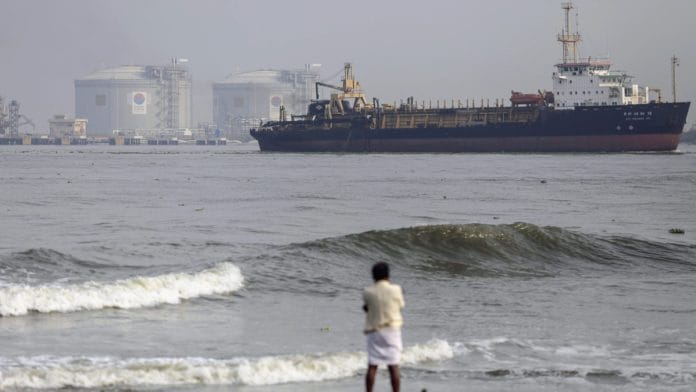
No conflict in the Gulf can be understood without reference to the Strait of Hormuz—the narrow artery through which a significant portion of the world’s oil supply flows. The United States’ strategic fixation on securing this passage reveals both its global reach and its structural vulnerability.
The recent conflict has exposed the fragility of global energy networks. Even the threat of disruption has reverberated through markets, raising costs and intensifying economic uncertainty. For the United States, already grappling with domestic economic pressures, the war risks becoming a multiplier of instability.
Empire, in this sense, is expensive. It requires not only military expenditure but also the constant management of crises—real and perceived. When the cost of control begins to outweigh its benefits, decline is no longer speculative; it becomes systemic.
Fractured Alliances and Shifting Power
The Iran war has also strained Washington’s relationships with traditional allies. European partners, already wary of unilateral military actions, have expressed unease. Reports of intelligence cooperation between Russia and Iran further complicate the geopolitical landscape, hinting at an emerging axis that challenges U.S. dominance.
Meanwhile, the global order is no longer unipolar. The rise of alternative power centers, including China, signals a transition toward a more contested world system. In such a landscape, the United States cannot act with the same impunity that characterized the post-Cold War era.
This is the paradox of contemporary American power: it remains formidable, yet increasingly constrained. Its military reach is vast, but its political legitimacy is diminishing.
The Empire’s Inner Contradictions
Perhaps the most telling signs of decline are not found abroad but at home. Endless wars have deepened domestic divisions, strained public finances, and eroded trust in political institutions. The spectacle of global dominance sits uneasily alongside internal fragmentation.
The Iran conflict, far from restoring confidence, may well exacerbate these contradictions. It reinforces a model of governance that prioritizes militarism over diplomacy, coercion over consensus. Such a model is not indefinitely sustainable.
History offers a cautionary tale. The British Empire did not collapse overnight; it retreated, recalibrated, and eventually conceded the limits of its power. The United States now faces a similar moment of reckoning.
What Lies Ahead?
The “whither” of the United States in the aftermath of the Iran war depends on choices yet to be made. It can continue along the path of militarized dominance, embracing a future of perpetual conflict and managed instability. Or it can pivot—however reluctantly—toward a more restrained, multipolar engagement with the world.
But such a pivot requires more than policy adjustment; it demands a rethinking of national purpose. Empire, after all, is not merely a geopolitical condition—it is an ideology.
If the current trajectory holds, the United States may not experience a dramatic سقوط—a sudden fall—but a gradual diminishing of influence, credibility, and control. The signs are already visible: unresolved conflicts, strained alliances, economic pressures, and a growing inability to dictate outcomes.
Empires fall, yes. But more importantly, they reveal, in their decline, the limits of power itself.
The Iran war may well be remembered not as a victory, but as another marker along that long, uneven road to reckoning.