




Thank you dear subscribers, we are overwhelmed with your response.
Your Turn is a unique section from ThePrint featuring points of view from its subscribers. If you are a subscriber, have a point of view, please send it to us. If not, do subscribe here: https://theprint.in/subscribe/
We were at a wedding on January 12, 2021. There was laughter, relatives and phones ringing. It was exceptionally cold day. We were waiting for the Lavan (Sikh marriage ceremony).
Then the mood changed.
The Supreme Court had constituted a committee to talk to the agitating farmers on the three farm laws. The names were announced: S. Bhupinder Singh Mann, Ashok Gulati, P.K. Joshi and Anil Ghanwat. Within minutes, calls started pouring in. Many were not inquiries. They were pressure, accusation and warning. The question was the same: why did your father become a member of this committee?
As if dialogue had become a crime. As if talking to farmers had become betrayal. As if a man who had spent his life fighting for farmers had suddenly become anti-farmer because he agreed to hear all sides.
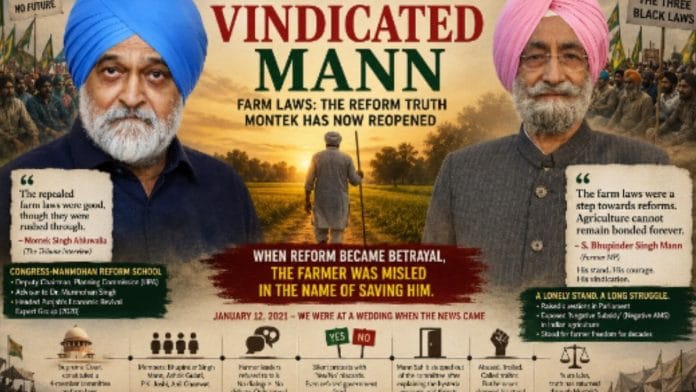
Years later, Montek Singh Ahluwalia, in an interview, has said the repealed farm laws were good, though rushed through. Montek is not a BJP voice. He belongs to the Congress-Manmohan Singh reform school. He was Deputy Chairman of the Planning Commission during the UPA years, and Capt Amarinder Singh appointed him to head Punjab’s economic revival expert group.
So when Montek says the farm laws were good, it is the old Congress reformist economic line speaking. It is also a vindication of S. Bhupinder Singh Mann’s stand.
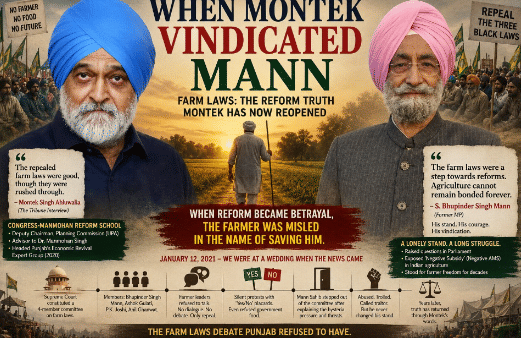
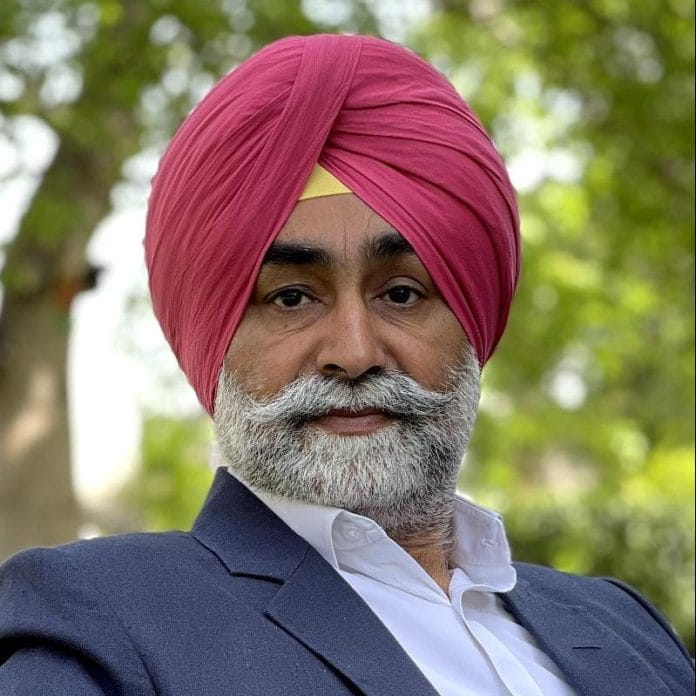
For decades, S. Mann had taken a clear stand. He is founder of the Bharti Kisan Union. Nominated to Rajya Sabha for his contribution to agriculture sector. Indian agriculture needed reform. The farmer needed freedom. Agriculture could not remain tied forever to outdated controls, restrictive markets, middlemen-dominated systems and political slogans.
He had also raised the issue of negative subsidy, or negative AMS in the Parliament.
The farmer was often forced to sell cheap so consumers could eat cheap and governments could control inflation. He was paying a hidden tax, yet told he survived because of government charity. Industry was liberated in 1991. Private investment was welcomed. But agriculture remained bonded. The factory owner got freedom. The farmer remained trapped.
That is why the farm laws were important. They were not perfect. MSP concerns, payment security and farmer-friendly dispute resolution had to be addressed. But they were a step towards long-pending reform.
I do not agree that the laws were suddenly rushed as policy ideas. The handling and consultation could have been better, but these ideas had been discussed for decades by farmer leaders like Bhupinder Singh Mann, Sharad Joshi, Shetkari Sanghatana and serious agricultural economists. Narendra Tomar while speaking in Parliament mentioned that the farm laws were a tribute to Late Sh Sharad Joshi for long standing demand of farmers.
The “Red Flags”, who infiltrated the kisan movement with “Green Flags” did not like this reform. The demand was old. The demand was there by all those who opposed it. The courage to implement it came late. But when it came, reform became betrayal.
Even Atal Bihari Vajpayee understood that agriculture needed liberalisation.
His government formed a high-level task force on agriculture headed by Sharad Joshi. Later, model APMC reforms, direct marketing, private markets, contract farming frameworks and reforms in the Essential Commodities Act were discussed again and again. These were not ideas invented overnight in 2020.
They were poll promises in the manifesto’s of the very same parties, at state and centra level, who later chose to oppose. 2020 saw classic cases of U Turns: By Congress (against its own manifesto), by the Kisan leaders themselves who had been demanding the same things for decades, Shiromani Akali Dal, and Capt Amarinder Singh Government who had in fact already implemented various components of the farm laws in Punjab.
Only Kisan leader from Punjab, who stood against the crowd, on his commitment, was S. Mann. Punjab refused to have a farm laws debate. Fear took over. Farmers were told land would be taken away, MSP would end, mandis would vanish and corporates would enslave them. Anyone supporting reform was branded anti-farmer. The text of the laws became irrelevant.
Fear became the law.Farmer leaders refused to recognise the Supreme Court committee even before engaging with it. They refused to place objections clause by clause. They wanted repeal. Yes or No. No dialogue. No discussion. No debate.
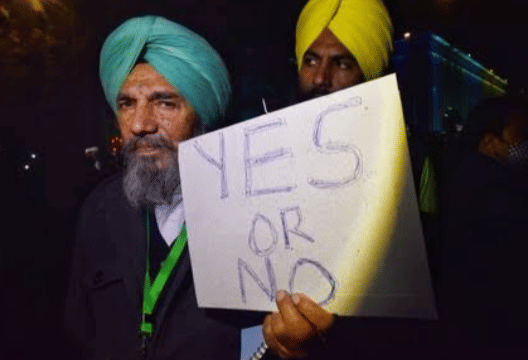
When S. Mann realised farmer leaders were unwilling to talk, he saw no purpose in remaining in the committee. He stepped out after seeking consent of Chief Justice Hon’ble Bobbde. But even that was twisted. The same people who refused dialogue claimed victory.
That period was personally painful. I saw people who knew our family repeat propaganda from protest stages and social media. Some were sincere but misled. Some were political. Some feared the crowd.
The protesting voice became the only farmer voice. But India has never had only one farmer voice. There is the MSP farmer, the fruit and vegetable farmer, the farmer who wants export freedom, the farmer crushed by stock limits, the farmer who wants direct market access, and the farmer who wants to escape the wheat-paddy trap.
Much of the agitation was also about the old procurement system, the arthiya network and the political economy built around wheat and paddy. If the farmer could sell outside old channels, who would lose control? If diversification became real, who would lose the comfort of the old system?
The laws were repealed. The reform debate was poisoned. Punjab remained trapped in wheat, paddy, falling groundwater, rising costs, stressed farmers, free power politics and no real diversification.This is why Montek’s interview matters. Farm laws were good: Montek’s words, Mann’s vindication.
Punjab must ask:
what did we achieve by killing the debate?
Did diversification happen?
Did groundwater recover?
Did farm debt disappear?
Did the young farmer see a brighter future?
No.
We returned to the same old system and called it victory. The farmer does not need to be protected from markets. He needs to be protected within markets. The policy framework needs to be changed. That was Mann ’s stand. The farmer was misled in the name of saving him. Punjab cannot afford to be misled again.
These pieces are being published as they have been received – they have not been edited/fact-checked by ThePrint.