




Thank you dear subscribers, we are overwhelmed with your response.
Your Turn is a unique section from ThePrint featuring points of view from its subscribers. If you are a subscriber, have a point of view, please send it to us. If not, do subscribe here: https://theprint.in/subscribe/
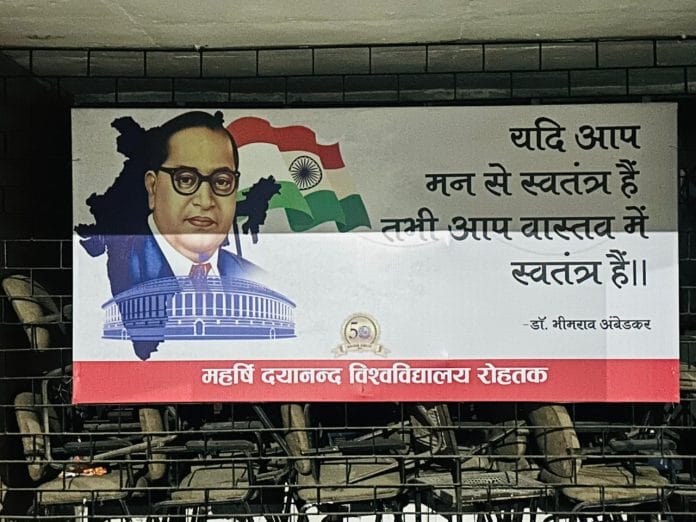
The news of Nithin Raj’s death carries the familiar weight of preventable tragedy. Another Dalit student lost to an institution that was meant to liberate him through education. Another family shattered by a system that continues to reproduce the very hierarchies our Constitution explicitly forbids. Yet what strikes most painfully is not merely the personal loss, but what it reveals about our profound collective failure to translate Dr B.R. Ambedkar’s vision into institutional reality, nearly 75 years after he warned us that constitutions are not self-executing.
Young Dalit students commit suicide at various educational institutions. It is not anomalous. It is systematic. From hostels to subtle contempt embedded in curriculum, they often confront rude comments from roommates, condescension from upper-caste faculties, and erasure of Dalit scholarship from syllabi. Indian education remains in a deep caste prejudice. An institution designed historically to reproduce brahmanical knowledge systems and caste hierarchies. Cosmetic alterations in the constitution have not translated into structural reality.
Nithin Raj’s death reminds us that we have failed to produce those egalitarian educational spaces envisioned by Babasaheb. He did not fight for reservations as charity or patronage. Rather, he fought to dismantle caste as a principle for stratifying society. For him, education was a primary weapon against caste oppression, even though that knowledge was weaponised against the masses to perpetuate brahmanism. Hence, he clamoured that educational institutions must become spaces of equality, which would not only grant access to Dalit students but also affirm their dignity and intellectual contributions
Instead, we have a system that allows access without belonging, opportunities without safety, admissions without acceptance. When they enter institutions, they are subjected to marginalisation even as they become visible. They are considered as anomalies, as beneficiaries of reservations, as reminders of institution’s generosity. They navigate hostility from peers, disdain from teachers and institutional apathy from administrations. The psychological impact is immense. Depression, anxiety and feelings of profound isolation are prevalent among Dalits at disproportionate rates.
In contemporary academia, the relevance of Ambedkar is profoundly understated. His views on caste, social transformation, and education remain among the most incisive. Nonetheless, these writings, the most important for addressing these issues, are often sidelined or reduced to footnotes in academic discourse. Meanwhile, mainstream academia continues to elevate brahmanical intellectuals while keeping Dalit scholars on the margins. The structure of academic knowledge production – what gets published, who gets cited, what constitutes canonical work- remains infected with caste prejudice.
For Ambedkar, brahminism was not just historical; it was prescriptive. He insisted that brahminism survives institutionally, through education system, through internalisation of hierarchy. This is precisely what is often missed: caste prejudice in academia is not a bug but a system. Universities remain a powerful mechanism reinforcing casteism. Therefore, symbolic inclusivity and diversity initiatives cannot eradicate anything that needs systemic overhauls.
What exactly did Ambedkar want? He urged for annihilation of caste, not living amicably with it. He advocated for intermarriage, inter-dining so as to eliminate all those boundaries which serve as tools for maintaining the status quo among different castes. When this is applied in academia, it means not just recruiting Dalit students and professors, but questioning the notion of “merit”, which sort of knowledge is deemed essential, whose perspectives shape curriculum and whose intellectual traditions are preserved and celebrated.
The death of Nithin Raj must be viewed as institutional violence and not an individual tragedy. The violence unfolds through exclusion, disrespect, ignorance and those many microaggressions accumulated daily until they form an unbearable psychological burden. It is highly invisible in a sanitised image of the institution.
On his birth anniversary, what might an honour of Ambedkar’s legacy look like in academia? It would mean decentering the brahmanical knowledge system, paving the way for caste-critical scholarship across all disciplines, requiring the unlearning of caste prejudices among professors, and affirming safe spaces for Dalit students. Thus, reimagining what education truly serves to accomplish. It asks to recognise that academic rigour and caste equality are not competing values but interdependent goals.
India adopted a Constitution drafted by Ambedkar, yet we systematically undermine its egalitarian promises. Educational institutions, often termed as temples of learning, are actually seats of brahminical privilege. Unless and until there is restructuring of academia in accordance with Ambedkar’s vision of caste annihilation, Dalit students will continue entering universities that remain hostile to them, that continually remind them of the insignificance of their knowledge and that their presence is only due to the consequence of tokenistic efforts rather than as a right.
Nithin Raj deserved better. Many others deserve better. The inherent question lies in whether we follow the vision outlined by Ambedkar for us or continue to offer ceremonial condolences over preventable deaths.
These pieces are being published as they have been received – they have not been edited/fact-checked by ThePrint.