




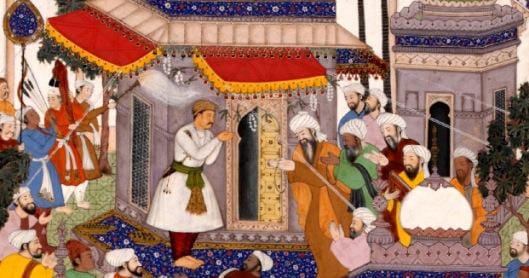

Thank you dear subscribers, we are overwhelmed with your response.Your Turn is a unique section from ThePrint featuring points of view from its subscribers. If you are a subscriber, have a point of view, please send it to us. If not, do subscribe here: https://theprint.in/subscribe/
Popular history often romanticises the Mughal Emperor Akbar as a benevolent visionary. His project, the Din-i-Ilahi, is frequently portrayed as a noble attempt at religious synthesis. However, stripping away the romanticism reveals a much sharper reality. The Din-i-Ilahi was not a spiritual quest. It was a calculated political strategy designed to solve a critical governance problem. Analyzing Akbar strictly as a political strategist allows us to evaluate the Din-i-Ilahi for what it was: a high-stakes administrative strategy that ultimately failed.
The Strategy
The Din-i-Ilahi was essentially an elite political contract. Akbar created an exclusive order for his top military commanders, regional governors, and court administrators. To join, members pledged absolute personal loyalty to the emperor above all secondary identities. It introduced an ethical code of conduct that overrode tribal, ethnic, and religious affiliations. Akbar was not trying to convert the masses. He was attempting to build a tightly bound, centralised executive core.
What It Was Expected to Achieve
As a political strategy, the Din-i-Ilahi targeted the chief structural vulnerability of the Mughal state: internal factionalism.
The Mughal ruling class was a fragile coalition of competing ethnic blocs. Turani, Irani, Rajput, and Indian Muslim nobles constantly jockeyed for influence. Whenever an emperor died, these factions backed different royal princes, triggering bloody wars of succession. These succession conflicts hollowed out the military, drained the imperial treasury, and disrupted governance.
Akbar designed the Din-i-Ilahi to neutralise this vulnerability. He expected the order to function as an institutional glue. By binding key powerbrokers to a shared code of state loyalty, he aimed to create a unified civil and military service. Had it worked, it would have eliminated succession wars, created a meritocratic administrative elite, and insulated the state apparatus from religious and regional polarization.
Why It Failed
Despite its strategic ambition, the Din-i-Ilahi failed because of fundamental design errors.
First, Akbar relied on personal charisma rather than institutional design. The order was tethered entirely to his person as the central authority. He failed to establish written laws, administrative procedures, or formal training mechanisms to pass the system down to subsequent generations.
Second, the strategy suffered from severe under-enforcement. Akbar was hesitant to force his political elite to adopt the code. Powerful commanders like Raja Man Singh flatly declined to join, and Akbar allowed them to retain their high positions regardless. An administrative strategy that remains optional for top leadership cannot transform an institution.
Third, the strategy provoked sharp blowback from entrenched religious and political establishments. Orthodox factions viewed the order as an overreach of imperial power that threatened their traditional influence. Without institutional structures to absorb this political friction, the strategy crumbled the moment Akbar died in 1605.
What Actually Happened
Because the strategy failed, the underlying structural defects of the Mughal Empire remained completely unaddressed.
Immediately after Akbar’s death, the Din-i-Ilahi vanished. The empire reverted to its old, destructive patterns. Jahangir, Shah Jahan, and Aurangzeb all faced bitter rebellions and succession struggles. The nobility fractured along religious and ethnic lines once again. A century after Akbar, these uncorrected structural flaws led to the rapid fragmentation of the state. When European colonial forces expanded into the subcontinent in the eighteenth century, they encountered a deeply divided political landscape ripe for exploitation.
The Counterfactual Lesson in Statecraft
Had Akbar built the institutional machinery needed to make the Din-i-Ilahi outlive him, the subcontinent would have possessed a professional, unified bureaucracy. That cohesion would have drastically altered the trajectory of 18th-century European expansion.
The failure of the Din-i-Ilahi offers a direct lesson for modern governance. A brilliant political strategy is useless without durable institutional design. Leaders who rely on personal authority rather than systemic rule-building leave behind fragile structures that collapse the moment they step off the stage.
An analysis of Akbar’s religious policies and the political context behind his statecraft strategies can be explored in this UPSC Medieval Indian History Lecture on Akbar’s Religious and Rajput Policy, which discusses the political realities and debate surrounding Din-i-Ilahi.
Submitted by: R Srinivasa Murthy
These pieces are being published as they have been received – they have not been edited/fact-checked by ThePrint.
Well Described…Akbar understood that governing a civilisation as diverse as India required something beyond military power—it required accommodation, dialogue and the creation of a shared political identity. His experiment ultimately failed as an organised religious movement, but the underlying principle of seeking common ground among different traditions remains remarkably relevant. Great things to learn…