





Thank you dear subscribers, we are overwhelmed with your response.
Your Turn is a unique section from ThePrint featuring points of view from its subscribers. If you are a subscriber, have a point of view, please send it to us. If not, do subscribe here: https://theprint.in/subscribe/
Water has been central to the rise and persistence of civilizations throughout history. It is rapidly becoming one of India’s most serious governance and security challenges. Already under threat, India’s water supplies are under enormous pressure from rapid urbanization, climate change, groundwater depletion, pollution and the increasing demands of agriculture and industry. What has long been viewed as a developmental problem is now posing serious economic, environmental and internal security challenges.
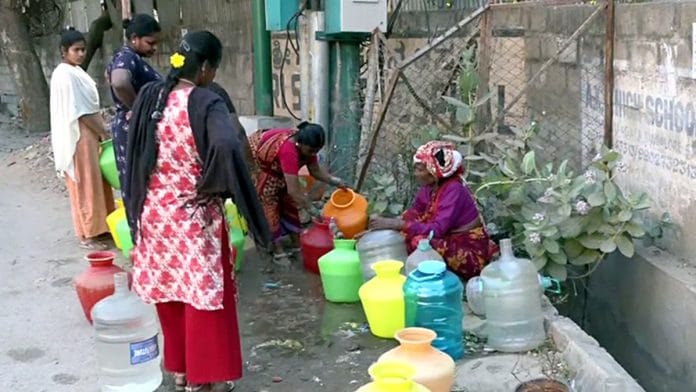
India has more than 18 per cent of the world’s population but only some 4 per cent of the world’s fresh water. Rising population growth, expanding cities and changing purchasing patterns have exacerbated this imbalance. According to government estimates, roughly 600 million Indians are under high to extreme water stress, and several large cities are projected to.
Climate change makes the crisis worse. In India, monsoon rains that support agriculture and refill water reservoirs have become more erratic. Some places have droughts lasting a long time, others have devastating floods in the same season. Heatwaves also increase evaporation, reducing water levels in reservoirs and rivers. Himalayan glacier melt is another long-term threat to river systems supporting millions of people in northern India.
Agriculture continues to be at the heart of India’s water scarcity. The sector uses around 80% of the country’s fresh water, the majority of which is lost in poor irrigation. The Green Revolution had increased food production substantially, but had also resulted in water-intensive farming practices, especially in Punjab and Haryana. However, crops such as paddy and sugarcane are extensively grown in water-scarce areas due to procurement incentives and subsidy arrangements. Groundwater pumping is increasing and water tables are dropping at alarming rates in many states.
It is especially worrying that we depend on groundwater. India is the world’s biggest consumer of groundwater, pumping out more than China and the United States together. Cheap electricity for agricultural pumping, poor water pricing mechanisms and lax regulation have accelerated unsustainable extraction. In many rural areas, falling water tables raise the cost of irrigation, adding to farmers’ misery and vulnerability.
Urban India too is facing a growing water problem. Rapid urbanization has led to poor water delivery, leakage, pollution and overexploitation of nearby water sources outpacing infrastructural development. Cities like Bengaluru, Delhi and Hyderabad are increasingly turning to faraway rivers and reservoirs to meet surging demand. Erratic supply and poor water quality usually hit informal settlements and economically disadvantaged areas the hardest.
Pollution makes it worse. Much of India’s river, lake and groundwater systems are polluted by untreated sewage, industrial waste and agricultural runoff. The Yamuna river in Delhi and parts of the Ganga remain heavily polluted despite several attempts at cleaning them. Water pollution is not only an environmental problem but also a public health concern. Contaminated water can cause waterborne diseases and increase the cost of healthcare.
The economic consequences of water scarcity are increasingly hard to ignore. Water shortages impact on agricultural production, industrial activity, energy generation and urbanisation. Thermal power plants are in many cases disrupted due to lack of water but industries like textile and semiconductors are highly dependent on continuous supply of water. Without adaptation measures, the economic costs of climate-driven water stress could soar in coming decades.
Water scarcity is also starting to impact India’s internal politics and international relations. Water stress has the potential to exacerbate political tensions, as in the case of the Cauvery dispute between Karnataka and Tamil Nadu or the Yamuna and Ravi-Beas rivers. As resources shrink, these conflicts may become more frequent and more politically sensitive.
Water insecurity has implications for migration and social stability beyond interstate conflicts. Climate-induced droughts, crop failures and declining agricultural viability are already driving rural misery and migration to cities. In fragile regions, water resource competition can increase social inequalities and conflicts at the local level.
Measures to address the situation have been introduced by successive governments. Jal Jeevan Mission, Atal Bhujal Yojana, Namami Gange and river-linking initiatives are all aimed at improving water availability, groundwater management and river restoration. Rainwater harvesting, micro-irrigation technologies and watershed development are also attracting more policy attention.
But there are serious implementation gaps. India’s water governance is spread across a large number of agencies, departments and state governments leading to overlapping tasks and poor coordination. Groundwater regulation is still inadequate, ecological sustainability is often ignored in urban planning, and many conservation projects lack proper maintenance and are not applied consistently.
Technology will assist. Smart irrigation systems, recycling of wastewater, desalination technology, satellite monitoring and artificial intelligence–based water management tools can all contribute to more efficient use and conservation. Without larger governance reforms and behavioral changes, however, the technology alone will not solve the problem.
India’s water crisis is in many ways a microcosm of the larger problem: reconciling economic growth, environmental sustainability and social justice. Water security is no longer an environmental issue per se; it is inextricably linked to food security, energy security, public health, urban governance and national stability. Over the next few decades, climate and demographic pressures will increase, testing India’s ability to manage one of its most critical natural resources. Long-term solutions will require stronger institutions, sustainable agriculture policies, better urban planning, groundwater management, investment in water infrastructure, and a greater public awareness of the need for conservation.
The future stability of India’s economy and society may depend not just on the speed of the economy’s rise, but also on how well it controls its water. In the context of a climate uncertain era, water security is not just about resource management, it is becoming increasingly fundamental to the growth trajectory of the country.
—————————————————————————————————————-
About the author:
Anusreeta Dutta is a columnist and climate researcher with experience in political
research analysis. ESG research and energy policy
These pieces are being published as they have been received – they have not been edited/fact-checked by ThePrint.