





Thank you dear subscribers, we are overwhelmed with your response.
Your Turn is a unique section from ThePrint featuring points of view from its subscribers. If you are a subscriber, have a point of view, please send it to us. If not, do subscribe here: https://theprint.in/subscribe/
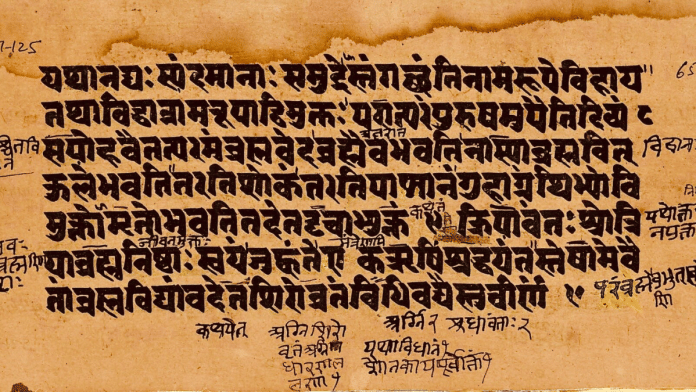
If there is one text in Indian history that evokes almost universal contempt in modern socio-political discourse, it is the Manusmriti. It is widely, and rightfully, criticised as a blueprint for caste discrimination, rigid social hierarchy, and gender inequality. For many, the very name of the text is synonymous with historical oppression.
However, when modern seekers and political commentators debate the Manusmriti, they often make a fundamental structural mistake. They treat it as the ultimate, unchangeable law of a religion, assuming it holds the same absolute authority as the holy books of other global faiths. To truly understand why this text is so deeply flawed, and why we have full permission to reject it, we need to look at ancient Indian philosophy through a contemporary lens. We must view it through the lens of system architecture and software engineering.
To understand how Indian philosophical texts actually work, you have to separate the core operating system from the applications running on top of it. The tradition divides its vast body of knowledge into two distinct categories. The first is Shruti, which translates to that which is heard. This category includes the Vedas and the Upanishads. This is the foundational source code of the culture. It deals purely with universal truths, the nature of human consciousness, and the fundamental spiritual equality of all life. It is timeless, open-source, and entirely unchangeable.
The second category is Smriti, which translates to that which is remembered. This includes texts like the Manusmriti and other social rulebooks. These are simply the apps built on top of the operating system. They are social codes written by specific human beings, designed to manage the civic and economic rules of a very specific time and geography.
Just like a software application built for a computer in the year 1995 is actively harmful to a modern system running today, a Smriti is never meant to last forever. The ancient sages built a brilliant self-correcting mechanism into the culture. Whenever a Smriti contradicts the core equality of the Shruti, the application must be immediately deleted and rewritten. The Manusmriti was never meant to be eternal. It was simply a product of its specific agrarian era.
Like any piece of legacy software that has been patched and edited by hundreds of developers over centuries, the Manusmriti is full of jarring contradictions. On one hand, it contains verses that highly elevate women, such as the famous line Yatra naryastu pujyante ramante tatra Devata. This translates to mean that where women are honoured, the gods rejoice.
On the other hand, the very same text contains verses that severely restrict a woman’s independence at every single stage of her life. It also prescribes harsh, highly unequal punishments based entirely on a strict caste hierarchy. It is not a single, coherent vision delivered by a divine entity. It is a chaotic compilation of local customs, legal opinions, and priestly biases that accumulated over many generations.
If the text was always meant to be overwritten, why does it hold such terrifying authority today? The answer lies entirely in colonial administration. When the British East India Company began ruling India, they were incredibly confused by a society that did not operate on a single, uniform rulebook. The British legal system desperately needed a single text to govern the masses. In 1794, colonial scholars translated the Manusmriti. They took a dusty, heavily altered academic text used by a tiny fraction of society and mistakenly elevated it to the status of divine, absolute law.
In software terms, the British colonial courts found a buggy, outdated application and forcibly hardcoded it into the core operating system of millions of people. By forcing a diverse, dynamic, and decentralised civilisation to bow to one rigid text, they weaponised the prejudices within the Manusmriti. They essentially removed the culture’s natural administrator rights to update its own social code.
This critical historical context does not erase the real-world damage the text has caused. For centuries, the regressive elements of this code were used by dominant groups to justify the systemic oppression of marginalised communities and women.
When Dr B.R. Ambedkar publicly burned the Manusmriti in 1927, it was a profound act of social justice. But viewed through the lens of ancient Indian philosophy, it was also something else. It was the ultimate, necessary act of version control. Burning an oppressive, outdated Smriti is exactly what the foundational operating system of the Upanishads demands of a true seeker. The socio-political contempt for the Manusmriti is entirely valid because it is a reaction to a corrupted social code that dehumanised people.
The Manusmriti is not a fair representation of ancient wisdom for the modern world. It is an archaeological artefact of social engineering that belongs in a museum, not in our daily lives. The true genius of the Indian philosophical tradition is not found in blind obedience to dead rules, but in the freedom to continuously rewrite our social contracts. As a modern republic, we have already exercised this ultimate right of version control. The Constitution of India is our contemporary Smriti. It is a brilliantly architected, living application designed to completely overwrite the old code. It stands as our definitive update, permanently aligning our civic operating system with justice, inclusion, and the foundational equality of the human spirit.
These pieces are being published as they have been received – they have not been edited/fact-checked by ThePrint.