





Thank you dear subscribers, we are overwhelmed with your response.
Your Turn is a unique section from ThePrint featuring points of view from its subscribers. If you are a subscriber, have a point of view, please send it to us. If not, do subscribe here: https://theprint.in/subscribe/
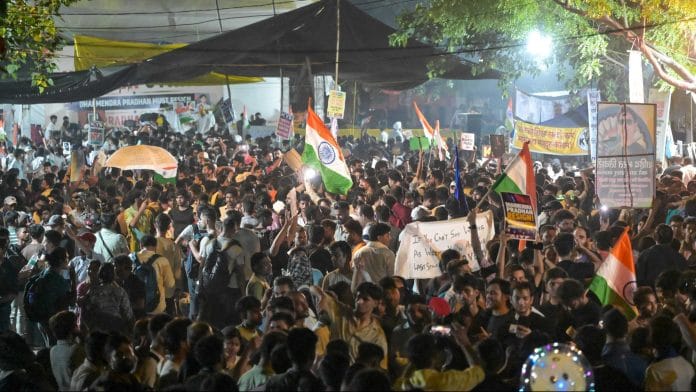
India calls itself the world’s largest democracy so often the line has stopped sounding like a claim and started sounding like a fact nobody checks. Then a few thousand students tried to walk from Jantar Mantar to Parliament, and got a very direct answer to what that fact is worth right now.
The state’s other language
A crackdown is not a response. It is what a government reaches for once it has run out of things to say or once the honest answer isn’t one it wants to give out loud. Every democracy runs on one basic mechanism: dialogue, the ongoing exchange between a state and the people it governs. Tear gas, water cannons, a baton charge on students walking toward the one building built for that exchange none of it is dialogue. It is what fills the space where dialogue should have happened.
The demand at the centre of it was not complicated not a call to rewrite the Constitution or topple a government. It was a resignation letter from an Education Minister presiding over a paper-leak scandal that a teenager in Odisha did not live to see resolved. Maybe Dharmendra Pradhan genuinely doesn’t know how to write one. That would almost be the kinder explanation. The less kind one: he knows exactly how, and has calculated the country can be tear-gassed into forgetting it was ever asked.
Why is there no response? What is so wrong that a month-long sit-in, a twenty-one-day hunger strike, and a march that ended in injuries outside Parliament couldn’t extract a straight answer to a straight question?
Notice how consistent the government’s alternative language has been. When Wangchuk’s fast became impossible to ignore, the answer wasn’t dialogue it was Delhi Police removing him to Safdarjung Hospital, a call so contested it took a High Court order to move him to a hospital of his choosing. When students walked toward Parliament on the Monsoon session’s first day, the answer wasn’t dialogue either it was tear gas and water cannons that left over a hundred needing treatment, and at least five FIRs filed after. When asked why police responded that way, the answer still wasn’t dialogue the government’s ecosystem changed the subject instead, insisting the protest had been hijacked by the Opposition and Left student unions, but it is still an argument about the messenger built to dodge the message. And when protesters kept showing up, the answer was surveillance instead of dialogue too now itself the subject of a High Court petition alleging police photographed and filmed demonstrators to intimidate, not to keep the peace.
None of that is silence. It is a government talking constantly, in every language except the one democracy actually runs on: dialogue.
Which is perhaps why, even after the barricades and the tear gas, the loudest sound at Jantar Mantar was never fear. It was a chant : लड़ेंगे, जीतेंगे. We will fight, we will win.
The vantage point
Widen the lens, because Jantar Mantar was never really about one exam or one minister. Read it alongside the numbers rather than against them. V-Dem’s Democracy Report 2026 counts India among the world’s most populous electoral autocracies, slipping five places further on its Liberal Democracy Index this year. Freedom House’s Freedom in the World 2026 keeps India at “Partly Free” unchanged since 2021, logging a fourteen-point decline since 2005. New Delhi has never been shy about waving such verdicts away; a minister once dismissed an earlier downgrade as the judgment of the world’s self-appointed moral custodians. It’s entitled to make that argument again. What it can’t do is make it while deploying water cannons on its own students for asking their government for exactly that: dialogue in the same season.
In a little over three weeks, the country will do what it does every 15th of August: raise a flag, invoke 1947, and call itself the world’s largest democracy again, this time from the Red Fort rather than a television debate. Somewhere between now and then would be a good time to decide whether that phrase still describes a government willing to sit down and have that dialogue, or just one too large to feel it has to.
These pieces are being published as they have been received – they have not been edited/fact-checked by ThePrint.