





Thank you dear subscribers, we are overwhelmed with your response.
Your Turn is a unique section from ThePrint featuring points of view from its subscribers. If you are a subscriber, have a point of view, please send it to us. If not, do subscribe here: https://theprint.in/subscribe/
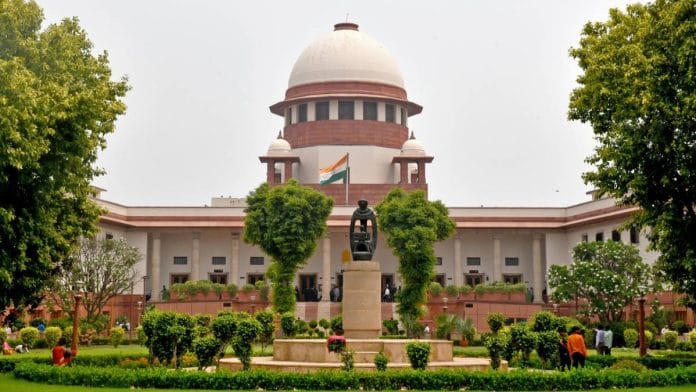
On 19 March 2026, a nine-judge Constitution Bench of the Supreme Court of India, led by Chief Justice Surya Kant, reserved judgment on the scope of the term ‘industry’ under Section 2(j) of the Industrial Disputes Act, 1947 (ID Act). The reference—arising from the case State of U.P. v. Jai Bir Singh—asks the Court to reconsider its own watershed ruling in Bangalore Water Supply & Sewerage Board v. A. Rajappa (1978), a decision that has governed Indian labour jurisprudence for nearly five decades. What appears to be a dry definitional dispute is in reality a question of immense constitutional consequence: who gets the protection of labour law, and who does not?
The Statutory Text and Its Problem
Section 2(j) of the ID Act defines ‘industry’ as ‘any business, trade, undertaking, manufacture or calling of employers’ and includes ‘any calling, service, employment, handicraft, or industrial occupation or avocation of workmen.’ The definition is famously two-sided: its first limb describes the employer’s activity; its second, the workman’s. This structural ambiguity—whether both limbs must be read conjunctively or independently—has generated a century of litigation. The stakes are considerable: if an establishment is an ‘industry,’ its workers can raise industrial disputes, demand reinstatement, and access the entire machinery of the Act. If it is not, they stand outside that protection.
Phase I — Early Breadth: Hospital Mazdoor Sabha (1960)
The first time the definition was tested in a major judicial case was in State of Bombay v. Hospital Mazdoor Sabha, AIR 1960 SC 610. A five-judge bench gave a wide meaning to the definition, finding that a government hospital was an ‘industry’. The Court used a functional test – whether the activity could be conducted non-governmentally- did not exclude the activity from the scope of the Act. This decision paved the way for a welfare perspective on the statute, one that emphasised the workers’ right to a forum for resolving their disputes, rather than the nature of the employer.
Phase II — The Restrictive Turn: University of Delhi and Safdarjung (1963–1970)
In 3 years, the liberal wave of Hospital Mazdoor Sabha was quelled. In University of Delhi v. Ram Nath, Air 1963 SC 1873, the Supreme Court ruled that a university was not an ‘industry’. The argument was that education, which was taught by teachers, not “workmen” under the Act, was not industrial activity. The decision was made less for doctrinal reasons and more for institutional concerns, critics said, that the extension of labour law to universities would threaten the academic discipline.
The Court’s restrictive turn further gathered momentum in the Madras Gymkhana Club Employees’ Union v. Management of Gymkhana Club, AIR 1968 SC 554 and Cricket Club of India v. Bombay Labour Union, AIR 1969 SC 276, where the Court ruled that non-proprietary members’ clubs were not the industries as defined. Management of Safdarjung Hospital v. Kuldip Singh Sethi, AIR 1970 SC 1407, was the zenith of the restrictive phase. Chief Justice Hidayatullah disagreed with Hospital Mazdoor Sabha and ruled that a hospital was not engaged in any economic activity that was similar to trade or business, as it was a department of government providing charitable medical services. Governed by a ‘commercial sense’ test, meaning only activities with profit-oriented or trade-like activities qualify.
Phase III — The Great Expansion: Bangalore Water Supply (1978)
The critical threshold was broken on 21 February 1978. A seven-Judge bench headed by Justice V.R. Krishna Iyer in Bangalore Water Supply & Sewerage Board v. A. Rajappa, AIR 1978 SC 548, overturned the entire building of restrictions. The Court drew up the famous ‘triple test’ which was as follows: (i) there was a systematic and organised activity; (ii) there was a cooperation between the employer and the employee; and (iii) the production of goods or services for the satisfaction of human wants and wishes, whether for profit or not. Based on this, hospitals, schools, clubs, research institutions and charitable organisations were all classified as ‘industries.’ In the subsequent case of Safdarjung v. University of Delhi, AIR 1975 SC 2032, it is pointed out that the judgment in the case explicitly overruled those cases.
Justice Krishna Iyer led the judgment by highlighting the welfare motive of the Act and the right to protect labour as granted under the Constitution. Only ‘sovereign functions’ in the true sense of the word, that is, powers exercised by the State as a sovereign, were not included. The Act extended to the “welfare activities and economic enterprises of the government”, regardless of their size or their public nature. It was a revolutionary ruling which gave millions of workers in hospitals, schools and government offices the right to strike.
.
Phase IV — Legislative Response and Continuing Uncertainty (1982–2005)
This broad interpretation was not supported by Parliament. The definition of ‘industry’ in Section 2(j) of the Industrial Disputes Act, 1982, was narrowed, which excluded hospitals, educational institutions and some charitable organisations. Amendment, however, failed to be brought into operation – a legislative lacuna that has been present for more than 40 years – and the Bangalore Water Supply interpretation remains the law in operation.
Post-1978 inconsistencies mounted. There were some instances of deviations from the seven-judge ruling in two-judge benches. The three-judge bench in 1996 gave its ruling in Bangalore Water Supply, which stated that a social forestry department was an industry. However, a two-judge bench came to a different conclusion on the related question in 2001. This bench has been referenced in a five-judge Constitution Bench in State of U.P. v. Jai Bir Singh (2005) 5 SCC 1, which in turn remanded the issue to a nine-judge bench (which will now be called a nine-judge bench), which is now set to give judgment.
The 2026 Reference: What Is at Stake
More than 27 Supreme Court cases have been cited from Bangalore Water Supply, and 66 High Court justices have been referenced in Bangalore Water Supply. It will be up to the nine-justice bench to either affirm, modify or overturn it. The unenacted 1982 Amendment is also likely to be a question for analysis as to whether it has any legal effect and whether the recently replaced ID Act has changed the definitional landscape for the Industrial Relations Code, 2020.
There were two poles to the arguments before the bench. Labour counsel, Indira Jaising (SLP), and C.U. Singh, argued that any exclusion of workers from the Act would leave them ‘going nowhere’’ – basically taking away the constitutional protection for Article 21 and 23 considerations that are inherent in labour welfare. The State and institutional counsel, with the Attorney General, said that the test of ‘commercial sense’ of Safdarjung better reflected legislative intent, and the addition of industrial dispute machinery to sovereign and charitable functions would mar institutional governance. During arguments, Justice Bagchi said the Preamble of the ID Act refers to ‘settlement of disputes’ for industrial peace, and thus, a restrictive interpretation would exclude ‘social tensions’ that the Act was meant to address.
Conclusion
The term ‘industry’ is not just a labour law trivia—it is the key question because if a worker can access the State’s dispute-resolution procedures at all, he or she does so when the question is decided in their favour. The seventy-year swing, from the bold stance of Hospital Mazdoor Sabha, to the narrow focus of Safdarjung and University of Delhi, to the broad rephrasing of Bangalore Water Supply, captures a greater dichotomy between the institutional autonomy and the protection of workers, which the Indian legal system has never adequately bridged. The Constitution’s remedy is a nine-judge bench. Its decision will decide whether the 1978 expansion will remain the bedrock of Indian labour law for the next few years, or be superseded by a new framework more attuned to the varied nature of public and charitable enterprise, for the coming decades.
These pieces are being published as they have been received – they have not been edited/fact-checked by ThePrint.