





Thank you dear subscribers, we are overwhelmed with your response.
Your Turn is a unique section from ThePrint featuring points of view from its subscribers. If you are a subscriber, have a point of view, please send it to us. If not, do subscribe here: https://theprint.in/subscribe/
The year is 2026, and the view from the White House Situation Room is one America has seen before.
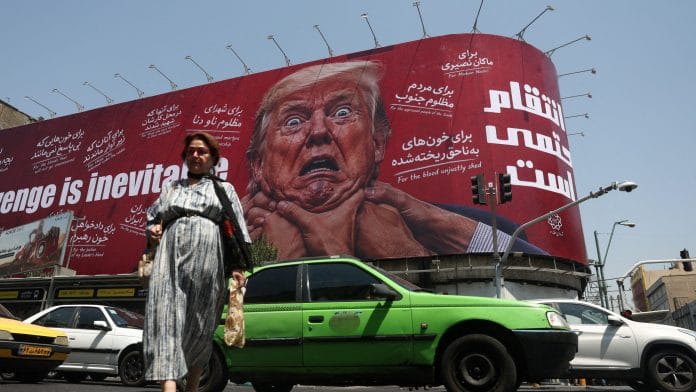
For the second time, Donald Trump has inherited the Iranian file. The president who returned to office promising to end America’s “endless wars” instead finds himself presiding over another cycle of cruise missile strikes, drone attacks and uneasy ceasefires.
It is a conflict that refuses to be called a war, yet refuses to end.
That is because the American confrontation with Iran is unlike almost any other modern conflict. It has no formal declaration of war, no peace treaty and no decisive battlefield. Instead, it unfolds through sanctions, proxy militias, cyberattacks, assassinations, diplomacy and periodic military exchanges. Long stretches of uneasy calm are punctuated by sudden crises before both sides step back just far enough to avoid outright war.
For nearly half a century, every new occupant of the White House has arrived convinced that he possesses the strategy that will finally resolve the American-Iranian impasse. Each eventually discovered that he was merely its latest custodian.
The story of America and Iran is a long-running play performed over desert sands and oil-slicked waters. Every president writes a few new scenes, introduces fresh characters and changes the dialogue. Yet the ending never changes. Since 1979, ten American presidents have attempted different combinations of diplomacy, sanctions, covert action and military force. None has fundamentally altered the relationship. Military campaigns have beginnings and endings. Relationships rarely do. The American confrontation with Iran belongs to the second category
The modern drama began in Tehran in 1979.
The Islamic Revolution overthrew the Shah and transformed Iran from one of Washington’s closest regional allies into its most determined adversary. But beneath the revolutionary fervour lay a deeper historical memory. Many Iranians remained haunted by 1953, when a CIA-backed coup removed Prime Minister Mohammad Mossadegh and restored the Shah to power. They believed foreign intervention had once stolen their revolution and feared it could happen again.
When President Jimmy Carter admitted the ailing Shah into the United States for cancer treatment later that year, those fears resurfaced almost instantly. Iranian students stormed the American embassy in Tehran, convinced another coup was being prepared. The 444-day hostage crisis severed diplomatic relations, froze Iranian assets and inaugurated the sanctions regime that continues to shape relations today. A strategic partnership was replaced by an enduring ideological confrontation.
Ronald Reagan inherited a relationship already poisoned by mistrust. During the Iran-Iraq War, his administration publicly tilted towards Saddam Hussein while secretly selling missiles to Tehran in exchange for American hostages held in Lebanon—the Iran-Contra affair that became one of the defining scandals of his presidency. By 1988, when the USS Vincennes mistakenly shot down Iran Air Flight 655, killing all 290 people on board, the confrontation had acquired an emotional bitterness that neither side has forgotten.
The presidencies of George H. W. Bush and Bill Clinton settled into a policy of “dual containment.” Bush spoke cautiously of goodwill if goodwill were reciprocated, but little changed. Clinton tightened sanctions further through the Iran-Libya Sanctions Act, seeking to isolate Tehran economically while the Shah’s son, Reza Pahlavi, lived quietly in suburban Virginia—a living reminder of an alliance that had disappeared into history.
Then came September 11.
For a brief moment, the two countries found themselves fighting a common enemy. Iran quietly assisted American operations against the Taliban in Afghanistan, creating perhaps the best opportunity for rapprochement since the revolution. The opportunity proved fleeting. President George W. Bush soon placed Iran in the “Axis of Evil”, while international attention shifted to Iran’s advancing nuclear programme and the centrifuges spinning beneath Natanz. The nuclear era of the relationship had begun.
Barack Obama attempted the boldest diplomatic reset in decades. Years of painstaking negotiations produced the 2015 Joint Comprehensive Plan of Action (JCPOA), under which Iran accepted significant restrictions on its nuclear programme in exchange for sanctions relief. Commercial aircraft manufacturers prepared to sell passenger jets to Tehran, foreign companies explored investment opportunities, and for the first time in decades the confrontation appeared manageable rather than inevitable.
Yet the agreement rested on political foundations that proved remarkably fragile.
Donald Trump entered office convinced the JCPOA was “the worst deal ever negotiated.” He withdrew from the agreement, restored sweeping sanctions under a campaign of “maximum pressure” and ordered the drone strike that killed General Qasem Soleimani in Baghdad in January 2020.
The White House presented the operation as a decisive restoration of deterrence. Yet within days Iran retaliated with missile strikes against American bases in Iraq, injuring scores of U.S. personnel. The promised end to America’s endless wars had instead opened another chapter.
Joe Biden sought to revive diplomacy without abandoning pressure. Negotiations resumed in Vienna, but regional proxy conflicts continued unabated. Iranian-backed militias exchanged fire with American forces across Iraq and Syria. In the Red Sea, Houthi attacks on shipping drew repeated U.S. military responses. Diplomacy and confrontation increasingly operated in parallel rather than as alternatives.
By the time Donald Trump returned to the White House in 2025, he had inherited not a new crisis, but a familiar one.
There were sanctions, drone attacks, mediated truces, threats against shipping in the Persian Gulf and warnings that Iran stood even closer to nuclear weapons capability. Both governments insisted they did not seek war while preparing carefully for the possibility that it might arrive tomorrow.
Ten American presidents have entered the Situation Room believing they possessed a new strategy. Some offered humanitarian assistance after earthquakes; others imposed the harshest sanctions in history. Some sent letters seeking dialogue; others dispatched aircraft carriers, bombers and Hellfire missiles.
None fundamentally changed the relationship.
Perhaps that is because Washington has spent decades treating Iran as a series of separate crises when it is, in fact, a single continuing political relationship.
As American and Iranian forces continue their intermittent confrontation across the Persian Gulf in 2026, one uncomfortable truth is becoming difficult to ignore. America’s endless war with Iran is not defined by sanctions, nuclear negotiations or periodic military exchanges. Those are merely the changing expressions of a deeper conflict.
The “endless war” is the relationship itself.
Author Bio: Aloka Sengupta is a healthcare professional and commentator on health, international affairs and geopolitics.
These pieces are being published as they have been received – they have not been edited/fact-checked by ThePrint.