





Thank you dear subscribers, we are overwhelmed with your response.Your Turn is a unique section from ThePrint featuring points of view from its subscribers. If you are a subscriber, have a point of view, please send it to us. If not, do subscribe here: https://theprint.in/subscribe/
The Window
On June 17, 2026, the US and Iran signed a 14-point Memorandum of Understanding to end their war. Buried in Point 5 is a ticking clock: Iran will allow toll-free passage through the Strait of Hormuz for 60 days “only.” After mid-August, Iran will “conduct dialogue” with Oman and Gulf states to “define future administration and maritime services”—code for Iranian toll collection and control.
That deadline is not arbitrary. It converges with two other deadlines:
Israel’s occupation cost ceiling. Netanyahu occupies southern Lebanon indefinitely, but the math is unsustainable. 1 million displaced. 3,798 killed. Israeli casualties climbing. International pressure from France, the US, and Arab partners. By mid-August, the cost of staying exceeds the benefit of claiming victory. Netanyahu needs an exit condition—and he has been quietly moving toward one: making the Lebanese Armed Forces stronger than Hezbollah. Once achieved (or declared), he redeploys and calls it victory.
India’s decision window. Trump has offered Modi a grand bargain that Trump cannot offer to anyone else. It requires India’s naval presence, India’s diplomatic leverage in the Indian Ocean, and India’s willingness to enforce the Hormuz settlement. The offer includes $500 billion+ in manufacturing relocation from China, semiconductor IP and foundry access, defense technology co-development, and operational co-command of Indian Ocean security. Modi has until mid-August to commit. After that, the window closes and the deal structure falls apart.
All three deadlines converge. One date drives the resolution of three simultaneous wars.
Why India, Why Now
For decades, India has positioned itself as a “net security provider” in the Indian Ocean. Modi speaks proudly of Indian naval strength. But that status has been hollow—India could not even protect an Iranian warship that participated in an Indian-hosted naval exercise. On March 4, 2026, the US Navy sank the IRIS Dena off Sri Lanka, days after it left Visakhapatnam. India was either blindsided by its closest strategic partner or complicit in the sinking of a guest. Either way, India looked weak.
That humiliation can be erased in a single move.
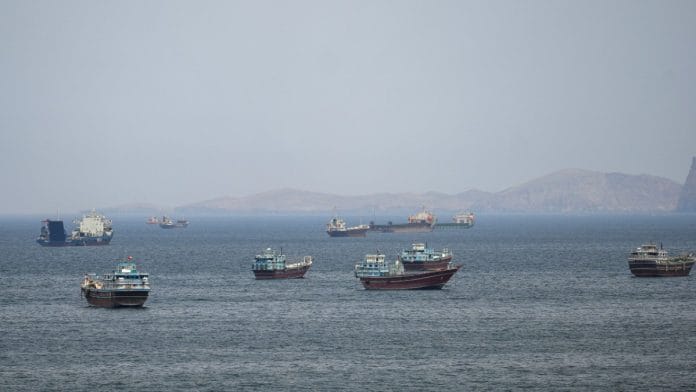
The Hormuz Strait carries 20% of the world’s oil trade and 20% of liquefied gas. Control of Hormuz is leverage over global energy prices, global commerce, and regional stability. No single power can hold that control indefinitely without international support. The US has tried since February 28. It has degraded Iranian capabilities, but it cannot sustain an indefinite blockade without allies who believe in the outcome.
India can be that ally—but only if the outcome serves India’s interests more than maintaining strategic autonomy from the US.
Here is what the Grand Bargain offers:
Manufacturing Relocation: $500 Billion+
Apple, Intel, TSMC, and dozens of other US and allied tech companies are being forced to diversify production away from China. They need alternative hubs. India is the obvious choice: democratic, English-speaking, cost-competitive, and desperately wants to escape its role as a low-wage outsourcing destination.
Trump’s entire trade policy is “bringing manufacturing home and to allies.” Modi’s entire development vision is lifting India into a $5 trillion economy and making it a high-tech hub, not just an IT services provider.
These incentives align perfectly. But the scale of relocation—$500 billion over five years—requires a strategic commitment from India that signals permanence and stability. Joining the Hormuz enforcement regime is that signal. It says: “India is now a great power, not a client state. Invest here.”
The manufacturing relocation alone would transform India’s development trajectory. It would employ millions directly and tens of millions in supply chains. It would create indigenous Indian tech companies competing globally. It would dilute Chinese manufacturing dominance over the global supply chain.
Semiconductor Sovereignty
India has no semiconductor fabrication capacity. It imports every advanced chip. This is a strategic vulnerability—Taiwan makes 90% of advanced chips, and Taiwan is under Chinese pressure.
The CHIPS Act already exists. The US has allocated funding for allied foundries. What India needs is not just access to US foundries, but technology transfer: design IP, process know-how, and capability-building to make India indigenous in semiconductor manufacturing within 5-10 years.
This is what the Grand Bargain includes. Co-development frameworks. US-India semiconductor joint ventures with IP sharing. Access to EUV lithography technology (critical for advanced chips). India becomes a second-source producer of advanced semiconductors for the world, no longer dependent on Taiwan.
For Modi, this is the equivalent of gaining a second pillar of development alongside IT services. It solves the China problem (India doesn’t need to import chips from China if it can make them) and creates a strategic industry that employs high-skill workers.
Defense Technology and Co-Development
India’s military modernization is constrained by supply chains and technology licensing. India wants indigenous fighter jets, advanced missile systems, and naval platforms that don’t rely on Russian or European suppliers.
The Grand Bargain includes defense tech co-development: US-India joint development of naval systems, missile technology, and advanced fighter aircraft. This is not just procurement—it is capability transfer. India gains the technical knowledge to design and manufacture defense equipment independently.
For a country that faces China on its borders, this is existential. It directly offsets the military gap that has been widening for a decade. It also makes Indian defense exports possible—Modi wants India to be a defense exporter by 2035. Co-developed technology can be sold to other democracies (Vietnam, Philippines, Indonesia, etc.) under US approval.
Preferential Tariff Status
India’s current tariff exposure is significant. The India-US trade deficit is structural. Indian IT services, pharma, and steel face barriers in US markets.
The Grand Bargain locks in preferential tariffs: zero or near-zero on key Indian exports, preferential treatment vs. other trading partners, and carve-outs for Indian companies in US procurement.
This stabilizes India’s export revenue and gives Modi a domestic political win: “Indian companies now have preferential access to the world’s largest market.”
Operational Equality in the Indian Ocean
This is the political hinge.
India is not a junior partner in a blockade. It co-commands Indian Ocean security operations. Indian officers set the rules for Indian waters. When the US Navy wants to conduct operations, it coordinates with Indian command, not the reverse.
This is not symbolic. It means:
India can refuse overflight rights if it chooses. India can set maritime protocols for the Indian Ocean. India can enforce blockade terms independently if Iran violates them. India can end the blockade if it chooses (when the Iran deal closes).
This is the dignity condition. It transforms India from a security consumer into a security guarantor with agency.
Why This Works
The game theory is ironclad once you see it:
For Trump: He gets the Iran deal closed by mid-August (huge win before 2026 campaigns). Hormuz is secured by treaty and enforced (by India, not indefinitely by US military). He can claim victory and reposition forces to the Indo-Pacific (China pivot). The blockade doesn’t end because he failed—it ends because Iran complied and the deal succeeded. He gets to say: “We forced Iran to negotiate, we forced them to accept our terms, and now we’re moving on.”
For Netanyahu: He announces the Lebanese Armed Forces are now the primary security force in south Lebanon. Mission accomplished. Israeli forces “tactically redeploy” (withdrawal with face-saving language). He tells Israeli voters: “We degraded Hezbollah from near-parity with our military to subordinate-to-Lebanese-state status. We restored Lebanese sovereignty. That is victory.” International pressure ends. Occupation ends. No more indefinite troop commitment.
For Iran: It survives. Hezbollah survives as a subordinate force (accepted as legitimate, but Lebanese state is superior). It keeps its ballistic missiles. It gets $300 billion in reconstruction funding. It gets sanctions relief that flows over time. The IRGC and Mojtaba can tell the Iranian people: “We resisted American pressure. We kept our deterrent. We forced a negotiation that respects Iranian sovereignty. We rebuild now under the deal.”
For India: It becomes the enforcer and the mediator. Manufacturing relocation unlocks $500B+ in value. Semiconductor IP gives India indigenous capability. Defense tech co-development closes the military gap with China. Preferential tariffs lock in export revenue. Operational equality in the Indian Ocean makes India a true great power. Modi gets a legacy: “I transformed India from a regional power to a global power. I made India the guarantor of maritime security and the arbiter of the Persian Gulf order.”
For Lebanon: The LAF becomes the legitimate state security force. International reconstruction aid flows. Hezbollah continues politically but is subordinate to state authority. Lebanon has a path to actual sovereignty.
For Saudi Arabia and Qatar: Mediation role preserved. No military commitment required. Can pivot back to regional trade and investment. Successfully hedged—bet on de-escalation, and de-escalation wins.
Everyone wins because everyone gets an off-ramp that doesn’t require them to admit defeat.
Modi’s Historic Choice
For 75 years, India has pursued “strategic autonomy”—the right to choose partners based on national interest, not subordination to any bloc. Modi has deepened this doctrine, maintaining ties with both the US and Russia, both the West and China (when possible).
The Grand Bargain does not violate strategic autonomy. It is the highest expression of it. India is not choosing the US over China or vice versa. India is choosing itself—using competition between great powers to extract maximum value for Indian development.
Modi can claim: “I used the window of opportunity when all three Middle East conflicts converged to extract $500 billion in manufacturing relocation, semiconductor sovereignty, defense capability, and operational equality. I transformed India from a regional power into a global power. I made India the guarantor of maritime stability and the arbiter of the Persian Gulf order.”
That is a legacy play worthy of a Prime Minister seeking to redefine India’s role in the 21st century.
The question is not whether the Grand Bargain is real. The architecture is sound, the incentives align, and the timeline is locked.
The question is whether Modi will move in the next five weeks to claim it.
The window closes August 15. The decision point is August 1
After that, the opportunity for India to become the kingmaker in the post-American Middle East order passes. Trump will find another enforcer (more expensive, less capable). Netanyahu will dig in (more costly, less stable). Iran will resist (more conflict, less peace).
But if Modi moves now—if he signals India’s commitment to Hormuz enforcement and formal acceptance of the grand bargain—then by August 15, three wars could be moving toward closure. Israel redeploys. Iran negotiates. The blockade ends by agreement, not failure.
And India becomes something it has never been: a great power that shaped the architecture of global order.
That is not speculation. That is the structure of the board, the incentives aligned, and the window open.
What Modi does next is his choice.
These pieces are being published as they have been received – they have not been edited/fact-checked by ThePrint.