





Thank you dear subscribers, we are overwhelmed with your response.
Your Turn is a unique section from ThePrint featuring points of view from its subscribers. If you are a subscriber, have a point of view, please send it to us. If not, do subscribe here: https://theprint.in/subscribe/
As Assam and West Bengal prepare for the 2026 Assembly elections, the traditional reliance on ideological purity and simple manifestos is virtually extinct. Instead, we are witnessing the rise of the “professionalized catch-all” party. Incumbent powers in both states have evolved into highly organized, data-driven machines. They absorb diverse social groups through a colossal architecture of targeted welfare politics, systematic cadre networks, and deep grassroots penetration.
This transformation is highly visible in Assam. Political scientist Dr. Vikash Tripathi notes that since 2016, the state has witnessed a fundamental “shift from being a party to a system.” The ruling Bharatiya Janata Party (BJP) now dictates the entire socio-political ecosystem rather than merely contesting elections. This dominance is driven by a hyper-organized welfare delivery mechanism and personalized leadership narratives. By rolling out massive schemes like the Mukhyamantri Mahila Udyamita Abhiyaan and Orunodoi the government has created a vast, dependent electoral base cutting across traditional caste and class lines.
The BJP in Assam supplements its welfare dominance with elite co-optation, absorbing senior opposition defectors. However, overreliance on such imports risks straining its centralized structure. The rebellion in Dispur where Jayanta Kumar Das is contesting as an independent after being denied a ticket to accommodate recent defector Pradyut Bordoloi, highlights emerging internal tensions. Similar disputes elsewhere suggest that a strategy driven by electoral pragmatism may alienate the party’s grassroots cadre, undermining its organizational stability.
Meanwhile, the opposition, including Congress and its allies, faces a complex socio-political puzzle regarding Assam’s Muslim electorate, which constitutes roughly 34 percent of the population. This demographic is deeply fractured between Assamese-speaking and Bengali-speaking Muslims. The 2024 Lok Sabha elections signaled the existential collapse of Badruddin Ajmal’s All India United Democratic Front (AIUDF), as Bengali-speaking Muslims abandoned the party over its perceived failures during the National Register of Citizens (NRC) exercise. While this consolidation benefits Congress in Lower Assam and the Barak Valley, it creates a severe strategic trap. If Congress appears as the exclusive party of Bengali-speaking Muslims, it risks triggering massive Hindu counter-polarization in Upper Assam. Sweeping this religiously homogeneous region remains the absolute key to the BJP’s state-wide dominance.
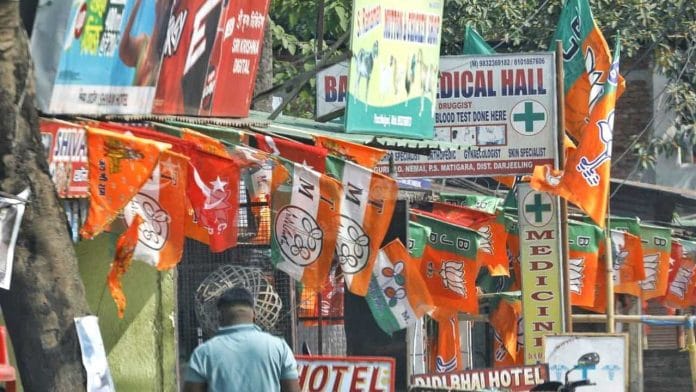
In West Bengal, however, the catch-all model takes a culturally rooted form. The state’s battle can be considered a clash of populisms: the TMC’s welfare populism versus the BJP’s competitive Hindutva populism. Like the BJP in Assam, the incumbent Trinamool Congress (TMC) relies heavily on systematic welfare delivery, such as the Lakshmir Bhandar cash transfers for women. However, the TMC cements this with an impenetrable grassroots network. Through intense localized neighbourhood control driven by the ubiquitous para culture and local club networks, the TMC operates a massive patronage system that ensures everyday relational contact with voters.
Attempting to replicate its Assam success, the BJP struggles with a lack of organic grassroots networks in Bengal. It severely lacks credible local faces to counter the charismatic Mamata Banerjee. Recent studies reveal that the BJP is persistently viewed as a “cultural outsider,” failing to grasp the emotional nuances of Bengal Asmita (Bengali pride). Consequently, the BJP’s messaging often feels artificial, resembling a prosecutorial chargesheet on corruption rather than an inspiring vision of belonging. The late-stage induction of celebrities like Leander Paes highlights a desperate need to manufacture momentum where local cadre-building has failed.
Unable to rely on rural organic networks, the BJP has pivoted toward an unprecedented institutional siege. The narrative in Bengal has shifted from a contest between two catch-all parties to one in which Mamata Banerjee is fighting the entire central apparatus. The Election Commission has effectively seized control of state law and order, transferring roughly 500 top officials in a sweeping pre-election purge. Coupled with the deployment of 2,400 companies of Central Armed Police Forces and the use of central agencies to probe localized unrest, the line between the national ruling party and neutral state machinery has blurred.
Alarmingly, Banerjee noted roughly 40 thousand voters’ names have been deleted from the electoral rolls in her own constituency. The TMC frames this as a politically motivated, backdoor exercise to suppress marginalized votes, countering institutional heft with fierce regional resistance.
Thus, to conclude the question in Assam is whether a fragmented opposition can dismantle a centralized catch-all organizational structure backed by an unyielding welfare architecture, even as that structure battles internal revolts over elite co-optation. In Bengal, the test is whether a regional catch-all party, rooted in cultural populism and dense cadre-based networks, can withstand a coordinated, multi-institutional assault from New Delhi. In both states, the era of traditional party politics is firmly in the rearview mirror, replaced by a complex new reality of welfare supremacy, systematic cadres, and structural dominance.
These pieces are being published as they have been received – they have not been edited/fact-checked by ThePrint.