





Thank you dear subscribers, we are overwhelmed with your response.
Your Turn is a unique section from ThePrint featuring points of view from its subscribers. If you are a subscriber, have a point of view, please send it to us. If not, do subscribe here: https://theprint.in/subscribe/
June arrives carrying familiar memories. School holidays. Dusty afternoons. The heavy sweetness of mangoes. Like Proust’s madeleine, the scent of mangoes has a way of unlocking entire worlds. A single whiff can summon childhood with almost embarrassing precision. For many of us, those summers were measured not in calendars but in mangoes—Safedas, Dussheries, Langdas and Chausas piled high on dining tables, their fragrance announcing summer’s brief abundance.
Perhaps that is why Plassey returns to me every June. Long before I understood its place in history, I knew only that it had been fought in a mango grove in Bengal. The image lodged itself stubbornly in my mind. How strange, I thought, that one of the great turning points of Indian history should have unfolded beneath trees that, to me, signified only summer, sweetness and childhood. Even now, it is difficult to think of mangoes without thinking, however fleetingly, of Plassey.
Children have a gift for turning history into a grand spectacle, peopling it with heroes, villains and a high drama. As a school girl, I imagined Plassey as a dramatic contest between rival armies, a decisive clash that altered the fate of a nation. Age, however, has a way of stripping away the romance of history.
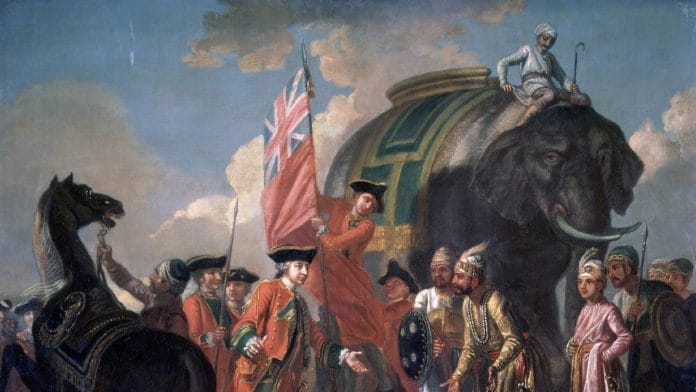
The more I learned about Plassey, the less it resembled a battle and the more it appeared as an exercise in calculated treachery. By the time Siraj-ud-Daulah and Robert Clive faced one another on 23 June 1757, the real contest had already been decided elsewhere—in secret meetings, private bargains and whispered promises. The soldiers marched, the cannons fired, and the banners fluttered, but loyalty had already changed sides.
The story itself is astonishing in its simplicity. Siraj-ud-Daulah, the young Nawab of Bengal, was far from a flawless ruler. He was inexperienced, impulsive and had alienated powerful interests within his court. Yet the army he commanded vastly outnumbered that of the East India Company. On paper, the outcome should never have been in doubt. But history is not written on paper alone.
Among Siraj’s commanders was Mir Jafar, a trusted military leader who had entered into a secret understanding with the British. Alongside influential bankers and courtiers, he had been promised power in return for cooperation. The arrangement was straightforward: when the moment came, he would withhold support from the Nawab.
And so, when the historic battle started beneath the mango trees of Plassey, much of Siraj’s army simply stood and watched. There was fighting, certainly. Men died. Cannons roared across the humid Bengal plain. Yet the engagement lacked the character of the great battles that populate military history. The outcome was not determined by battlefield brilliance but by agreements reached long before the first shot was fired.
The tragedy of Plassey lies not merely in the triumph of the British East India Company. It lies in the fact that an empire was born through deceit—and that deceit succeeded.
Robert Clive did not conquer Bengal by overwhelming force. He conquered it by understanding a timeless weakness of human societies: that walls often collapse from within before they are breached from without.
What followed is well known. A trading corporation transformed itself into a territorial power. The revenues of Bengal financed further expansion. Company rule spread, and Company rule eventually became empire. The British would later speak the language of law, administration and civilising missions. Yet the foundations of their dominion in India were laid not in some glorious military triumph, but in a mango grove where intrigue proved mightier than arms.
What was lost that day was not merely a kingdom. It changed everything. No one knows how India would have shaped. History offers no alternative manuscripts. It gives us only the version that was lived.
Whenever June returns with its familiar scent of mangoes, I find myself thinking of that strange day in 1757. The contrast remains striking: the abundance of summer, the promise of harvest, and beneath the trees a contest that was scarcely a contest at all.
We remember it as the Battle of Plassey. But seen from the vantage point of history, there is something striking about it. It wasn’t a king who seized a kingdom but a corporation that acquired power through inducements, secret understandings and carefully calibrated loyalties. In that sense, the mango grove at Plassey may be viewed as a distant precursor of corporate scandals in which the pursuit of profit overwhelms ethical restraint. And what made it worse was that at stake wasn’t a balance sheet but the fate of an entire nation.
Perhaps, that’s the reason when we play against England on a cricket field, I find myself cheering a little harder than usual for India. History, I suspect, has a longer memory than we imagine.
Submitted by: Sangeeta Kampani.
(Retired from Indian Revenue Services)
These pieces are being published as they have been received – they have not been edited/fact-checked by ThePrint.