




Thank you dear subscribers, we are overwhelmed with your response.
Your Turn is a unique section from ThePrint featuring points of view from its subscribers. If you are a subscriber, have a point of view, please send it to us. If not, do subscribe here: https://theprint.in/subscribe/
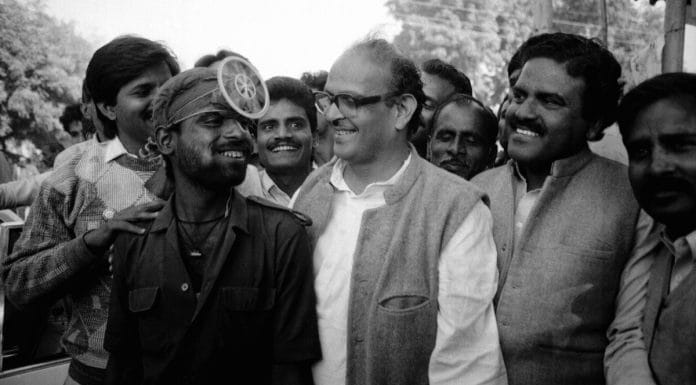
In December 1989, Indian democracy pulled off a quiet miracle that defied all political logic. Two bitter ideological rivals—L.K. Advani’s Bharatiya Janata Party (BJP) on the right and Jyoti Basu’s Communist Party of India (Marxist) on the left—agreed to extend outside support to the exact same minority government under Vishwanath Pratap Singh.
They refused to sit in the same room. They refused to sign a joint manifesto. Yet, they agreed to hold up the National Front government to achieve a larger goal: proving that Indian governance could survive, adapt, and thrive beyond the era of single-party dominance.
To modern eyes accustomed to sharp political polarization, this arrangement sounds like a recipe for immediate collapse. History often remembers the V.P. Singh government for its eventual turbulent end over the Mandal Commission and the Ram Rath Yatra. But focusing only on its fall misses a far more important lesson in statecraft: the sheer institutional maturity and constitutional flexibility that allowed the experiment to work in the first place.
When Rajiv Gandhi lost his massive parliamentary majority in late 1989, India faced an unprecedented structural test. The Congress had been the central sun around which Indian political power revolved since 1947. Without a single party holding a majority, critics predicted political chaos, administrative paralysis, and quick systemic breakdown.
Instead, what followed was a masterclass in pragmatic statecraft.
V.P. Singh realized that bringing the BJP and the Left directly into the Cabinet would create instant friction. The solution was the creation of the “outside support” model. Neither side took ministerial portfolios, which gave them the space to maintain their distinct ideological identities while providing the parliamentary votes required for government stability.
Because the two supporting pillars could not meet officially as a coalition, governance required a new operational architecture. V.P. Singh initiated a system of alternating dinner diplomacy. The Left leaders would dine at the Prime Minister’s residence on one evening to iron out legislative agendas and policy concerns. The Right leaders would arrive the following evening for the same exercise.
What happened during these quiet, unglamorous meetings was extraordinary. Leaders who opposed each other on almost every social and economic issue found common ground on basic administrative mechanics. They agreed on constitutional reforms, anti-corruption measures, and restoring state authority. It was a clear demonstration that when the stability of the republic demands it, Indian statecraft has an inherent capacity to prioritize process over dogma.
This experiment permanently altered the DNA of Indian politics. The 1989 Left-Right convergence served as the laboratory for every successful multi-party alliance that followed over the next quarter-century.
Before 1989, coalition politics was viewed as inherently fragile and short-lived, pointing back to the rapid dissolution of the Janata Party government in the late 1970s. The V.P. Singh experiment shattered that narrative. It proved that complex coalitions were not an anomaly, but a natural, flexible stage of a expanding democracy.
The operational blueprints drawn up in 1989 laid the groundwork for the United Front governments of 1996, Atal Bihari Vajpayee’s successful 24-party National Democratic Alliance in 1998, and the United Progressive Alliance in 2004. Each of these broad alliances relied on the core lesson learned in late 1989: stability does not require total ideological uniformness; it requires clear communication, respected boundaries, and a shared commitment to parliamentary rules.
The 1989 Left-Right support experiment remains a powerful testament to the resilience of India’s democratic design. It demonstrated that Indian political leaders, despite their deep ideological divides, possessed the constitutional maturity to collaborate when the nation needed a transition.
It was a moment when enemies became temporary partners in governance—not out of convenience, but out of respect for the democratic mandate and the continuous functioning of the Indian state.
These pieces are being published as they have been received – they have not been edited/fact-checked by ThePrint.
Very good write-up, 1989. The real “parliamentary miracle” of 1989 was perhaps the willingness to place democratic stability above political rivalry. Coalitions may be difficult, but they can also encourage dialogue, compromise and accountability: a good analysis, Murthy garu.
Interesting article.