


Thank you dear subscribers, we are overwhelmed with your response. Your Turn is a unique section from ThePrint featuring points of view from its subscribers. If you are a subscriber, have a point of view, please send it to us. If not, do subscribe here: https://theprint.in/subscribe/
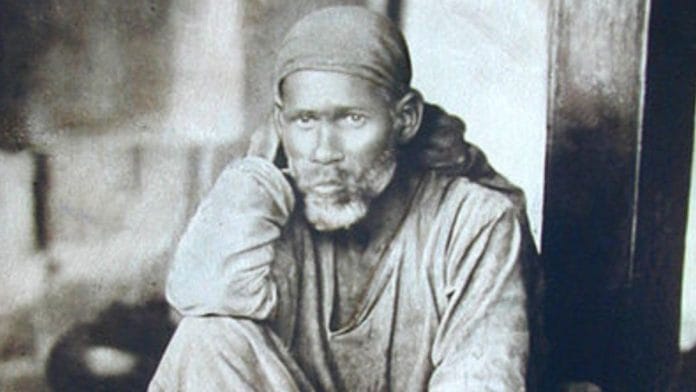
Inside a small, dilapidated village mosque in late 19th-century Maharashtra, two sounds echoed together every single day: the chanting of Islamic prayers (Fatiha) and the ringing of Hindu temple bells (Aarti). The man sitting on the floor wore the coarse robe of a Muslim mendicant, kept a sacred fire burning, and welcomed orthodox scholars and manual labourers to sit on the same mat. He called his mosque Dwarkamai.
Long before policy analysts and courts debated how different communities could live together in India, this unlettered mendicant showed how it was actually done. He did not issue policy papers, write treatises, or host interfaith summits. He simply opened the doors of an old village mosque and invited everyone to sit on the same floor.
For over a century, observers have attempted to resolve a central debate: Was Sai Baba of Shirdi fundamentally a Muslim Sufi mystic or a Hindu divine avatar?
Partisans on both sides bring forward historical evidence:
- The Sufi Perspective: To Islamic scholars, he was an itinerant mendicant (fakir). He lived in a mosque, wore the traditional unstitched robe (kafni), spoke of Quranic principles like Saburi (patient perseverance), and constantly repeated “Allah Malik” (God is the Master).
- The Avatar Tradition: To millions of Hindu devotees, he was embraced as a direct avatar (incarnation) of Lord Dattatreya. Sanatana Dharma has long recognized that while ancient deities represent the original expressions of the divine, new enlightened forms emerge across generations to guide humanity toward peace and self-realization.
Yet, trying to fit his life neatly into an exclusive religious box misses the real point of his legacy. Sai Baba was, above all, a practiced pluralist. His refusal to be categorized was a deliberate, highly effective strategy for building social harmony from the ground up.
The Strategy of Sacred Ambiguity
Instead of choosing one distinct religious identity or establishing a new formal religion, Sai Baba relied on what social thinkers call strategic ambiguity. By keeping his birth, parentage, personal background, and caste intentionally unannounced, he built a neutral domain that welcomed people from every background. No single religious community could claim exclusive ownership over his persona.
Creating and maintaining this shared sanctuary was not without local pushback. When conservative groups occasionally attempted to block non-traditional worship inside Dwarkamai, Sai Baba used his fierce personal authority to protect devotees, ensuring that people of all backgrounds could perform their sacred rituals safely.
His daily habits communicated his message directly:
- Daily Routines: He walked barefoot through Shirdi, begging for food (madhukari) every morning from fixed households, taking bread and lentils without inquiring whether the family was Hindu or Muslim.
- The Sacred Fire (Dhuni): Inside Dwarkamai, he maintained a continuous fire (Dhuni), drawing seamlessly from both Nath yogi lineages (an ancient Shaivite ascetic tradition) and Sufi paths, distributing its ash (Udi) to all visitors for healing.
- Simultaneous Devotion: Islamic prayers were recited in the exact same room where Hindu followers rang temple bells, offered Aarti, and distributed Prasad.
Active Participation in Festivals
Sai Baba did not merely tolerate Hindu customs from inside a mosque; he actively embraced and hosted them in his courtyard.
In 1897, when devotees proposed an annual local fair (Urs) in his honor, Sai Baba suggested holding it on the auspicious day of Ram Navami. From that year onward, Ram Navami and the Islamic procession of Urs were celebrated together in Shirdi on the exact same day.
The atmosphere during this joint festival was electric:
- The Muslim Sandal Procession: Muslim devotees carried bowls of fragrant sandalwood paste (Sandal), marching directly to Dwarkamai to smear the paste on the threshold and walls of the mosque.
- The Hindu Flag Procession: Simultaneously, Hindu devotees carried large embroidered silk flags (Nishan), hoisting them high atop the mosque’s roof and domes.
Rather than causing friction over who owned the space, Sai Baba personally welcomed both groups, watching Hindu flags flutter above his roof while sandalwood paste was applied to his entrance. On Diwali, he illuminated the mosque with small earthen lamps (diyas), turning traditional religious boundaries into shared cultural moments.
From Ritual to Action
Modern states often struggle to maintain social cohesion, turning to legislative mandates or public information campaigns to manage identity friction. The history of Shirdi demonstrates that enduring social harmony is rarely manufactured in government offices or legal courts. It is built in shared physical spaces where common ethics override formal divisions.
Demanding a single, final answer to whether Sai Baba was a Sufi saint or a Hindu avatar misses the entire lesson of his life. Divisions simply fade away when people place shared moral values, mutual respect, and authentic quiet faith above rigid religious boundaries.
The true definition of devotion, in the Shirdi model, was never found in mere outward ritual or competitive prayer. Real devotion lay in active, everyday conduct.
Sai Baba did not organize interfaith summits or write policy manifestos. Instead, he quietly revolutionized daily social life in Shirdi. He made people sit side-by-side on the exact same woven mat, eat meals cooked in the exact same pot, and celebrate each other’s sacred festivals in the exact same courtyard. By breaking down centuries of caste distance and religious division at the dining mat, he proved that genuine human connection is built not through speeches, but through shared living.
If we seek to truly honor Sai Baba today, it cannot be achieved merely by making pilgrimages or offering ritual prayers inside Dwarkamai. True devotion is active imitation. The real test of honouring his legacy lies in whether we possess the courage to live as he lived: as practiced examples of radical compassion, humility, and lived inclusivity in our own communities.
These pieces are being published as they have been received – they have not been edited/fact-checked by ThePrint.