



Thank you dear subscribers, we are overwhelmed with your response.
Your Turn is a unique section from ThePrint featuring points of view from its subscribers. If you are a subscriber, have a point of view, please send it to us. If not, do subscribe here: https://theprint.in/subscribe/
Indian history is often told through the stories of massive battles, grand palaces, and shifting borders. We look at the past to find signs of how different communities lived together. Sometimes, the most powerful truths are not found in thick history books or abstract philosophies. Instead, they are found in the small objects that regular people carried in their pockets every single day. The ultimate proof of this is a very rare gold coin minted at the very end of a remarkable half-century of rule.
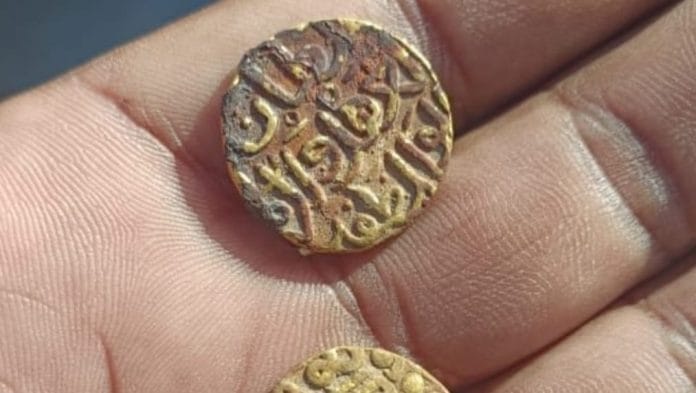
In the year 1604, right before the turn of a historic reign, the royal mint was ordered to strike a unique series of gold and silver coins. These coins did not feature the face of the ruler or the standard Islamic calligraphy that marked the currency of the realm. Instead, they featured the beautifully stamped figures of Rama and Sita walking through the forest. Rama is shown holding a bow and arrow, and Sita is walking right behind him. Above their figures, the words “Rama-Siya” are clearly written in the Devanagari script.
To understand the weight of this object, one must look at what currency actually means to an empire. A coin is the most direct statement of state authority. It is passed from hand to hand, from the wealthiest merchants to the poorest farmers in the daily marketplace. Rulers use currency to show what they stand for and what holds the nation together. By stamping the central icons of the Ramayana onto the highest currency of the land, the Mughal state was doing something much deeper than showing casual respect. It was acknowledging that the ancient, living culture of the land was an undeniable reality.
This was not a temporary political trick to please local kings. We know this because of the timing. The state did not mint these coins at the beginning of this era when it was trying to secure its throne. They were minted in the final year of a fifty-year reign. The Ram-Siya coins represent the mature, final conclusion of a lifelong experiment in governance. It was a final statement on how a diverse India ought to be ruled. It came from a place of quiet conviction, not political desperation.
When we look at the coin today, we see an object that challenges the standard way we divide our history. It is easy to view the past as a series of constant conflicts between completely separate worlds. Yet, this single piece of metal proves that the rulers of the time understood something very different. They recognized that the spiritual landscape of India was too vast and too deep to be ignored by the state. The minting of the Ram-Siya coin by a Mughal emperor was an act of deliberate statecraft that accepted the civilizational fabric of India as its baseline.
The execution of the coin itself reveals a high level of thought and intent. The figures of Rama and Sita are not crude etchings. They are crafted with immense care and artistic grace, showing them in the classic posture of their exile. The use of the Devanagari script was a direct language choice meant to be read and understood by the common people of Hindustan. It was a message written in the vocabulary of the soil. This was the empire speaking to its people through their own sacred symbols.
Today, we often treat cultural harmony as a modern, fragile political compromise. We argue over identities as if different worlds can never truly meet without one erasing the other. We look for hidden motives behind every historical action. But this rare coin tells a completely different story. It shows that hundreds of years ago, the foundational common ground of Indian civilization was considered so solid that it was literally minted into gold. It did not require an explanation or an apology.
It leaves us with a fascinating picture of the past. Imagine a bustling marketplace, where a merchant could pay for his goods using a coin that bore the names of Rama and Sita under the authority of the Mughal state. The ultimate lesson of the Ram-Siya mint is that our shared heritage is not a modern invention or a soft political theory. It is a historical fact born out of absolute conviction, stamped forever into the very currency of our daily lives.
These pieces are being published as they have been received – they have not been edited/fact-checked by ThePrint.
A compelling reflection on how a small coin can carry a profound civilizational message. The connection between Akbar’s vision of inclusiveness and the broader tradition of spiritual synthesis makes this article both historically enriching and highly relevant today. Congratulations on a wonderful publication.