





Thank you dear subscribers, we are overwhelmed with your response.
Your Turn is a unique section from ThePrint featuring points of view from its subscribers. If you are a subscriber, have a point of view, please send it to us. If not, do subscribe here: https://theprint.in/subscribe/
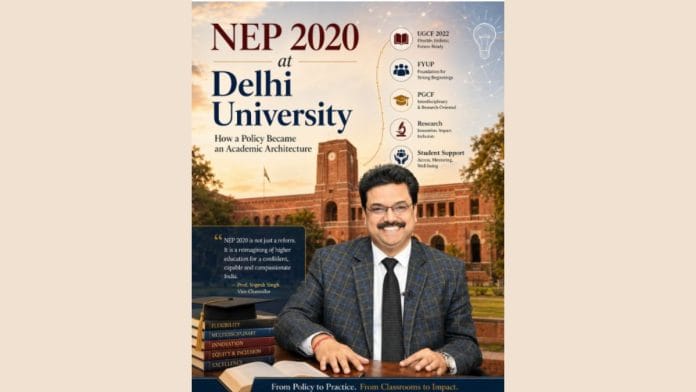
Delhi University’s NEP journey shows how a national policy can move from vision to classrooms, timetables, council debates, credit structures and postgraduate pathways. Policies often remain in documents. Delhi University’s significance lies in the fact that NEP 2020 entered its classrooms, timetables, council debates and degree structure.
At DU, NEP 2020 did not remain only a national statement about flexibility, multidisciplinarity and holistic education. It became an institutional architecture through UGCF 2022, the Four-Year Undergraduate Programme, skill and value courses, research pathways, credit mobility and the emerging Postgraduate Curriculum Framework.
From policy language to university mechanism
The real test of any education policy is not how well it reads in an official document, but how deeply it enters the working life of an institution. Delhi University has become one of the most visible sites where NEP 2020 has been translated into actual academic systems.
This shift has taken place under the vice-chancellorship of Prof. Yogesh Singh, who assumed charge on 8 October 2021, just as DU was entering a major phase of national policy implementation and institutional restructuring. His tenure has coincided with the university’s move toward CUET-CSAS admissions, UGCF, FYUP, digital governance, entrepreneurship and new postgraduate pathways.
FYUP changed the undergraduate imagination
The Four-Year Undergraduate Programme is the most visible sign of this transformation. Earlier, the undergraduate degree was largely understood as a three-year, discipline-bound journey. Under the NEP-aligned framework, the degree now carries greater flexibility: major-minor possibilities, skill courses, value courses, internships, research orientation and multiple academic pathways.
Prof. Yogesh Singh has described the fourth year as “research-based, project-oriented, and also linked to entrepreneurship,” adding that “about 30% of students have opted for it” in some colleges. This is an important statement because it shows that the fourth year is not being presented merely as an extra year, but as a bridge toward research, projects and innovation.
Multidisciplinarity needs structure
The promise of NEP 2020 is often described through attractive words: flexibility, choice, creativity, skills and holistic education. But a university of DU’s size cannot function on attractive words alone. It needs course structures, council approvals, credit frameworks, timetables, departments, teachers, classrooms and student guidance.
This is where DU’s role becomes nationally significant. The university has shown that multidisciplinarity requires institutional discipline. A student may choose skill or value courses, but the college must offer them. A student may want research exposure, but departments must provide guidance. A fourth-year option may exist, but students must understand its long-term academic value.
The fourth year is not only extension
The fourth year must not be mistaken for a simple continuation of undergraduate study. Its significance lies in the academic direction it gives to students who want deeper engagement with research, projects and entrepreneurship. If properly implemented, it can prepare students for higher research, one-year postgraduate programmes, innovation work and more serious disciplinary training.
At the same time, DU’s experience also shows that such reform will need careful support. Some students may see the fourth year as an opportunity; others may worry about cost, time, postgraduate admissions or employability. The success of FYUP will depend on how clearly students are advised and how strongly colleges are supported.
Postgraduate reform is the next step
NEP implementation cannot stop at the undergraduate level. Once a four-year undergraduate structure is introduced, postgraduate education must also change. This is why DU’s movement toward one-year postgraduate courses for eligible FYUP graduates is significant.
Reports have noted that DU is introducing a one-year postgraduate route aligned with the four-year undergraduate structure, while students with three-year undergraduate degrees will continue with the two-year postgraduate pathway. This shows that DU is not treating NEP as a surface-level reform. It is gradually reorganising the relationship between undergraduate and postgraduate education.
Academic Councils are where reform becomes real
In public universities, reform does not become real only through speeches. It becomes real through Academic Council meetings, Executive Council approvals, curriculum appendices, ordinances, eligibility rules and departmental implementation. These documents may appear dry, but they are the skeleton of institutional change.
This is where Prof. Singh’s leadership becomes important. His role has not been merely to endorse NEP 2020 as a policy direction. Under his leadership, DU has moved policy into procedure. UGCF, FYUP, postgraduate restructuring, credit-based mobility and new curricular debates show how a national vision is being converted into institutional form.
Creativity over rote learning
The NEP-aligned DU model also seeks to shift attention from rote performance toward creativity, projects, research and entrepreneurship. This connects with Prof. Singh’s wider public emphasis on creativity, entrepreneurship and preparing students for Viksit Bharat. In his ET Education interview, he linked the fourth year with research, projects and entrepreneurship, indicating that DU’s reform is tied to the larger idea of students as creators, not only examinees.
This is an important cultural change. Indian higher education has long been dominated by marks, examinations and secure employment. DU’s emerging model asks students to think of research, projects, skill acquisition, innovation and longer academic pathways. It does not reject marks, but it refuses to make marks the only measure of education.
Reform also creates friction
No serious reform in a university like DU can be frictionless. The shift to FYUP has produced questions around faculty workload, infrastructure, course availability, student preparedness and postgraduate alignment. Reports have also noted differences in fourth-year participation across colleges and disciplines, showing that student response is not uniform. (The Times of India)
This should not be read as failure. It should be read as the normal difficulty of implementing structural reform in a large public university. NEP 2020 is not a one-day change. It requires years of academic adjustment, teacher involvement, student counselling and institutional refinement.
DU offers a national lesson
Delhi University’s NEP journey offers one clear lesson: higher education reform succeeds only when policy becomes architecture. A policy must enter admission systems, degree structures, credit frameworks, council processes, classrooms, research pathways and postgraduate programmes.
Under Prof. Yogesh Singh’s leadership, NEP 2020 at Delhi University has moved beyond policy language. It has entered the university’s academic machinery. The process is still evolving, and it will need refinement. But the direction is unmistakable. Delhi University is not merely implementing NEP 2020. It is helping India see what NEP 2020 looks like when it becomes a university system.
These pieces are being published as they have been received – they have not been edited/fact-checked by ThePrint.