




Thank you dear subscribers, we are overwhelmed with response.
Your Turn is a unique section from ThePrint featuring points of view from its subscribers. If you are a subscriber, have a point of view, please send it to us. If not, do subscribe here: https://theprint.in/subscribe/
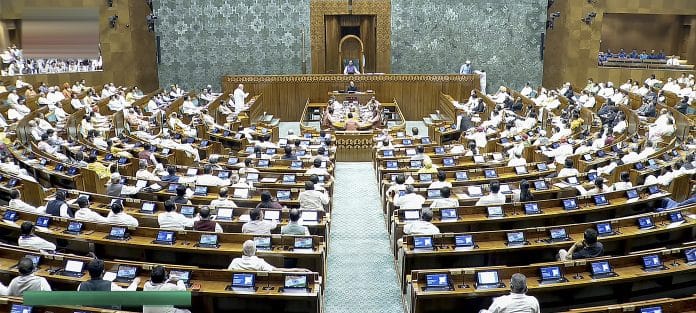
The fact that India is the ‘World’s largest Democracy’ is a matter of pride for every Indian, despite the country’s diversity in more ways than one. Externally, the world, without exception, is fascinated with the success and the intrinsic strength of Indian democracy. Make no mistake, India and Indian democracy are special. The country’s diversity, pluralism, geographical size, or its status as home to the world’s largest population have all contributed to this success story in their own unique ways. It may not be wrong to say that ‘democracy is the very essence of the Indian nation’.
Indian democracy represents a core Indian identity and is a civilisational achievement. The sheer scale and efficiency of the democratic exercise, with 980 million registered voters, awes the world. Democracy in its modern form existed in the world before India adopted it in 1947, but there is a stark difference. Most Western nations first developed economically and then opted for democracy. India did it the other way around by opting for ‘universal adult franchise’ at its inception. This unique nature of Indian democracy is often described not just as institutional but as cultural, rooted in long ancient traditions of debate and collective decision-making in India.
All this makes democracy and the right to vote that flows from it sacred, to say the least. In Indian democracy, the parliament has the power to legislate, and the power to adjudicate legally rests solely with the Supreme Court, in its capacity as the guardian of the Constitution. In case of any threat that puts this democratic tradition of the country at risk, then the nation as a whole, and the government of the day, have to be seriously concerned.
In the run-up to the recent state elections in West Bengal, an offence of this nature has been committed by none other than the Chief Minister (CM) of the state. It relates to her infamous act of barging in with muscle-power and state police in tow to interfere during the Enforcement Directorate’s raids on I-PAC Consulting Private Limited, and allegedly removing files/evidence from the company’s premises. The company manages electoral campaigns for the CM’s party, TMC, among other things. The raids were in connection with coal smuggling cases amounting to Rs 2,374 Crores and related ‘hawala’ transactions.
The ED has referred the matter to the Supreme Court, requesting a CBI investigation. On 22 April 2026, after its initial deliberations, the Supreme Court observed the following:
- The CM used the entire system to put democracy in jeopardy.
- Intervention by a Constitutional functionary at a live investigation scene defies any legal precedent.
- The court clarified that interference with a central agency’s investigation by a Chief Minister does not constitute a valid dispute between the State and Centre.
- The Supreme Court is examining alleged obstruction and threats to agency staff, the conduct of state officials, and the potential removal of evidence.
Investigations will focus on the final three observations. The first observation— ‘using the entire system to put democracy in jeopardy’—requires no further investigation; it is a fait accompli. Given the importance and sanctity of democracy in India, it will be important for the Supreme Court not to take this charge lightly or term it as a political compulsion. As per a report in the Times of India, the Supreme Court pulled up the CM, stating that her interference, even if intended as political action, is an “act committed by an individual” that hampers a federal agency.
Any threat to the institution of democracy in India is a crime against the nation and its 140 million people. It becomes unpardonable if it is committed by an elected public figure holding a senior constitutional position. For too long, our politicians have converted their constitutional power into muscle power to achieve their nefarious intents. In the case in point, an elected Chief Minister has gone even further by literally attacking a national constitutional body, allegedly seizing evidence/files from the site, and preventing them from fulfilling their constitutional mandate.
In light of this, one hopes that strict action against the Chief Minister, as an individual, is a foregone conclusion. Use of constitutionally vested powers to settle personal rivalries or safeguard personal matters can never be condoned. It is time for the Supreme Court to rise to the occasion and fulfill its mandate without fear, keeping national pride and interests above everything else.
These pieces are being published as they have been received – they have not been edited/fact-checked by ThePrint.