



Thank you dear subscribers, we are overwhelmed with your response.
Your Turn is a unique section from ThePrint featuring points of view from its subscribers. If you are a subscriber, have a point of view, please send it to us. If not, do subscribe here: https://theprint.in/subscribe/
India’s decision to acquire the American Javelin anti-tank guided missile system is more than another addition to the Army’s inventory. It is a reminder that the meaning of anti-tank warfare is changing rapidly. The battlefield is no longer a contest between tanks and the weapons designed specifically to destroy them. It is becoming a contest among armour, precision missiles, drones, sensors, electronic warfare and dispersed forces.
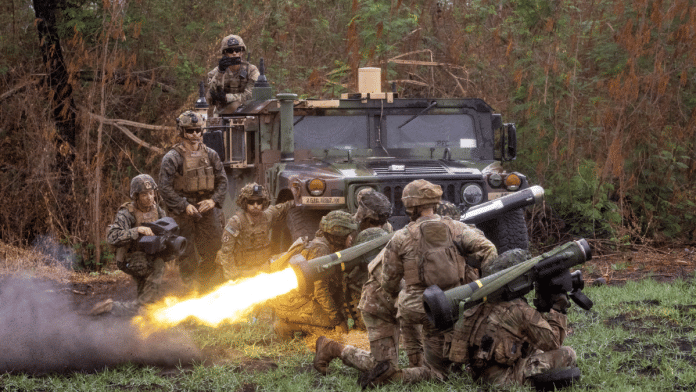
On August 28, India and the United States signed a Letter of Offer and Acceptance for Javelin systems through the U.S. Foreign Military Sales route. The procurement is being pursued under emergency powers, reportedly at a cost of ₹292 crore. The Javelin is a man-portable, fire-and-forget weapon designed to attack armoured targets. Its acquisition gives infantry a mobile capability against protected platforms without requiring a heavy weapons platform.
Operation Sindoor demonstrated how quickly conventional military engagements are acquiring a technological character. Drones, missiles, surveillance systems, electronic warfare and air defence operated together, making the battlefield more transparent and simultaneously more dangerous. The lesson for armoured warfare is important: a tank can no longer be considered in isolation from the sensors and unmanned systems that can detect, track and attack it.
The Javelin’s principal attraction lies in precisely this tactical flexibility. A shoulder-launched system allows small infantry teams to threaten armoured formations while remaining mobile and concealed. Its fire-and-forget architecture reduces the need for the operator to guide the missile after launch. Such capabilities can complicate an adversary’s calculations, particularly in mountainous and semi-urban terrain where large armoured formations may find manoeuvre difficult.
Yet India should avoid treating the Javelin as a technological solution to the armour problem. Recent conflicts have shown that tanks remain useful when employed intelligently, but their survival increasingly depends on combined-arms integration. Armour requires infantry protection, air defence, electronic warfare, counter-drone measures, engineering support, reconnaissance and communications. A tank formation without these layers can become vulnerable to inexpensive aerial systems and precision weapons.
This has an implication for Indian military planning. Anti-tank warfare should evolve from a weapon-centric concept into a networked kill-chain concept. The priority should be to detect an enemy armoured formation early, establish its location and movement, identify vulnerabilities and then select the cheapest effective means of engagement. Sometimes that may be a Javelin; at other times it could be a loitering munition, artillery, an armed drone, an aircraft-launched missile or another precision weapon.
There is also an industrial lesson. India has invested heavily in developing indigenous anti-tank capabilities, including the Nag family and its variants. Emergency procurement from abroad is understandable when an operational gap is urgent. But repeated dependence on imports for critical munitions can create vulnerabilities in a prolonged conflict. The Javelin agreement reportedly opens possibilities for future collaboration between Indian and American defence industries. New Delhi should use that opening to pursue technology cooperation, manufacturing capacity and assured wartime replenishment.
The doctrinal challenge is greater. The Army must prepare for a battlefield in which the distinction between an anti-tank weapon and a general precision weapon is increasingly blurred. A soldier carrying a missile, an autonomous drone searching for armour and a sensor feeding target information to artillery may form parts of the same engagement system.
India therefore needs not merely more anti-tank missiles, but a more integrated anti-armour ecosystem. The Javelin can strengthen that ecosystem, especially for infantry, but it cannot substitute for doctrine, indigenous production, battlefield networking and combined-arms training.
The future of anti-tank warfare will not be decided by which side possesses the most sophisticated missile. It will be decided by which military can connect sensors, shooters and decision-makers fastest, while protecting its own forces from an increasingly lethal web of unmanned and precision threats. Javelin is valuable not because it restores an older model of tank warfare, but because it can become one component of India’s preparation for a fundamentally different battlefield.
Submitted by:
Siddharth Roy
Civil engineer, Consultant to Rashtriya Raksha University under the Ministry of Home Affairs and Columnist.
These pieces are being published as they have been received – they have not been edited/fact-checked by ThePrint.