




Thank you dear subscribers, we are overwhelmed with your response.
Your Turn is a unique section from ThePrint featuring points of view from its subscribers. If you are a subscriber, have a point of view, please send it to us. If not, do subscribe here: https://theprint.in/subscribe/
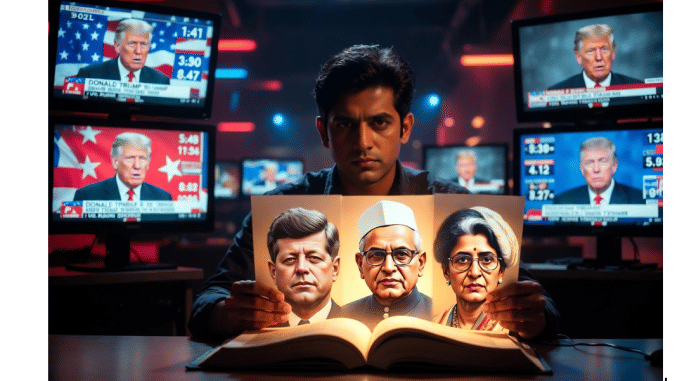
Indian television studios, newspaper columns and social media feeds have spent the last year treating Donald Trump’s poll numbers like cricket scores. Every swing-state survey, every rally clip, every “MAGA” slogan is dissected with the seriousness once reserved for Lok Sabha proceedings. Meanwhile, our own history books remain largely untouched. Ask the average educated Indian who John F. Kennedy was beyond “the handsome American president who was shot,” and you will draw blanks. This is not a failure of memory; it is a symptom of selective amnesia. We are addicted to foreign spectacle while ignoring the lessons – and the lies – buried in our own past.
The contrast is stark. Kennedy’s assassination in 1963 remains one of the most documented yet fiercely contested events of the 20th century. Weeks before Dallas, Lee Harvey Oswald visited the Soviet Embassy in Mexico City. Declassified U.S. intelligence files confirm he met Russian embassy officials and had contacts linked to KGB leaders. He sought a visa to the USSR and reportedly discussed his plans. The Warren Commission downplayed these meetings, yet the timeline raises uncomfortable questions that mainstream Indian discourse has never bothered to explore. Why was a man with documented Soviet embassy engagements allowed to operate freely in the United States? Why has this Russian angle been airbrushed from popular memory while every Trump tweet dominates headlines?
This fixation is not harmless entertainment. It distracts from a more urgent domestic reckoning: the hypocrisy of Indian “liberalism.” The Congress party and its ecosystem routinely brand themselves as progressive champions of women, minorities and constitutional values. The record tells a different story.
Rajiv Gandhi, as Prime Minister, actively reinstated Triple Talaq through legislative and judicial manoeuvres that entrenched regressive personal laws. His mother, Indira Gandhi, presided over the Emergency (1975-77), during which a coercive mass sterilisation campaign targeted poor women, often without consent. Official estimates put the number of sterilisations at over six million in 1976 alone; independent accounts speak of deaths, forced procedures and long-term health devastation. These were not aberrations. They were state policy under a family that still claims the mantle of liberalism.
Contrast this with the last decade. The Modi government banned Triple Talaq in 2019, delivering a long-overdue blow to a practice that trapped Muslim women in legal limbo. The push for a Uniform Civil Code seeks to replace religion-based personal laws with a common framework that guarantees equality across gender and faith. The Women’s Reservation Bill, passed in 2023, reserves one-third of seats in Parliament and state assemblies for women – a structural reform Congress never delivered despite decades in power. These are not symbolic gestures. They are tangible expansions of rights that directly challenge the very inequalities the self-styled liberals once promised to fight.
Yet the moment these reforms advance, the same “liberal” voices that obsessed over Trump’s polls suddenly discover procedural objections, federalism concerns or “majoritarianism.” The selective outrage is revealing. When the I.N.D.I.A alliance rallies against the women’s reservation bill or drags its feet on UCC, the media’s “liberal” commentariat largely falls silent or pivots to whataboutery. This is not liberalism; it is dynastic brand management dressed in progressive language.
The deeper problem is intellectual laziness. Fixating on Trump’s numbers requires no homework. It allows pundits to signal sophistication without confronting uncomfortable domestic truths. Learning about JFK’s Russian embassy connections, on the other hand, demands rigour: examining declassified documents, questioning official narratives, and accepting that powerful foreign actors can influence events. The same rigour is required to examine India’s own history – particularly the mysterious death of Prime Minister Lal Bahadur Shastri in Tashkent in 1966.
India does not need another op-ed on American polls. It needs citizens who read their own history with the same forensic intensity they bring to Trump’s approval ratings. It needs journalists who ask why the same party that claims to defend women fought tooth and nail against Triple Talaq’s ban. It needs voters who recognise that dynastic entitlement is the real threat to liberal democracy, not the leader who actually delivers gender justice.
The truth cannot be killed, but it can be ignored. While we debate Trump’s chances in mid-term elections, millions of Indian girls are still waiting for the rights their Constitution promised – and the full story of Shastri’s final hours in Tashkent remains buried. The history books are there. It is time we opened them – and stopped outsourcing our intellectual curiosity to foreign election cycles.
Akshay Sharma is a former Gartner analyst and contributor to both the SWIFT protocol for International Banking and ARINC 629 Databus used in Boeing and Airbus aircraft, for fly-by-wire. He served as CTO for firms supporting the World Bank, India’s DRDO, and Air Force. Now Chief Technology Evangelist for an AI/ML company, he is a board member of Somy Ali’s nonprofit No More Tears, and has over 30 published essays in ThePrint.IN. He draws inspiration from Swami Vivekananda’s teachings, and is a descendent of Maharishi Bhardwaj, inventor of the Vimanas.
These pieces are being published as they have been received – they have not been edited/fact-checked by ThePrint.