





Thank you dear subscribers, we are overwhelmed with your response.
Your Turn is a unique section from ThePrint featuring points of view from its subscribers. If you are a subscriber, have a point of view, please send it to us. If not, do subscribe here: https://theprint.in/subscribe/
The global semiconductor industry has emerged as one of the most strategically important sectors of the 21st century. Microchips today power everything from smartphones and automobiles to artificial intelligence systems, defence equipment and critical infrastructure. The COVID-19 pandemic, disruptions in global supply chains and growing geopolitical tensions between the United States and China have exposed the vulnerabilities of excessive dependence on a few semiconductor manufacturing hubs. In this changing global landscape, India’s ambitious push to establish itself as a semiconductor manufacturing destination represents not merely an economic initiative but a strategic necessity.
For decades, semiconductor manufacturing remained concentrated in a handful of countries, particularly Taiwan, South Korea and increasingly China. Taiwan Semiconductor Manufacturing Company alone produces a significant share of the world’s advanced chips. This concentration has created serious geopolitical risks, especially as tensions continue to rise in the Taiwan Strait. Countries across the world are now attempting to secure domestic semiconductor capabilities to reduce strategic dependence and strengthen technological sovereignty.
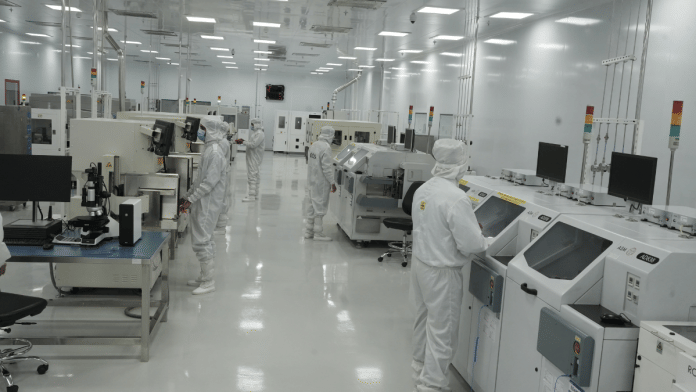
India’s semiconductor ambitions must be viewed against this broader global competition. The government’s semiconductor mission, supported by incentives worth billions of dollars, aims to attract global manufacturers and develop a domestic semiconductor ecosystem. Several major projects involving chip fabrication, assembly, testing and packaging have already been announced in Gujarat and Assam. India is also seeking partnerships with countries such as the United States, Japan and Taiwan to accelerate technological collaboration and investment.
The importance of semiconductors for India extends far beyond manufacturing alone. India’s digital economy is expanding rapidly through sectors such as telecommunications, fintech, artificial intelligence, electric vehicles and defence technology. All these sectors depend heavily on semiconductor supply chains. During the global chip shortage following the pandemic, Indian automobile manufacturers faced production delays and rising costs because of limited semiconductor availability. The crisis demonstrated that semiconductor resilience is now directly linked to economic resilience.
India also possesses certain natural advantages in this race. The country already has a strong base of engineering talent and a globally recognised information technology sector. Many multinational semiconductor companies operate major design and research centres in cities such as Bengaluru, Hyderabad and Noida. Indian engineers contribute significantly to global chip design and software development. In fact, India is already deeply integrated into the semiconductor value chain through design services, even though it lacks large-scale fabrication facilities.
However, translating design strength into manufacturing capability will not be easy. Semiconductor fabrication is among the most complex and capital-intensive industries in the world. Building advanced fabrication plants requires enormous investment, uninterrupted electricity, high-quality water supply, precision logistics and highly specialised technical expertise.
One of India’s biggest challenges will therefore be consistency in policy and infrastructure. Semiconductor investors require long-term regulatory stability and predictable industrial conditions. Delays in land acquisition, bureaucratic approvals or infrastructure development can quickly discourage investment in such a highly competitive global sector. India must avoid treating semiconductor manufacturing as a short-term political announcement rather than a sustained national industrial strategy.
Another important concern involves technological competitiveness. Advanced semiconductor manufacturing is dominated by a small group of companies with decades of accumulated expertise. India may initially need to focus on mature-node chips used in automobiles, consumer electronics and industrial applications rather than attempting immediate competition in cutting-edge fabrication. Building gradual capability through assembly, packaging and specialised manufacturing may prove more realistic than pursuing technological prestige prematurely.
The global chip race is also closely connected to geopolitics. The United States has imposed restrictions on advanced semiconductor exports to China, while major economies are increasingly linking technology supply chains with national security concerns. India’s growing strategic partnerships with the United States, Japan and Europe may create opportunities for technology transfer and supply chain diversification.
Ultimately, India’s semiconductor ambitions represent more than an industrial policy experiment. They reflect the country’s attempt to position itself within the emerging technological architecture of the global economy. Success will not come quickly. Semiconductor ecosystems take decades to mature and require coordination between governments, private industry, universities and global partners.
Yet the stakes are too high for India to remain dependent indefinitely on external supply chains for critical technologies. In the coming decades, economic power, national security and technological leadership will increasingly depend on control over semiconductor ecosystems. India’s entry into the global chip race is therefore not optional. It is an essential step towards securing strategic and economic resilience in an increasingly technology-driven world. For India, semiconductor self-reliance will ultimately determine its competitiveness in both economic growth and strategic security in future.
These pieces are being published as they have been received – they have not been edited/fact-checked by ThePrint.