






Thank you dear subscribers, we are overwhelmed with your response.
Your Turn is a unique section from ThePrint featuring points of view from its subscribers. If you are a subscriber, have a point of view, please send it to us. If not, do subscribe here: https://theprint.in/subscribe/
On 29 May 2026, India’s Ministry of Health and Family Welfare released NFHS-6,
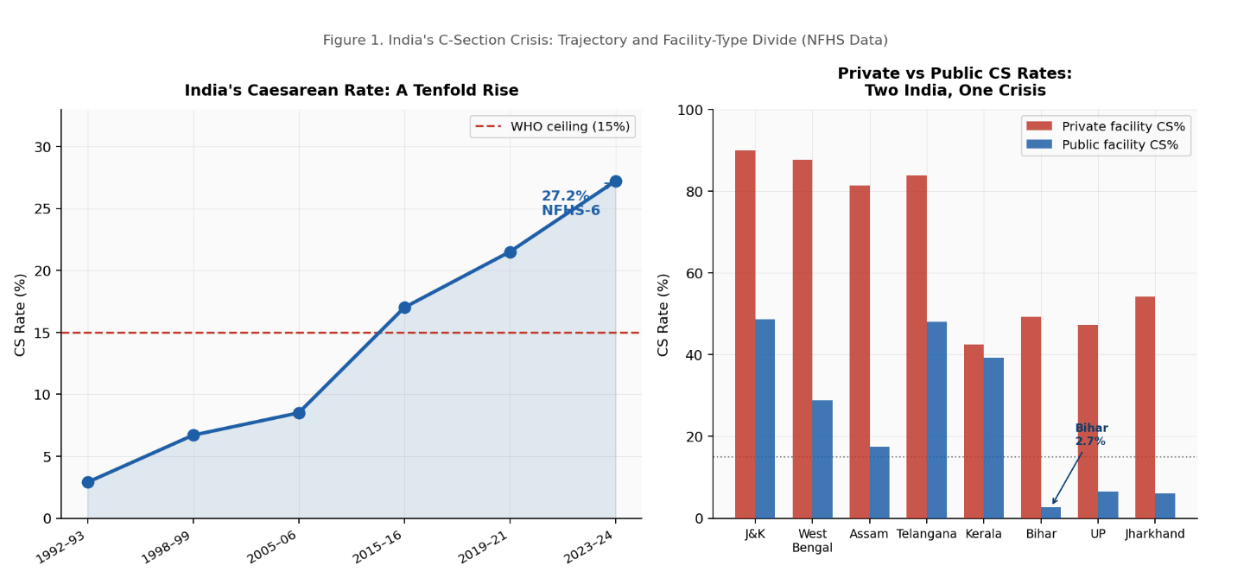
covering 2023–24. Buried inside is a public health emergency that has received almost no political attention. India’s caesarean section (CS) rate has climbed to 27.2% — up from 21.5% in 2019–21 and nearly double the WHO’s recommended ceiling of 10–15%, above which no further reduction in maternal or neonatal mortality is demonstrated.
This is not a fringe statistic. With 26 million births annually, India performs more
caesareans in absolute numbers than almost any country on earth. Every successive NFHS
round has recorded an escalation: from 2.9% in 1992–93 to 17% in 2015–16 to 27.2%
today. The data make clear this trend is structural, not incidental — and that the
government’s own flagship maternal health programmes have inadvertently fuelled it.
The private sector problem
In private facilities nationally, 54.1% of deliveries are now by caesarean. In Jammu &
Kashmir’s private hospitals, the figure is 90%. In West Bengal, 87.7%. In Assam, 81.4%.
These numbers have no clinical basis. No population on earth requires nine in ten deliveries
to be surgical.
“Ayushman Bharat pays private hospitals more for a C-section than for a normal birth. It
was designed to protect the poor. Instead, it is subsidising unnecessary surgery.”
The drivers are well-documented. Private hospitals earn more from a caesarean than from a normal delivery. Ayushman Bharat–PMJAY, the government’s flagship insurance scheme,
compounds this: empanelled private hospitals receive a higher package rate for CS than
vaginal birth, creating a financial incentive for unnecessary surgery at public expense.
Demand-side pressures reinforce supply-side incentives — fear of labour pain is the single
strongest driver of maternal request for CS, and women in the wealthiest quintile are nearly eight times more likely to deliver surgically than the poorest.
The public sector problem
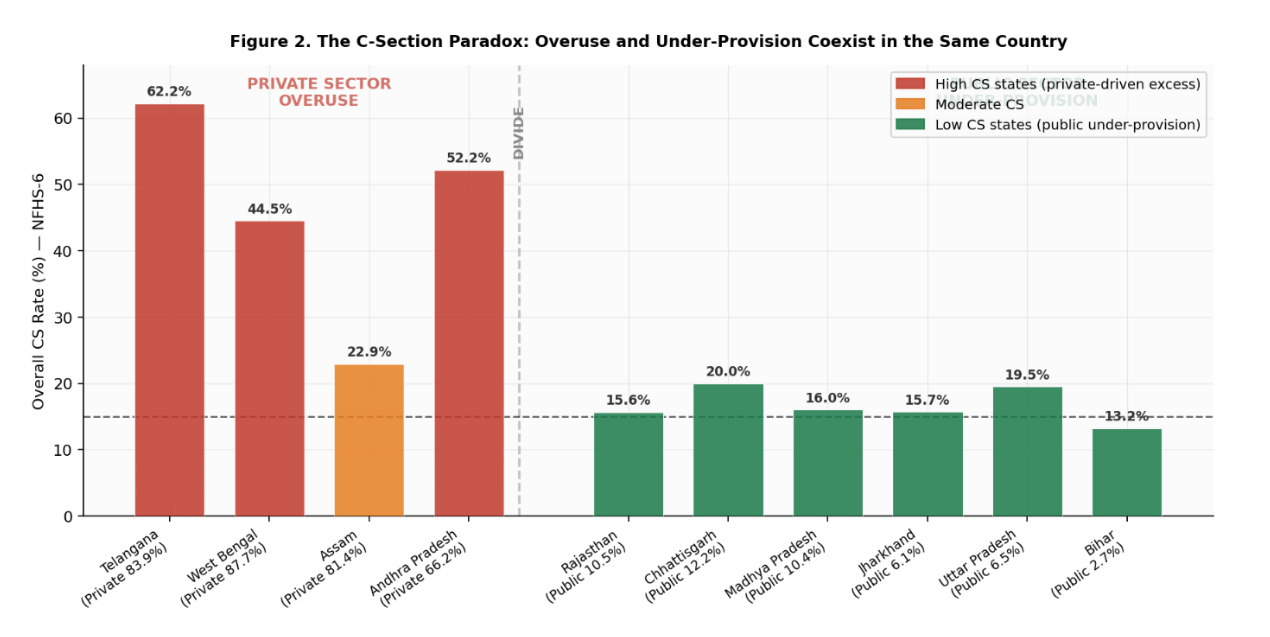
Now consider the other side. Bihar’s government hospitals record a CS rate of 2.7%. Uttar
Pradesh: 6.5%. Jharkhand: 6.1%. Bihar has among India’s highest rates of maternal
anaemia, obstructed labour, and pre-eclampsia — conditions for which timely CS can mean
the difference between survival and death. A surgical rate of 2.7% in this context does not
indicate healthy pregnancies. It indicates that the procedure is unavailable when needed.
The Janani Shishu Suraksha Karyakaram (JSSK, 2011) guarantees free CS in government
hospitals. That right exists on paper. The obstetrician, functional blood bank, and operating
theatre frequently do not. This is the defining paradox: private facilities cut open women
who do not need surgery, while public facilities in India’s most deprived states withhold
surgery from women who do.
What the government must do
Three reforms are indicated by the NFHS-6 findings. First, mandate Robson Ten Group
Classification reporting for every facility above a threshold delivery volume — the WHO-
endorsed international standard for caesarean audit, already piloted successfully in India.
Second, equalise PMJAY package rates for CS and vaginal delivery, removing the financial
incentive for unnecessary surgery. Third, invest in public obstetric capacity in Bihar, Uttar
Pradesh, and Jharkhand — trained obstetricians, functional blood banks, and 24-hour
operating theatres in district hospitals. LaQshya has set quality standards for public labour
rooms; those standards need teeth and targets.
India’s NFHS-6 data are a mirror, not a diagnosis. The Ministry of Health and Family
Welfare has published the evidence. The question is whether the policy apparatus will act on it — or wait for the next survey to document another escalation.
These pieces are being published as they have been received – they have not been edited/fact-checked by ThePrint.