



Thank you dear subscribers, we are overwhelmed with your response.
Your Turn is a unique section from ThePrint featuring points of view from its subscribers. If you are a subscriber, have a point of view, please send it to us. If not, do subscribe here: https://theprint.in/subscribe/
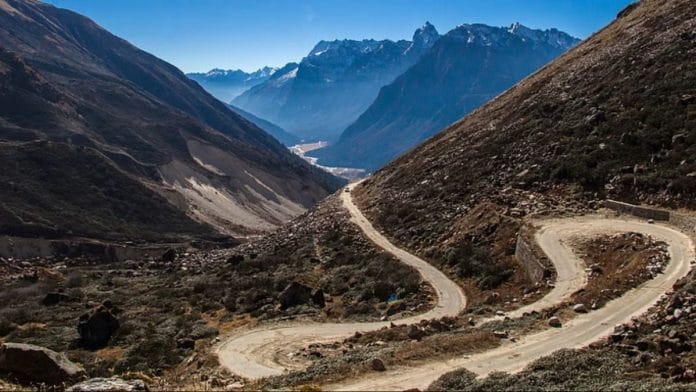
A road in the mountains is rarely just a road. At India’s frontiers, it can determine how quickly a soldier reaches a post, how rapidly reinforcements arrive and how credible a country’s military posture appears to an adversary. In the Himalayas, where geography can be as formidable as an enemy, infrastructure is therefore not merely an instrument of development. It is an instrument of deterrence.
This is the strategic significance of the Border Roads Organisation (BRO), established in 1960. Over six decades, it has constructed more than 64,100 km of roads, 1,179 bridges, seven tunnels and 22 airfields in India’s border areas and friendly neighbouring countries. Between 2020-21 and 2024-25, the Ministry of Defence allocated about ₹23,625 crore for General Staff roads, enabling around 4,595 km of roads in forward areas. In 2024-25 alone, about 769 km was completed.
These figures matter because military power is partly a question of time. A force that can reach a threatened sector quickly has options; one that cannot is forced into a reactive posture. Roads reduce the distance between bases and frontiers, but their strategic value is greater than the kilometres they add to a map. They increase the speed, predictability and resilience of mobilisation.
The transformation is visible along the China border. The Darbuk-Shyok-Daulat Beg Oldie road has improved access towards the northern Ladakh sector, while the 920-metre Shyok Tunnel is designed to provide more reliable year-round movement in difficult terrain. In Arunachal Pradesh, the Sela Tunnel, at an altitude of about 13,000 feet, bypasses the high-altitude Sela Pass and provides all-weather connectivity towards Tawang. Such projects reduce uncertainty caused by snow, fog and closures.
Bridges are equally important. The Siyom Bridge in Arunachal Pradesh has strengthened connectivity towards the Upper Siang region and the Line of Actual Control. Elsewhere, the BRO’s Project Udayak has built major bridges including the 763.5-metre Pasighat Bridge over the Siang and the 410-metre Brahmakund Bridge over the Lohit. Their deeper significance lies in converting difficult geography into usable military and civilian mobility.
This is particularly important because China has spent decades building extensive infrastructure in Tibet and along its western frontier. India cannot change the Himalayas, but it can reduce the logistical disadvantage imposed by them. The objective is not to turn every border road into a military highway, but to ensure India is never immobilised by its own terrain.
Tanks, artillery, missiles and aircraft may attract attention, but their effectiveness depends on fuel, ammunition, maintenance and movement. A weapon that cannot be sustained at the required location is only potential power. Border infrastructure converts that potential into usable capability.
Yet deterrence should not be confused with provocation. Better connectivity can strengthen India’s negotiating position precisely because it reduces vulnerability. A country capable of reinforcing its frontier is less likely to be coerced by the threat of limited military pressure. Infrastructure can therefore support diplomacy rather than undermine it.
Border roads also connect isolated communities to markets, hospitals, schools and emergency services. In eastern Arunachal Pradesh, BRO infrastructure has reduced travel times between remote areas and Assam. Such connectivity can help keep border villages inhabited. Strategically, populated border villages create stronger human presence and resilience.
But India must now move from building roads to building resilient networks. Landslides, avalanches, cloudbursts, earthquakes and glacial hazards can destroy a road faster than it takes to construct one. Strategic infrastructure therefore requires redundancy, slope stabilisation, protective structures, alternative alignments, rapid repair capability and robust maintenance. A single vulnerable road cannot provide reliable deterrence.
BRO’s expenditure reached a record ₹16,690 crore in 2024-25, with a target of ₹17,900 crore for 2025-26. The challenge is ensuring dependable year-round capacity under the most difficult conditions, not merely inauguration statistics.
India’s border infrastructure should consequently be judged by a different metric: not how many kilometres are built, but how quickly and reliably a soldier, relief team or essential supply can reach the frontier when conditions are worst.
In the Himalayas, deterrence begins long before a confrontation. It begins with a bridge that does not fail, a tunnel that remains open, a road that survives winter and a logistics chain that keeps moving. Asphalt, steel and concrete may appear civilian. At the border, they can be instruments of national security.
Submitted by:
Siddharth Roy
Civil engineer, Consultant (invitee) to Rashtriya Raksha University under the Ministry of Home Affairs and Columnist.
These pieces are being published as they have been received – they have not been edited/fact-checked by ThePrint.